More Than Amenities: What These Spaces Actually Do
Most of us think of a public library as a place to borrow books, a park as a place for a morning jog, and a community center as a venue for fitness classes or seniors' bingo. Those descriptions aren't wrong — but they capture only the surface. Beneath the everyday utility, these spaces are doing something far more consequential: they're maintaining the connective tissue of community life.
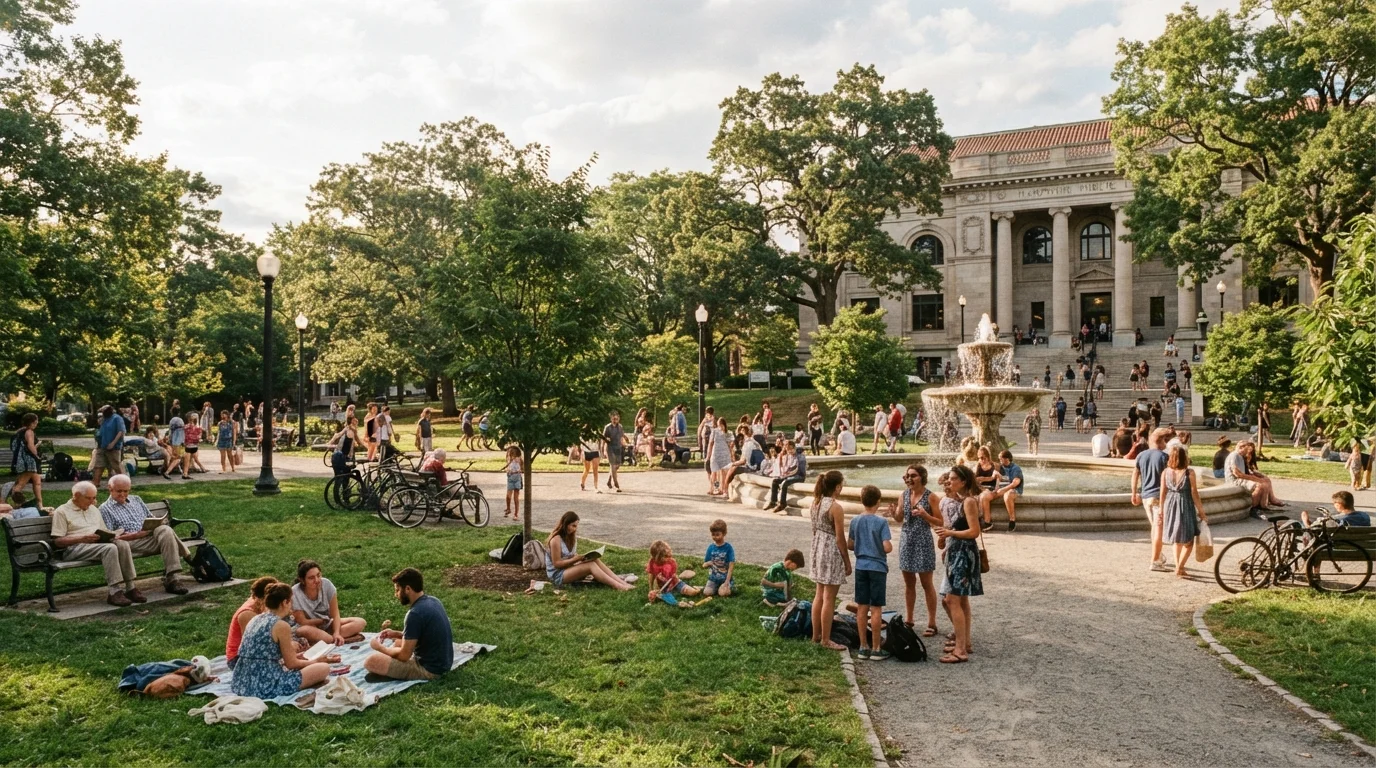
Social infrastructure — the term researchers use for these shared physical environments — functions as the stage on which ordinary Americans practice being neighbors. It's where a retiree strikes up a conversation with a teenager over a chess table. It's where new parents find each other at the sandbox. It's where an immigrant family joins a free English-language program and, in doing so, begins to feel at home in a new city.
Sociologist Eric Klinenberg's research documented how neighborhoods with robust social infrastructure showed dramatically stronger community solidarity during extreme events like Chicago's 1995 heat wave, where social isolation — not just heat — was a primary driver of mortality. The spaces that keep people connected in ordinary times turn out to be life-sustaining in extraordinary ones.
See our look at what thriving communities have in common for more on the patterns that distinguish strongly connected neighborhoods.
The Three Pillars and What Each Uniquely Provides
While all public spaces contribute to social infrastructure, libraries, parks, and community centers each fill a distinct civic role worth examining separately.
Libraries
Public libraries are arguably the most egalitarian institutions in American civic life. They offer unconditional access — no purchase required, no dress code enforced — making them one of the few truly public spaces where people at every income level are equally welcome. Beyond books and digital resources, modern libraries increasingly function as social service hubs, offering job search assistance, mental health referral services, early childhood programming, and safe spaces for people experiencing housing instability.
Parks
Green space serves a dual function: it promotes individual well-being through physical activity and contact with nature, and it creates conditions for spontaneous social encounter. A well-designed park is a setting for serendipity — where a regular dog-walking route becomes a standing social ritual, or a neighborhood pickup basketball game becomes an informal cross-cultural exchange. Research in environmental psychology suggests that access to quality green space is associated with reduced stress and increased feelings of neighborhood safety.
Community Centers
If parks are where communities encounter each other informally, community centers are where they organize intentionally. Recreation programs, after-school care, senior services, civic meetings — these spaces concentrate resources and bring structured programming to people who may not have the means or mobility to access private alternatives. In many communities, the local rec center is where civic identity is literally rehearsed: through youth sports leagues, holiday celebrations, and town halls.
The Equity Dimension: Who Gets Good Public Space
Not all communities have equal access to quality social infrastructure, and that gap is not random. Decades of research on park equity have found that lower-income neighborhoods and communities of color frequently have less park acreage per resident, fewer maintained facilities, and reduced programming budgets compared to wealthier areas in the same city.
The same pattern holds for libraries. Branches in under-resourced neighborhoods often operate with reduced hours, aging facilities, and smaller collections — precisely when the communities they serve have fewer private alternatives and greater need for free public resources.
100M+
Americans served by public libraries annually
The American Library Association has reported that U.S. public libraries collectively receive over a billion visits per year, serving communities across all income levels.
~1 in 3
Americans live in park-poor areas
Trust for Public Land research has found that roughly one in three Americans lacks reasonable access to a quality park within a 10-minute walk of home.
40%
Adults report significant loneliness
Surveys conducted by organizations including Cigna have consistently found that around 40% of American adults report feeling significantly lonely, a gap that accessible social infrastructure can help address.
This disparity matters beyond fairness. When public spaces are neglected, the communities that rely on them most are left without the social scaffolding that more affluent neighborhoods supplement through private means — gyms, paid recreation programs, private clubs. The result is a widening gap not just in amenities, but in civic belonging itself.
Geography also shapes the picture. As explored in our article on how community life differs across settings, rural communities often face distinct infrastructure challenges, including long travel distances to shared spaces and reliance on a smaller number of multipurpose facilities.
How to Engage With Your Community's Shared Spaces
The good news is that social infrastructure isn't passive — it responds to use and participation. Civic spaces that are regularly used are more likely to receive funding, attract programming, and be maintained. The most basic act of engagement is simply showing up.
- Use your library deliberately. Attend author talks, sign your children up for summer reading programs, and explore what services your branch offers beyond books. Many libraries now offer free museum passes, seed libraries, and digital literacy workshops.
- Treat parks as social spaces, not just exercise corridors. Slowing down — sitting on a bench, joining a free fitness class, attending a summer concert in the park — creates the conditions for casual encounters that build neighborhood familiarity over time.
- Participate in programming at community centers. Even a single recurring class or club connects you to a consistent group of people, which is often how deeper community ties form.
- Attend public meetings. Parks and recreation departments, library boards, and city councils hold public comment sessions where residents can advocate for specific needs and priorities.
If you've recently moved and are building your civic footing, our framework for new residents offers a practical starting point for plugging into local life from the ground up.
Local traditions and celebrations — examined in our piece on local culture worth knowing — frequently unfold in these very spaces, making them natural entry points for newcomers seeking connection.