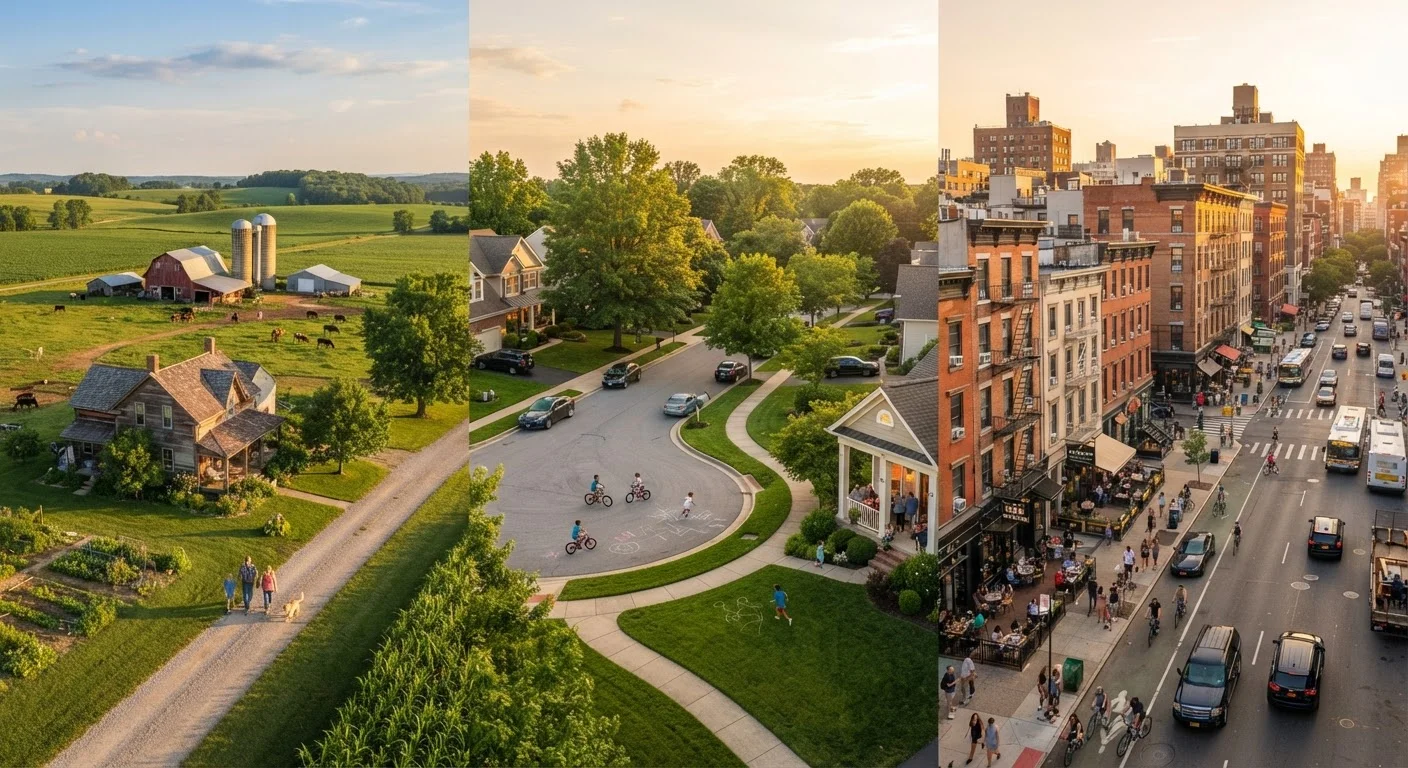
Rural Life: Familiarity, Mutual Aid, and the Long Memory of Place
In rural America, community often begins with geography and deepens through necessity. When the nearest grocery store is twenty miles away and the volunteer fire department depends on local sign-ups, neighbors aren't just people you wave to — they're part of the infrastructure of daily life.
Research on social capital consistently finds that rural residents report higher levels of trust in their neighbors compared to urban counterparts. This familiarity is generational: families who have lived side by side for decades share a kind of unspoken history that doesn't need an app or an event to maintain itself. A casserole dropped off during a hard week, help baling hay before a storm — these are the currencies of rural belonging.
That said, rural tight-knit culture comes with real pressures. Conformity can be expected; outsiders may take years to feel fully accepted; and the same closeness that provides support can sometimes feel like scrutiny. The trade-offs of tight-knit community life are worth weighing honestly before romanticizing the front-porch ideal.
Church congregations, county fairs, local diners, and volunteer organizations often serve as the main social gathering points, filling roles that formal civic infrastructure plays in denser communities.
Suburban Life: Structured Belonging and the Rhythms of Family
Suburban neighborhoods tend to organize community life more deliberately. Homeowners associations, school PTAs, neighborhood watch groups, and youth sports leagues create overlapping structures that pull residents into regular contact — whether they sought it out or not.
This built-in scaffolding is one of suburban life's quiet strengths. It lowers the barrier to connection: you don't have to initiate a relationship from scratch when there's already a block party on the calendar or a school carpool to coordinate. Shared institutions — the community pool, the soccer field, the elementary school — act as natural gathering points that social infrastructure provides in ways that feel almost invisible until they're gone.
The flip side is that suburban community life can feel transactional or surface-level. When relationships are built primarily around children's schedules or property concerns, they may not deepen the way rural friendships forged through hardship often do. And when children grow up or circumstances change, those connective threads can dissolve.
| Rural | Suburban | Urban | |
|---|---|---|---|
| Primary social bond | Long-term, generational familiarity | Shared institutions and family life | Interest-based, diverse circles |
| Typical gathering points | Churches, diners, volunteer groups | Schools, HOAs, recreational leagues | Block associations, cafes, civic groups |
| Level of anonymity | Very low — everyone knows everyone | Moderate — tied to shared contexts | High — privacy is common |
| Mutual aid culture | Strong and informal | Moderate, often structured | Present, but more intentional |
| Ease of belonging for newcomers | Can take years to feel accepted | Faster via organized entry points | Variable — effort-dependent |
| Social pressure / conformity | Higher | Moderate | Lower |
For a closer look at how formal suburban structures differ from other community organizations, see our breakdown of the differences between block associations and HOAs.
Urban Life: Density, Diversity, and the Art of Selective Connection
Cities present a paradox: nowhere are more people living in closer physical proximity, yet urban loneliness is a well-documented phenomenon. The key is understanding how urban social life actually works — because it operates by different rules.
In dense urban settings, community rarely forms around geography alone. Instead, it clusters around interest, identity, and shared cause: a neighborhood activist group fighting for a new crosswalk, a community garden on a vacant lot, a block association organizing a street fair. Urban residents often maintain multiple, overlapping social circles that don't necessarily know each other — a richness of connection that rural or suburban life may not easily replicate.
Anonymity — often cited as a downside of city living — can also be a feature for people who value privacy, who belong to minority groups, or who simply want the freedom to move through their neighborhood without obligation. As the trade-offs of urban vs. suburban adult life show, what reads as isolation to one person reads as freedom to another.
The challenge is that urban connection requires more intentional effort. Without the natural gathering forces of small-town familiarity or suburban shared institutions, urban residents often have to actively seek belonging — through civic engagement, local cultural traditions, or simply showing up to the same coffee shop often enough to become a regular.
What All Three Settings Share — and What That Means for You
Despite their differences, thriving communities across all three settings tend to share the same core ingredients: regular opportunities for face-to-face interaction, shared purpose, and a sense that neighbors look out for one another. Research on community well-being bears this out — as explored in our piece on what thriving communities have in common.
The practical implication is that geography sets the context for community, but it doesn't determine the outcome. A rural transplant who doesn't attend local events may feel more isolated than an urban apartment dweller who joins a neighborhood association. A suburban resident who ignores every HOA meeting may feel less rooted than a city renter who knows every business owner on their block.
Understanding the social logic of your specific setting — how people typically make contact, what institutions carry trust, what norms govern neighborly interaction — is often the first step toward actually feeling at home. Each environment rewards a somewhat different kind of engagement, and the sooner you learn its rhythms, the easier belonging becomes.