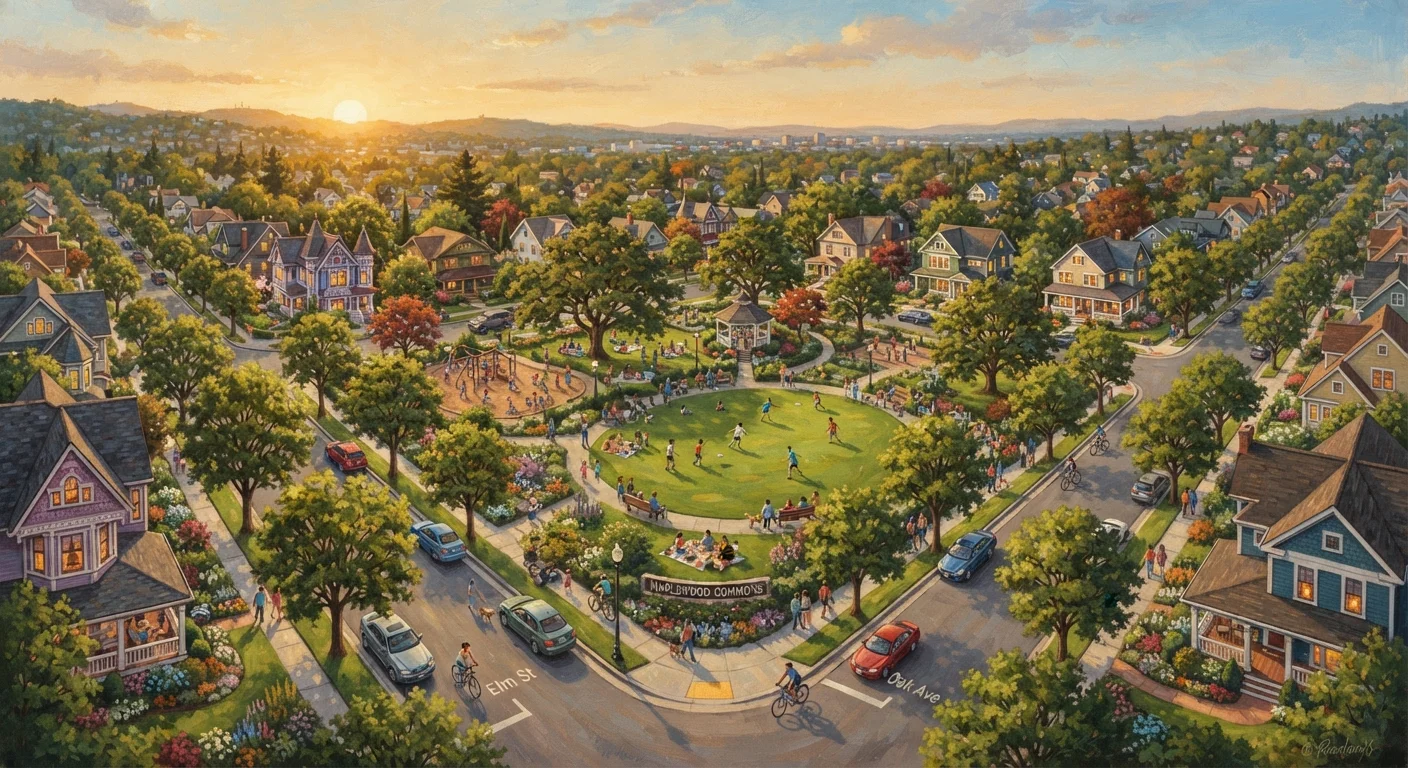
The Patterns That Show Up Again and Again
When researchers study neighborhoods that consistently rank high in well-being, satisfaction, and resilience, certain traits surface repeatedly — regardless of whether the community is rural, suburban, or urban. These aren't accidental qualities. They're the result of accumulated habits, intentional design, and shared values built over time.
This article is a reference guide to those defining characteristics — a practical lens for understanding what separates a place people want to stay from one they want to leave. Whether you're evaluating where you live now or thinking about how to strengthen your current neighborhood, these patterns offer a useful framework.
| Primary driver of community well-being | Social trust between neighbors (Robert Putnam, Bowling Alone (2000) and subsequent social capital research) |
| Civic participation indicator | Local election voter turnout (National Civic League, America's Healthiest Communities data) |
| Shared space types linked to cohesion | Parks, libraries, community centers, public markets (Eric Klinenberg, Palaces for the People (2018)) |
| Reported health benefit of strong community ties | Reduced risk of social isolation-related health decline (U.S. Surgeon General's Advisory on Social Connection, 2023) |
| Key informal practice in resilient communities | Reciprocal neighbor assistance and mutual aid (FEMA Community Resilience research literature) |
| Community identity anchor | Local traditions, celebrations, and shared rituals (American sociological research on place attachment) |
Social Infrastructure That Actually Gets Used
Thriving communities invest in — and actually use — social infrastructure: the physical spaces and institutions that bring people together without requiring them to be friends first. Think public libraries, parks, community centers, playgrounds, and farmers markets.
Research from sociologist Eric Klinenberg suggests that robust shared spaces are among the most reliable predictors of community cohesion, particularly during times of stress. When people bump into each other regularly in neutral, welcoming spaces, trust and familiarity grow organically. That familiarity becomes a form of social capital that communities can draw on in harder times.
See how libraries, parks, and community centers do more than provide amenities — they're the backbone of local belonging.
Key Traits of Connected Communities
Across studies on neighborhood well-being, a consistent cluster of traits emerges. These aren't always dramatic or expensive to cultivate — many are rooted in everyday norms and expectations.
Social capital
The networks of relationships, trust, and norms of reciprocity that enable people to work together effectively within a community. Higher social capital generally correlates with better civic outcomes and personal well-being.
Social infrastructure
The physical places and institutions — libraries, parks, faith communities, schools, markets — where people come together in everyday life. Strong social infrastructure supports connection even among people who aren't already friends.
Generalized trust
A broad confidence that most people in your community are honest and well-intentioned, even when you don't know them personally. It's different from close personal trust and can be built through repeated low-stakes positive interactions.
Civic participation
Active involvement in the governance and collective life of a community, including voting, attending public meetings, joining neighborhood organizations, and volunteering for local causes.
Place attachment
The emotional bond that develops between people and the specific places where they live. Strong place attachment motivates residents to invest in and care for their local environment and community over time.
Mutual aid
Voluntary, reciprocal exchange of resources and support within a community, such as neighbors helping each other during emergencies, sharing tools, or providing childcare informally.
- High civic participation: Residents vote in local elections, attend town halls, join neighborhood associations, and volunteer. Participation signals investment in shared outcomes.
- Reciprocal helping networks: Neighbors check on each other, share resources, and pitch in during emergencies. This kind of informal mutual aid is a hallmark of community resilience.
- Welcoming norms toward newcomers: Strong communities tend to have intentional practices — block parties, welcome committees, or simply a culture of introductions — that integrate new residents rather than leaving them to find their footing alone.
- Local pride without insularity: Residents feel connected to local identity and traditions without being closed off to change. Local traditions and celebrations often anchor this sense of shared identity.
Trust as the Foundation
Generalized trust — the sense that most of your neighbors are basically decent people you can rely on — is one of the strongest predictors of community well-being documented in social science literature. It's distinct from close friendship; it's the lower-stakes confidence that your kids can play outside, that someone will return a dropped wallet, that disputes can be resolved without hostility.
Trust is built incrementally through repeated, low-stakes positive interactions. Communities that prioritize accessible public spaces, transparent local governance, and fair conflict resolution tend to develop and sustain higher levels of trust over time.
It's worth noting that tight-knit community bonds, while genuinely valuable, also come with trade-offs. Close community bonds come with social pressures too — and understanding that balance matters as much as celebrating connection.
The Role of Individual Habits
Community health isn't only structural — it's also behavioral. The people who help communities thrive tend to share certain practices: they introduce themselves to neighbors, show up to local events, support local institutions, and extend goodwill even when it isn't immediately reciprocated.
These habits mirror what we see in strong personal relationships. People with lasting, fulfilling relationships tend to invest consistently in connection rather than waiting for a reason to engage. The same principle scales to community level.
Geography shapes what these habits look like in practice — front-porch culture functions differently from city block associations. How community life differs across rural, suburban, and urban settings is worth exploring if you're thinking about how your own environment shapes the possibilities for connection.
This article is for general informational and educational purposes only. It reflects research trends and general patterns, not a guarantee of outcomes for any specific community or individual.