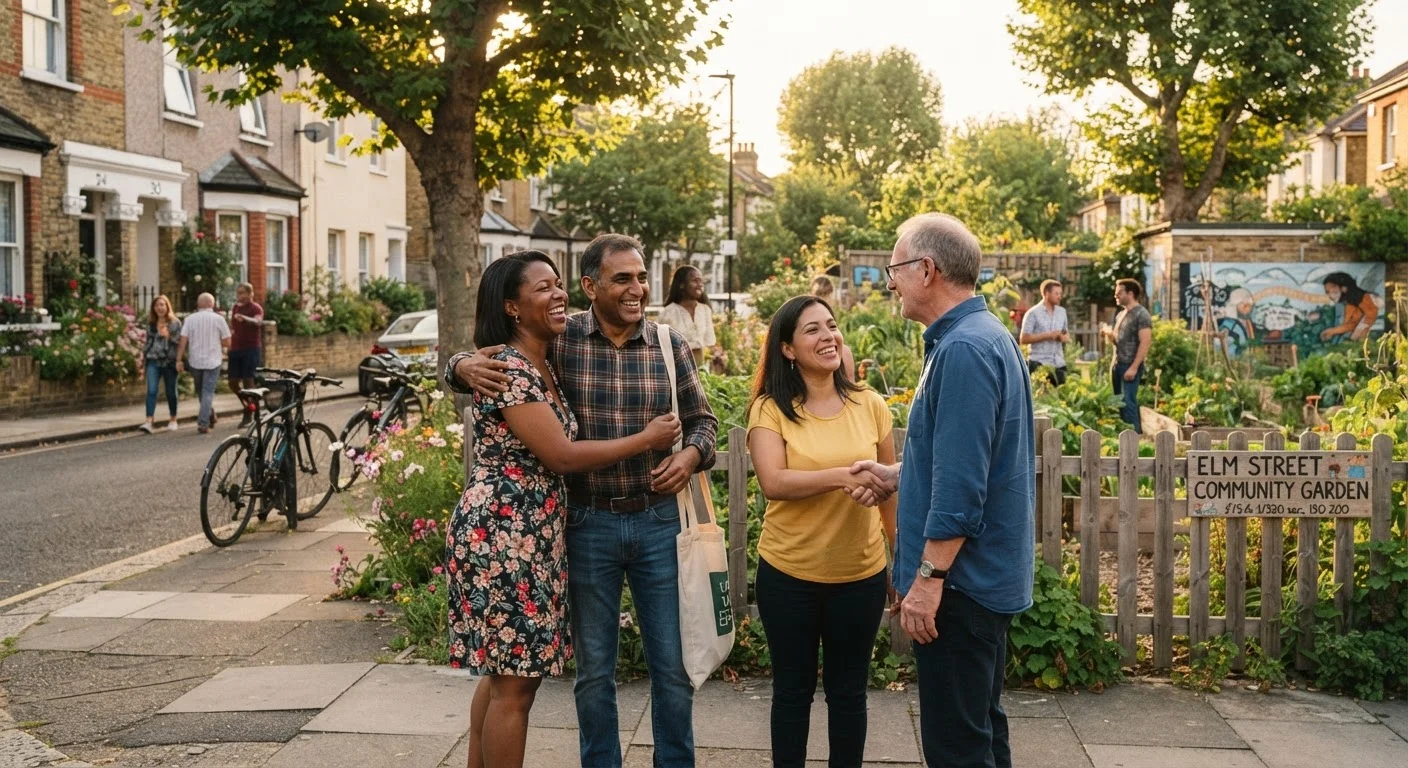
Why Community Engagement Matters More Than Ever
Moving to a new place can feel socially disorienting — and that feeling is more widespread than most people admit. Research from institutions like the Survey Center on American Life has consistently found that Americans' local social networks have thinned considerably over recent decades, with fewer people reporting close friendships rooted in their neighborhoods. For new residents, this backdrop matters: you're not walking into a tight-knit community automatically waiting to embrace you. Building connection takes deliberate effort.
That's not a discouraging fact — it's a clarifying one. It means your effort genuinely counts, and the habits you build in your first months shape the kind of life you'll have for years. Strong community ties are associated in research literature with better mental health, greater sense of safety, and higher life satisfaction. For the practical side of relationship-building, starting locally is one of the highest-leverage moves you can make.
49%
Americans with three or fewer close friends
According to the Survey Center on American Life's 2021 American Perspectives Survey, nearly half of Americans reported having three or fewer close friends — a significant shift from prior decades.
28%
Adults who report feeling lonely
The U.S. Surgeon General's 2023 advisory on the loneliness epidemic estimated that roughly 1 in 3 adults report feeling lonely, with measurable health consequences.
2x
Volunteering's effect on life satisfaction
Studies published in social science literature have consistently found that regular volunteers report substantially higher life satisfaction compared with non-volunteers, independent of income and health.
Understanding Your New Environment
Before you attend a single event or knock on a single door, it's worth pausing to read the room. Community life is not uniform across the United States — the norms, rhythms, and social entry points vary enormously by setting. A rural town of 3,000 people operates on entirely different social logic than a dense urban neighborhood of the same population. Front-porch culture, block associations, church networks, and informal gathering spots all differ in weight and accessibility depending on where you've landed.
For a grounded look at how geography shapes community, see our article on how community life differs across rural, suburban, and urban settings. Reading that context alongside your own observations will help you identify which channels are worth prioritizing.
A useful early exercise: spend your first two weeks as an anthropologist rather than a participant. Notice where people gather, what local institutions seem active, what topics come up on community boards or local social media groups. Look for the informal social anchors — a coffee shop that functions as a community living room, a park where families consistently show up on weekends, a farmers market that draws regulars. These are your on-ramps.
Your First 30 Days: Low-Stakes Entry Points
The instinct many new residents have is to wait until they feel settled before engaging socially. This tends to backfire — settling in and feeling socially comfortable are more interdependent than sequential. The research on belonging suggests that repeated low-stakes exposure to other people builds familiarity faster than single high-stakes social events.
Practical first-month moves include:
- Introduce yourself to immediate neighbors. A brief, no-expectation hello while checking your mail or bringing in groceries creates the seed of recognition that can grow into genuine connection over months.
- Attend one recurring local event. Recurring matters more than special. A weekly farmers market or monthly neighborhood association meeting gives you the advantage of seeing the same faces repeatedly — which is how strangers become acquaintances.
- Join a local online group. Nextdoor, local Facebook groups, or neighborhood apps give you low-pressure insight into what your community cares about and what events are happening before you've built any in-person relationships.
- Patronize local independent businesses regularly. Regularity at a local coffee shop, bakery, or bookstore builds the kind of familiar-face recognition that researchers describe as a meaningful layer of social infrastructure.
As you settle your physical space, remember that a calm and functional home environment supports the energy you need for social outreach. Our room-by-room home organization guide can help you establish that foundation faster.
Prioritize recurring low-key events over one-off social occasions. Seeing the same people in the same context multiple times — even briefly — does more for belonging than a single dinner party.
Social familiarity builds through repeated exposure, a principle well-documented in social psychology research on proximity and friendship formation.
When introducing yourself to neighbors, make it brief and expectation-free. A short, friendly exchange with no agenda leaves the door open far better than a long conversation that can feel overwhelming.
Low-pressure first contacts reduce the social risk both parties feel, making follow-up interactions more likely to occur naturally.
Look for community roles that are "needed but unglamorous" — helping set up chairs, staffing a sign-in table, or organizing supplies. These tasks put you in close, repeated contact with long-term members faster than attending as a passive guest.
Shared work creates a natural basis for conversation and signals genuine commitment, which community members tend to remember and appreciate.
Building Deeper Roots Through Volunteering and Civic Life
Once you've established basic familiarity, volunteering is one of the most reliable escalators to genuine community belonging. It puts you in repeated contact with people who share a local commitment, gives you a concrete shared purpose — which social science consistently identifies as a powerful bonding mechanism — and signals to your neighbors that you're invested in the place, not just passing through.
The key is matching your contribution to what's actually needed, rather than defaulting to whatever opportunity appears first. Our detailed guide on matching your skills to local volunteer opportunities walks through this process step by step.
Beyond formal volunteering, civic participation opens additional doors: attending city council or school board meetings, joining a neighborhood association, or participating in local planning processes. You don't need to have opinions on every issue to show up — being a consistent, engaged presence is itself a form of community investment that communities notice and value.
Local traditions and cultural events are another underutilized entry point. Learning what your community celebrates — and why — accelerates your sense of belonging in ways that ordinary socializing sometimes doesn't. See local traditions across American communities for context on why these rituals matter and how to respectfully participate as a newcomer.
Navigating Social Barriers as a New Resident
It would be dishonest to write a community engagement guide without acknowledging that building connection isn't frictionless for everyone. Introversion, cultural differences, social anxiety, a demanding work schedule, or the particular demographics of a neighborhood can all make the standard advice feel out of reach.
A few reframes worth holding:
- You don't need to be everyone's friend. Research on social wellbeing suggests that a combination of a few close ties and a larger number of weak ties — familiar faces you nod to, neighbors you chat with briefly — is genuinely protective. You're not trying to build a social circle from scratch in a month; you're building a web of recognition over time.
- Rejection is rarely personal. Established communities have existing rhythms. If a first overture isn't reciprocated warmly, it usually reflects the other person's circumstances, not a verdict on you.
- Physical activity creates community access points. Joining a running group, a recreational sports league, or a yoga class puts you in regular side-by-side contact with others — a format that many people find easier than purely social settings. Our guide for first-time exercisers can help if getting active is also a new step for you.
For those finding the emotional weight of relocation heavier than expected, building resilience around that transition is a legitimate priority. Emotional resilience strategies for adults offer a grounded starting point for managing that layer alongside the social one.
Sustaining the Habit: Community as a Long-Term Practice
Community engagement is not a project with a completion date — it's a practice that deepens with consistency. The residents who feel most genuinely rooted in their communities after five or ten years are rarely those who made the biggest social splash when they arrived; they're the ones who kept showing up to the same recurring events, kept saying hello to the same neighbors, kept contributing in small ways across many years.
A sustainable approach looks like:
- Choosing one or two recurring commitments rather than trying to do everything
- Being willing to let some connections develop slowly without forcing them
- Treating community participation as non-negotiable in your weekly schedule, the same way you'd treat exercise or any other priority habit
- Periodically reassessing where you're investing your time as the community and your own life evolve
If you share your home with others — a partner, roommates, or family members — their engagement (or lack of it) will shape yours. Finding community together is easier when domestic life itself is running smoothly. The strategies in our guide on organizing shared spaces when people have different habits speak to that foundation.
The most honest thing we can say is this: community doesn't happen to you. It's something you build, one ordinary interaction at a time, until the place where you live becomes the place where you belong.