Why pH Is the Hidden Control Panel of Your Garden
You can water faithfully, fertilize every season, and still watch plants struggle — yellowing leaves, slow growth, poor yields. In many cases, the problem isn't what you're adding to the soil. It's what the soil's chemistry is preventing plants from using. That's where pH comes in.
Soil pH works like a gatekeeper for nutrients. Essential elements — nitrogen, phosphorus, iron, manganese, and others — are present in most soils, but plants can only absorb them when the pH sits within a compatible range. Outside that window, nutrients bond tightly to soil particles and become chemically unavailable, no matter how much you've applied. Gardeners call this 'nutrient lockout.'
Understanding pH doesn't require a chemistry degree. It simply means knowing where your soil sits on the acidic-to-alkaline scale — and making small, informed adjustments when it's off. It's one of the highest-leverage things you can do before planting anything, whether you're starting a vegetable patch or reviving a tired flower bed. See the complete seasonal lawn and garden guide for how pH fits into a year-round care plan.
What the pH Scale Actually Means
The pH scale runs from 0 (extremely acidic) to 14 (extremely alkaline), with 7.0 as the neutral midpoint. In practical gardening terms, you're rarely dealing with extremes. Most soils fall somewhere between 4.5 and 8.5, and the changes that matter most happen within just a couple of points on that scale.
Here's what makes pH counterintuitive: the scale is logarithmic. A soil with a pH of 5.0 is ten times more acidic than one at 6.0, and one hundred times more acidic than 7.0. That means even modest readings on a test can reflect significant chemical differences underground.
6.0–7.0
Optimal pH range for most vegetables
University extension services consistently identify this range as the sweet spot where the broadest range of vegetable crops can access key nutrients efficiently.
4.5–5.5
Preferred pH for acid-loving plants
Crops like blueberries, azaleas, and rhododendrons are specifically adapted to this strongly acidic range, where aluminum solubility and iron availability suit their unique nutritional needs.
3–6 months
Typical time for lime to take effect
Most cooperative extension recommendations suggest waiting a full growing season after liming before retesting, as pH shifts occur gradually through soil microbial and chemical processes.
Different plants have evolved to thrive at different points on this scale. Blueberries and azaleas prefer strongly acidic conditions (around 4.5 to 5.5). Most lawn grasses, vegetables, and perennials do best in a mildly acidic to neutral range (6.0 to 7.0). Lilacs and clematis can tolerate slightly alkaline conditions up to 7.5. Matching your soil to your plants — or your plants to your soil — is where pH knowledge becomes genuinely useful.
How to Test Your Soil pH
There's no substitute for an actual soil test. Visual clues like plant color or slow growth can point toward a pH problem, but they can't confirm one or tell you how far off you are.
The two most practical options for home gardeners are:
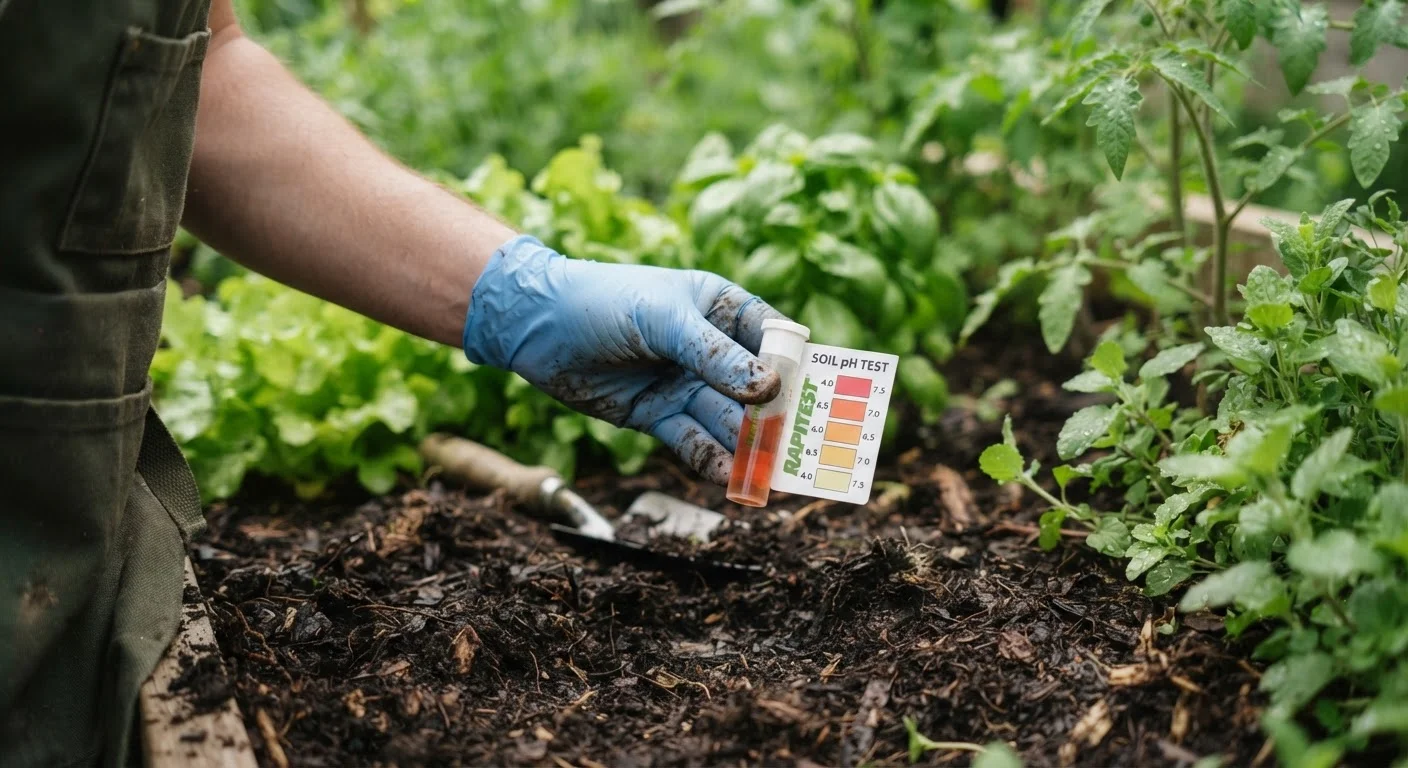
- At-home test kits — Simple, inexpensive, and widely available at garden centers. These typically involve mixing a small soil sample with a reagent solution and comparing the resulting color to a chart. Results are quick and useful for a general read.
- Cooperative extension lab tests — Your state's land-grant university cooperative extension service often offers detailed soil analysis for a modest fee. These reports include your pH reading, nutrient levels, and specific amendment recommendations for your crops or grass type. For new garden beds or persistent problems, this is the more informative choice.
When collecting your sample, take small scoops from several spots in the same bed and mix them together before testing. This gives you an averaged reading that better represents the whole area. Test to a depth of about 4 to 6 inches — the active root zone for most plants.
If you're just starting your first food garden, soil testing is one of the foundational first steps. The beginner's guide to starting a vegetable garden walks through how soil prep connects to everything that follows.
Adjusting Soil pH: Raising and Lowering It
Once you know your pH, correction is straightforward — though not instant. Soil chemistry changes gradually, so plan amendments ahead of your planting window, ideally in fall for spring gardens.
To raise pH (make soil less acidic)
Ground limestone — commonly called garden lime — is the standard amendment. It's inexpensive, safe to handle, and effective. How much you need depends on your current pH, your target pH, and your soil texture (clay soils need more lime than sandy ones). Always follow the quantity guidance from a soil test or extension recommendation rather than applying by feel.
To lower pH (make soil more acidic)
Elemental sulfur is the most reliable option for reducing alkalinity. Soil bacteria convert it into sulfuric acid over time, gradually dropping the pH. This process is slower than lime and works best in warm, moist soil with active microbial life. Acidifying fertilizers and organic matter like pine needles or peat can provide mild ongoing acidity but aren't reliable for making large corrections.
After any amendment, wait at least three months before retesting. Large corrections may require multiple applications spread across seasons. Patience is part of the process.
pH, Nutrients, and the Whole Soil Picture
Soil pH doesn't work in isolation. It interacts with your soil's organic matter content, microbial activity, drainage, and what you add to it over time. Compost, for example, has a gentle buffering effect that helps stabilize pH across seasons — another reason it's such a valuable amendment. The guide to compost, mulch, and fertilizer explains how these inputs each contribute differently to soil health.
One important nuance: fertilizing a soil with the wrong pH often achieves very little. Phosphorus, for instance, becomes largely unavailable in both highly acidic and highly alkaline conditions. If your plants aren't responding to feeding, checking pH before adding more fertilizer can save you time, money, and effort.
Similarly, consistent watering practices influence how nutrients move through the soil and how pH amendments distribute themselves. Good deep, infrequent watering habits support the root depth that allows plants to access nutrients across a wider soil volume.
Taken together, pH testing and amendment is one of the few interventions that can produce visible, lasting improvement across your entire garden — not just in one season, but in every season that follows.