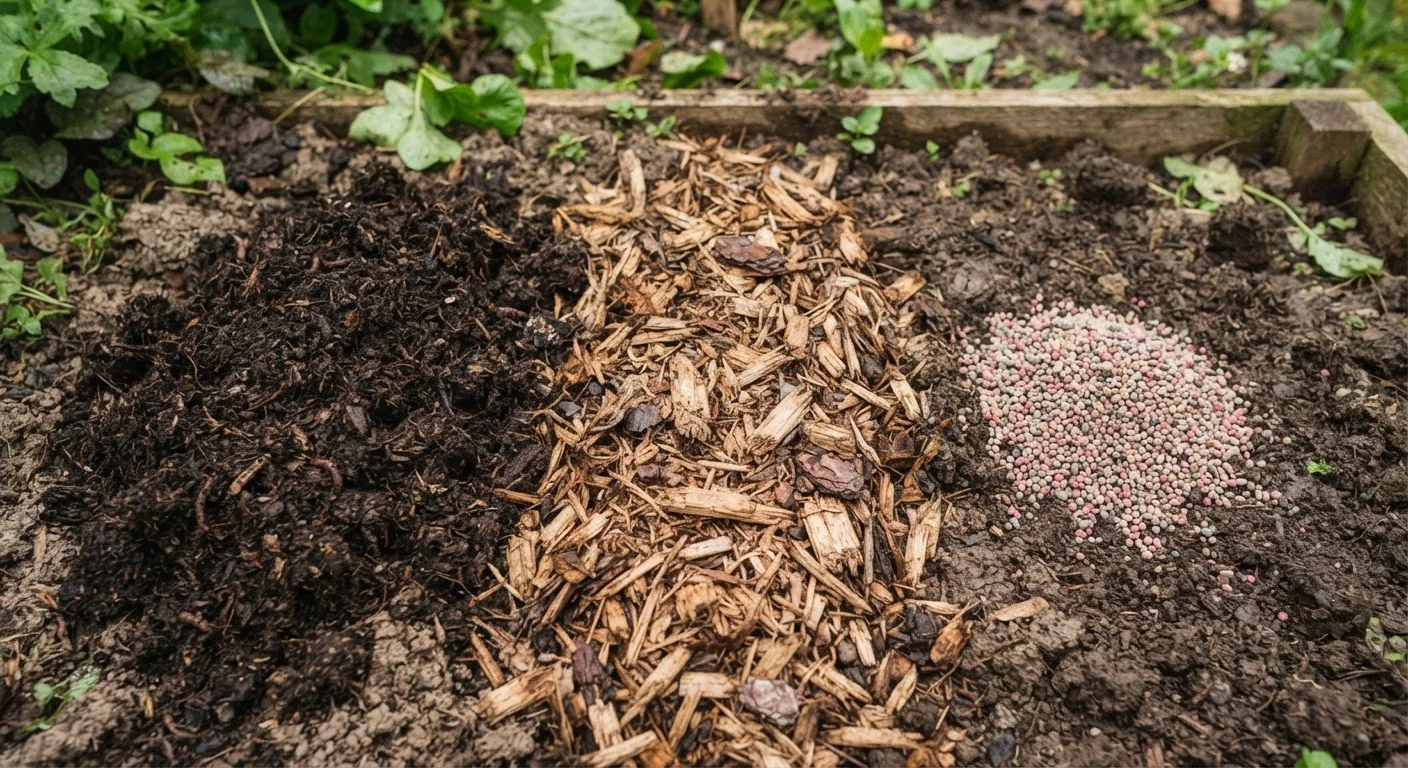
Why the Confusion Exists — and Why It Matters
Walk into any garden center and you'll find bags labeled compost, mulch, and fertiliser stacked near each other, sometimes even sharing shelf space. It's easy to assume they do roughly the same thing. They don't. Each one addresses a different problem in your garden, and applying the wrong one won't just waste money — it can set your plants back.
Think of your garden soil like the foundation of a house. Compost is the structural work that strengthens that foundation. Mulch is the weather-stripping that keeps conditions stable. Fertiliser is the targeted repair when a specific system is failing. You'd never replace insulation with concrete, and you wouldn't replace concrete with a vitamin. The same logic applies here.
For a broader view of how these amendments fit into your overall care routine, see The Complete Guide to Lawn and Garden Care Through Every Season.
Compost: Building Soil From the Ground Up
Compost is decomposed organic matter — kitchen scraps, yard waste, leaves, and similar materials broken down by microbes, fungi, and invertebrates into a dark, crumbly material sometimes called humus. Its primary role is to improve soil structure and support biological activity, not to deliver a quick nutrient hit.
When you work compost into your garden beds, it does several things at once:
- Loosens dense clay soils, improving drainage and root penetration.
- Adds body to sandy soils, helping them retain moisture longer.
- Feeds soil microorganisms, which in turn make nutrients more available to plants.
- Introduces slow-release nutrients as organic matter continues to break down.
Compost is typically incorporated into the top 4–6 inches of soil before planting, or applied as a top dressing around established plants. It works slowly and cumulatively — a single application won't transform your garden overnight, but consistent use over multiple seasons builds measurably healthier soil. If you're starting a new growing space, Your First Vegetable Garden walks through how to prepare ground from scratch, including how to incorporate compost effectively.
Mulch: Protecting the Soil Surface
Mulch is a layer of material — wood chips, straw, shredded leaves, pine needles, or even gravel — spread over the soil surface. Unlike compost, most mulch is not worked into the soil. It stays on top, where it acts as a protective barrier between soil and the elements.
Its main jobs are:
- Retaining soil moisture by slowing evaporation, which can reduce watering frequency.
- Regulating soil temperature, keeping roots cooler in summer and warmer as temperatures drop in fall.
- Suppressing weeds by blocking light from reaching weed seeds at the soil surface.
- Reducing soil erosion from rain and wind.
Organic mulches — wood chips, straw, shredded bark — gradually break down over time and contribute modest amounts of organic matter to the soil, which is a secondary benefit. A standard application depth is 2–3 inches; going deeper can prevent water and air from reaching roots effectively, and piling mulch directly against plant stems can promote rot and pest activity. Keep mulch a few inches away from trunks and stems.
Mulching Around Trees and Shrubs
When mulching around established trees and shrubs, aim for a ring that extends to the drip line of the canopy rather than just around the base. This protects a wider area of the root zone. Always leave a gap of several inches between the mulch and the trunk or main stems to prevent moisture buildup that can invite rot and pests.
Fertiliser: Targeted Nutrition When Plants Need It
Fertiliser delivers specific plant nutrients — most commonly nitrogen (N), phosphorus (P), and potassium (K), referenced on packaging as the N-P-K ratio. Unlike compost, fertiliser is designed to act relatively quickly, getting nutrients into the soil solution where roots can absorb them.
There are two broad types:
- Synthetic fertilisers are manufactured and typically fast-acting. They deliver precise nutrient ratios but don't improve soil structure or biology.
- Organic fertilisers (bone meal, blood meal, fish emulsion, composted manure) release nutrients more slowly and contribute some organic matter, bridging toward the benefits of compost.
Fertiliser is most useful when soil testing reveals a specific deficiency. Applying fertiliser without understanding your soil's current nutrient levels is a bit like taking supplements without knowing what you're lacking — sometimes fine, sometimes counterproductive. For guidance on how soil chemistry affects what plants can actually absorb, Soil pH and Why It Shapes Everything in Your Garden is a useful companion read.
Over-fertilising is a real risk: excess nitrogen, in particular, can burn plant roots, promote leafy growth at the expense of fruit and flowers, and leach into groundwater. Follow label directions and err toward less rather than more.
How the Three Work Together
| Compost | Mulch | Fertiliser | |
|---|---|---|---|
| Primary role | Improves soil structure and biology | Protects soil surface | Delivers targeted plant nutrients |
| Where it's applied | Worked into soil | Spread on soil surface | Applied to soil or foliage |
| Speed of effect | Slow, cumulative over seasons | Immediate surface protection | Relatively fast nutrient uptake |
| Main benefit | Long-term soil health | Moisture retention, weed suppression | Corrects specific nutrient deficits |
| Risk of overuse | Low — hard to over-apply | Moderate — too deep blocks water | High — can burn roots or pollute water |
| Improves soil biology | Yes, significantly | Partially, over time | No direct benefit |
In practice, a well-maintained garden bed typically uses all three amendments in different roles and at different times. A common approach:
- Incorporate compost into beds each spring and fall to build long-term soil health.
- Apply mulch over the soil surface after planting to conserve moisture and control weeds through the growing season.
- Use fertiliser selectively — after a soil test, or when plants show signs of nutrient stress — to address specific gaps.
Thinking about when to plant and how to space crops alongside your amendment schedule? Planting Depth, Spacing, and Timing pairs well with this approach. And if you're planning companion plantings, understanding soil nutrition matters there too — see Companion Planting.
No single amendment replaces the others. Compost alone won't stop weeds or fix a magnesium deficiency. Fertiliser alone won't repair clay-heavy soil. Mulch alone won't feed your plants. Used together with intention, they cover each other's gaps and create garden conditions where plants can genuinely thrive.