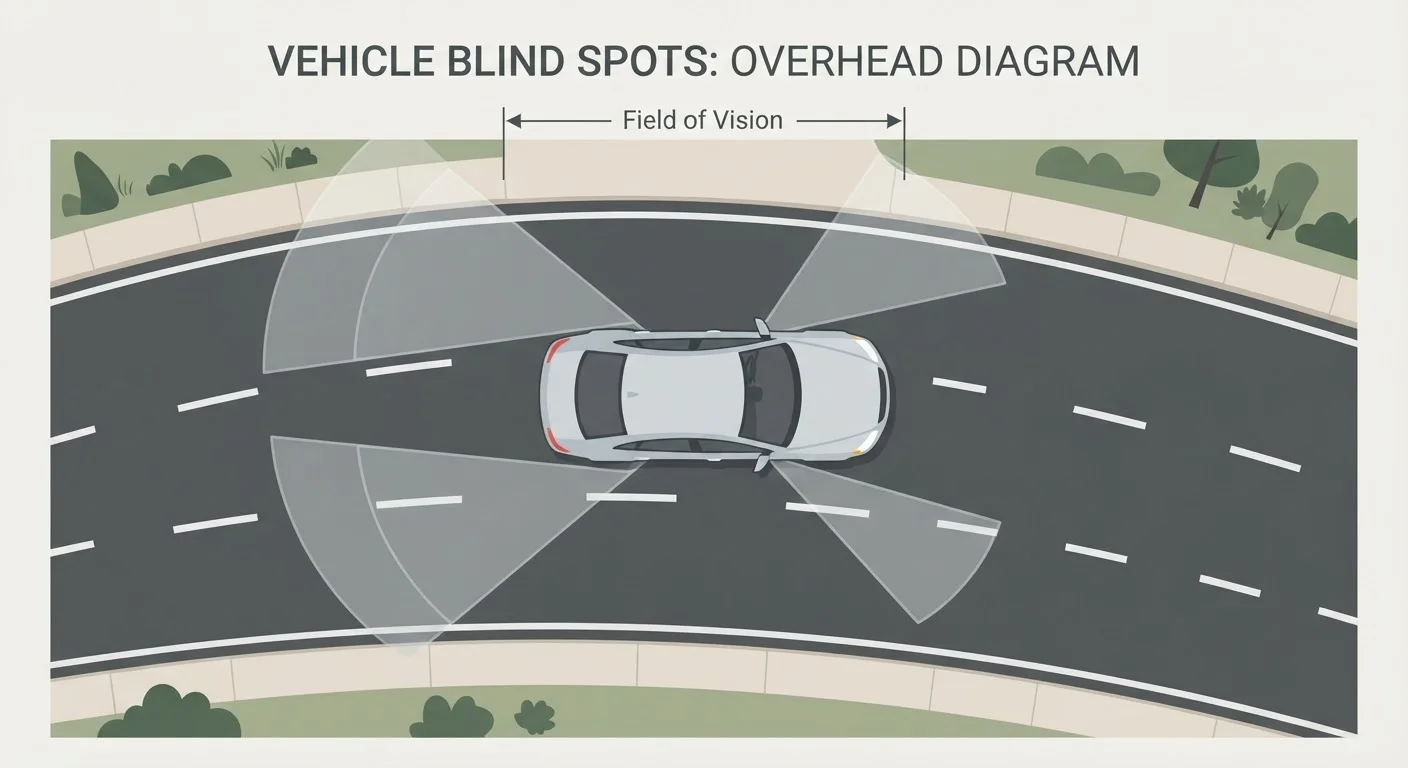
Where Blind Spots Actually Fall on Your Vehicle
Most drivers have a general sense that blind spots exist, but fewer can pinpoint them precisely. On a standard passenger sedan, there are four distinct zones worth understanding:
- Rear quarter zones: These are the most significant. They sit diagonally behind each rear pillar (the C-pillar) and extend outward. A motorcycle or bicycle can fit entirely within this zone at highway speed.
- Front hood zone: The area directly in front of the car, close to the bumper, is obscured by the hood. This matters most when pulling out of a parking space or approaching a pedestrian crossing slowly.
- Rear bumper zone: The space immediately behind the vehicle — particularly relevant when reversing — is hidden from the driver's view. Backup cameras help, but coverage angles vary.
- Side mirror inner edge: A narrow strip runs parallel to each side of the car just inside the mirror's field of view. Vehicles travelling in adjacent lanes can briefly disappear into this strip as they pull alongside you.
Vehicle design plays a major role in how large each zone is. Thicker pillars, higher window lines, and longer rear decks all increase blind spot coverage. Trucks, SUVs, and vans have substantially larger zones than compact sedans — something worth keeping in mind when sharing the road with those vehicles.
Why Mirrors Don't Solve the Problem on Their Own
Mirrors are essential, but they are fundamentally limited tools. Each mirror has a fixed field of view. The rearview mirror covers only what is directly behind the vehicle. Side mirrors, even when correctly adjusted, still leave the rear quarter zones exposed — those diagonal sightlines simply cannot be captured by a flat or convex mirror mounted on the door.
Many drivers also set their mirrors incorrectly. A common habit is angling the side mirrors inward so a slice of the car's own body is clearly visible. This feels reassuring, but it wastes mirror real estate on your own vehicle instead of expanding coverage into the zone where other road users actually travel.
A Note on Blind Spot Monitoring Limitations
Most BSM systems are calibrated for adjacent-lane vehicle detection at highway speeds. They are generally less reliable at detecting cyclists, pedestrians, or vehicles approaching at significantly different speeds. Always treat a BSM alert as an addition to your checking routine — not a reason to skip the shoulder check. Consult your vehicle's owner manual for the specific coverage area and limitations of your system.
For drivers who frequently change lanes on highways, understanding how blind spots interact with following distance is equally important. See our article on why tailgating is more dangerous than most drivers realise for context on spacing and reaction time.
Practical Habits That Compensate for Blind Spots
Awareness of where blind spots fall is only useful if it changes driving behaviour. The following habits are supported by road safety research and driver training programs:
- Shoulder check before every lane change: Turn your head approximately 45–60 degrees in the direction you intend to move. This brings the rear quarter zone into view. Mirrors first, then shoulder check — in that order, every time.
- Adjust mirrors outward: Angle each side mirror until your car's body is only just visible at the inner edge. The goal is to push mirror coverage as far into the rear quarter zone as possible.
- Slow down in complex environments: At lower speeds, you have more time to detect a hazard that enters your blind spot and react. In urban settings with cyclists and pedestrians, this margin matters considerably. Our guide on sharing the road with cyclists and pedestrians covers this in more depth.
- Signal early: Indicating well before a lane change gives other drivers time to adjust their position or speed, reducing the chance someone is in your blind spot when you move.
- Don't linger in other drivers' blind spots: When travelling alongside a larger vehicle, either move ahead or drop back so you are visible in their mirrors. This is particularly important near trucks.
Poor weather amplifies these risks significantly. Rain, fog, and reduced contrast make it harder to detect movement in your peripheral vision. See our companion article on driving in rain, fog, and ice for techniques that address visibility more broadly.
What Technology Can and Cannot Do
Blind spot monitoring (BSM) systems — now standard on many vehicles — use radar or camera sensors to detect objects in adjacent lanes and alert the driver, typically with a light in the side mirror housing or an audible tone. These systems are a genuine safety aid, and research from the Insurance Institute for Highway Safety (IIHS) has found that vehicles equipped with BSM show reductions in lane-change crashes.
However, there are consistent limitations across most systems. BSM sensors are typically optimised to detect vehicles travelling at similar speeds in adjacent lanes. Many systems underperform when detecting cyclists, pedestrians, or very fast-approaching vehicles. Coverage angles also vary by manufacturer and vehicle model.
The practical takeaway: treat BSM as a useful secondary layer of awareness, not a substitute for the shoulder check. The same logic applies to backup cameras — they improve rearward visibility but have fixed fields of view and may miss objects at the edges of the frame.
If you're considering how technology fits into your overall vehicle decisions, our broader guide on keeping ownership costs down without cutting corners on safety addresses how to weigh safety features against budget sensibly.
This article is for general informational and educational purposes. Always follow local traffic laws and consult a qualified driving instructor for personalised guidance on safe driving techniques.