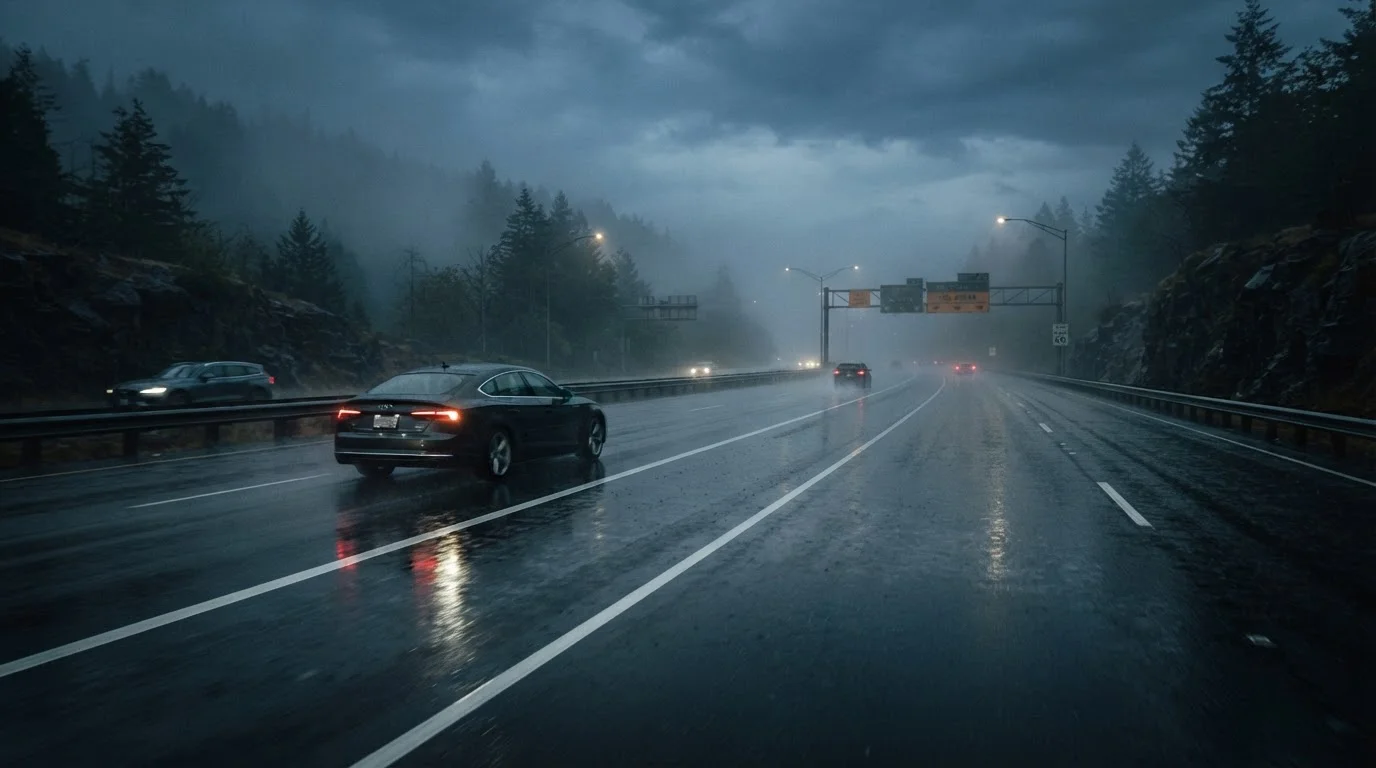
Why Posted Speed Limits Don't Account for Weather
Speed limits are set for dry, clear-visibility conditions. When rain, fog, or ice enters the picture, those numbers become a ceiling — not a target. Research from road-safety agencies consistently shows that inappropriate speed for conditions is a primary factor in weather-related crashes. Stopping distances roughly double on wet roads and can increase tenfold on packed snow or ice compared to dry asphalt.
A practical starting point is the two-second rule on dry roads, four seconds on wet roads, and eight or more seconds on icy surfaces. Count from when the vehicle ahead passes a fixed point to when your front bumper reaches the same point. If you get there sooner, you are following too closely. On a motorway in rain, this often means travelling at 50–60 mph rather than 70 mph — and that is entirely appropriate. For a broader foundation of safe-speed habits, see our end-to-end safe driving guide.
Driving in Rain: Traction, Aquaplaning, and Lights
Rain reduces tyre grip almost immediately. Tyre tread channels water away from the contact patch, but if tread depth is low or water depth is high, aquaplaning (hydroplaning) occurs — the tyre rides on a film of water and steering response disappears. If you feel the steering go light, ease off the accelerator gently without braking hard and allow the tyres to re-engage the surface.
Correct lighting matters as much as speed. Switch on dipped (low-beam) headlights as soon as visibility drops — not just when it is dark. Rear fog lights are appropriate only when visibility falls below roughly 100 metres; leaving them on in light rain dazzles the driver behind and masks your brake lights. Keeping wiper blades in good condition and ensuring washer fluid is topped up sounds basic but is often overlooked — visit our car maintenance hub for a full pre-weather-season vehicle checklist approach.
Check Tyres Before Wet-Weather Driving
Tyre condition is the single most important vehicle factor in wet-weather grip. The legal minimum tread depth in the US varies by state, but road-safety research generally recommends replacing tyres at or before 2/32 inch (1.6 mm) of remaining tread. A simple test: insert a penny into the tread groove with Lincoln's head facing down — if the top of his head is visible, tread is critically low. Also check tyre pressure, as under-inflation further reduces wet-road contact and increases aquaplaning risk.
Navigating Fog: The Golden Rules
Fog is particularly dangerous because it creates a false sense of safety — drivers often feel they can see far enough, when in reality a hazard may materialise with almost no warning time. The core principle is simple: if you cannot stop within the distance you can clearly see, you are travelling too fast.
Use low-beam headlights, never high beams. High beams reflect off water droplets in fog and create a white wall effect that reduces your forward visibility. Front fog lights, if fitted, can help illuminate the road surface immediately ahead. Avoid the temptation to use the tail lights of the vehicle in front as a guide — this encourages dangerously close following. Look out for speed-activated fog warning signs on motorways, which are triggered by real-time visibility sensor data. Night driving principles around glare and lighting overlap closely with fog technique and are worth reading together.
Ice and Snow: Smooth Inputs and Situational Awareness
Black ice — a thin, transparent layer of ice — is the most unpredictable hazard because it is effectively invisible. It forms when road surface temperature drops below 0°C (32°F), typically on bridges, overpasses, and shaded sections first, as these lose heat faster than open road surfaces. A dashboard thermometer reading of 4°C or below is an alert to treat any surface as potentially icy.
The guiding principle on ice is smoothness. Abrupt braking, sharp steering, or sudden acceleration can break traction instantly on an icy surface. Brake gently by pressing progressively rather than stamping; if your car has ABS (Anti-lock Braking System), firm sustained pressure is correct since ABS modulates the braking for you. Accelerate from stops slowly in the highest gear the engine comfortably allows to minimize wheelspin. Keeping a longer-than-usual following distance also gives you time to observe how other drivers' vehicles behave on the surface ahead — an early warning system for ice patches.
Vulnerable road users — cyclists and pedestrians — are at heightened risk in icy or snowy conditions. Give them extra space and anticipate slower, less predictable movement. Our article on sharing the road with cyclists and pedestrians covers safe overtaking distances in detail.
Reduce speed below the posted limit whenever weather degrades visibility or traction.
Speed limits reflect ideal conditions. Driving at the posted limit in rain, fog, or ice extends stopping distances far beyond safe margins and reduces time to respond to hazards. Adjusting speed is the single highest-impact change a driver can make in poor conditions.
Apply the four-second following rule on wet roads and extend to eight or more seconds on ice.
Reaction time is fixed at roughly 1.5 seconds for most drivers, but stopping distance is not — it multiplies sharply as traction falls. Greater following distance is the practical buffer that compensates for both longer stopping distances and reduced visibility.
Use dipped (low-beam) headlights in rain and fog; reserve rear fog lights for visibility below 100 metres only.
Low beams illuminate the road without creating glare for oncoming drivers. Rear fog lights misused in moderate rain obscure your brake signals and irritate following drivers, creating secondary risk. High beams in fog actively worsen your own forward visibility.
Apply steering, braking, and acceleration inputs smoothly and progressively on slippery surfaces.
Sudden inputs shift vehicle weight abruptly, breaking the tyre's grip on low-friction surfaces. Smooth, gradual movements keep the tyre's contact patch loaded evenly and maintain steering and braking effectiveness.
Treat any bridge, overpass, or shaded road section as potentially icy when temperatures are at or below 4°C.
These surfaces lose heat through both top and underside, making them freeze faster than surrounding road. Anticipating ice in these locations allows speed and following distance adjustments before contact with the hazard.
Clear all windows, mirrors, and lights completely before setting off in snow or frost.
Partial clearance creates blind spots that matter most when maneuvering in busy or narrow conditions. Snow on a roof can slide onto the windscreen under braking or onto following vehicles. Dirty or obscured lights reduce both your visibility and your conspicuity to others.
Quick Actions Before You Drive in Poor Conditions
Preparation before the journey significantly reduces risk. Clear all windows fully — not just a small patch — including the rear windscreen and mirrors. Check that all lights are working and lenses are clean. Allow extra time so speed pressure does not build during the drive. Fatigue compounds poor-weather risk substantially; a driver who is already tired has reduced hazard perception at exactly the moment conditions demand more of it. See our companion piece on recognising fatigue at the wheel for specific warning signs to watch for.