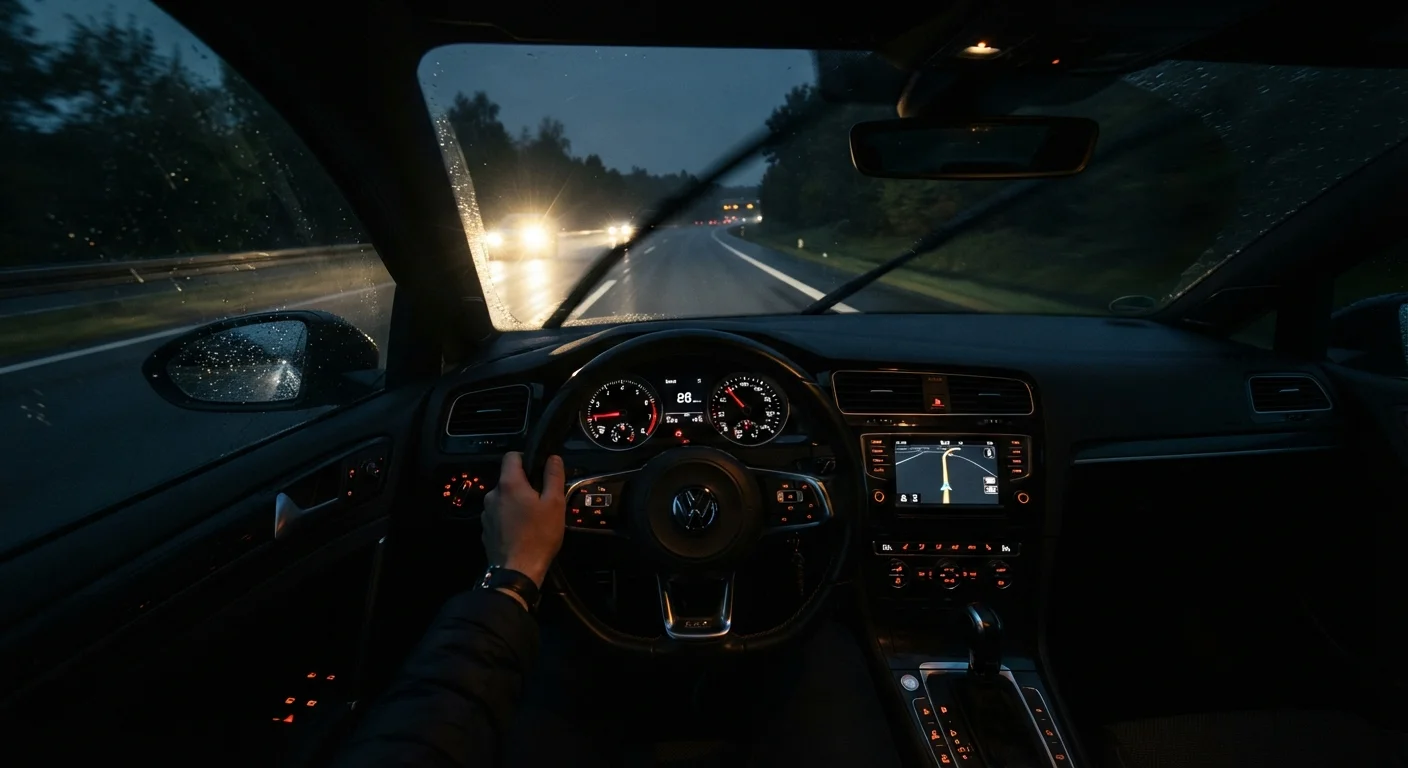
Why Night Driving Is Genuinely More Dangerous
Roughly half of all traffic fatalities in the U.S. occur at night, despite the fact that far fewer miles are driven after dark. That disparity isn't coincidental — it reflects how fundamentally darkness changes the driving task. Human vision evolved for daylight. At night, visual acuity falls, depth perception weakens, and peripheral vision narrows. The eye's ability to detect contrast — essential for spotting a pedestrian in dark clothing or an animal at the road's edge — drops substantially.
Headlights are engineered to compensate, but they cover only a limited arc ahead of the vehicle. Even a well-aimed, clean set of low-beam headlights typically illuminates road ahead to roughly 160 feet. At 55 mph, stopping distance from the moment hazard detection begins can exceed 200 feet under normal conditions. That gap is what safety researchers call overdriving your headlights — and it's one of the most underappreciated risks on any night road.
Understanding these physical realities is the starting point for adjusting your approach. For a broader look at how visibility challenges change driving demands, see our guide on adapting to poor visibility in weather.
Managing Glare: Oncoming Lights and Dashboard Brightness
Glare is one of the most immediate discomforts of night driving, and it comes from two directions: externally from oncoming headlights, and internally from your own dashboard and infotainment screens. Both impair night vision, though in different ways.
When an oncoming vehicle's headlights hit your eyes directly, the pupil constricts and your effective vision of the road ahead drops sharply for several seconds afterward. The standard guidance — and it holds up — is to shift your gaze slightly to the right, toward the painted edge line, rather than looking into the oncoming beams. This keeps your lane reference without fixating on the light source.
High-beam misuse compounds the problem. Always switch to low beams when an oncoming vehicle is within approximately 500 feet, and when following another vehicle within 300 feet. High beams aimed into a driver's mirrors create the same temporary impairment as a direct glare hit.
Inside the car, dim your instrument cluster and infotainment display to their lowest comfortable setting after dark. A bright center screen destroys the eye's dark adaptation. Many modern vehicles offer a dedicated night mode; use it.
Check Your Headlights Before Driving at Night
Before any significant night drive, do a quick walk-around: confirm both low and high beams are working, check that lenses are free of road grime, and look for signs of oxidation or yellowing. Cloudy lenses can reduce light output by more than 50%. Many auto parts retailers offer lens restoration services, or you can check with a qualified mechanic.
Best Practices for Safer Night Driving
The following practices are grounded in road-safety research and standard driver training guidance. Applied consistently, they reduce your exposure to the most common night-driving hazards.
Reduce speed to match your actual stopping distance within headlight range.
Low-beam headlights illuminate roughly 160 feet ahead, but stopping distance at higher speeds can exceed that. Slowing down closes the gap between what you can see and what you need to stop safely.
Keep headlight lenses clean and confirm aim is correctly adjusted.
Oxidized or dirty lenses scatter light and significantly reduce beam distance and clarity. Misaimed headlights either fail to illuminate the road surface or blind oncoming drivers.
Use high beams on unlit roads without traffic, and switch promptly when traffic appears.
High beams can extend visibility to 350–400 feet, a significant improvement over low beams. Failing to use them on empty rural roads wastes available light; failing to dip them blinds other drivers.
Increase your following distance to at least four seconds after dark.
Night conditions slow hazard detection. A longer following gap means you have more time and space to respond if the vehicle ahead brakes unexpectedly or swerves.
Dim interior screens and instrument lighting to preserve night-adapted vision.
Bright interior light forces the pupil to constrict, reducing sensitivity to the darker road environment outside. Maintaining dark adaptation is critical for spotting low-contrast hazards.
Schedule rest stops before fatigue sets in on long night drives.
Drowsiness erodes hazard perception and reaction time independent of darkness; combined, they create significantly elevated crash risk. Waiting until you feel impaired is already too late.
Night driving also intersects with blind spot management — darkness makes the areas your mirrors don't cover even more consequential, since hazards in those zones are harder to detect before a lane change.
Fatigue, Speed, and Following Distance After Dark
Darkness and monotony are powerful triggers for drowsiness. The visual stimulation that keeps drivers alert during the day — signage, activity, varied landscapes — is stripped away at night. This makes fatigue a compounding risk factor, not a separate one. If you're driving late after a full day, your hazard perception is dulled in two directions at once: reduced ambient light and a fatigued brain processing inputs more slowly.
Recognising the warning signs of driver fatigue is a skill worth developing before a long night drive. Micro-sleeps — involuntary sleep episodes lasting just a few seconds — can occur without the driver registering them, and at highway speeds a few seconds represents hundreds of feet of uncontrolled travel.
Following distance should increase at night. The standard three-second gap that works adequately in dry daytime conditions is insufficient when your ability to detect a slowing vehicle ahead is reduced. A four-to-five-second gap provides a more appropriate buffer. This connects directly to the physics explored in our article on why tailgating is more dangerous than most drivers realize: the numbers worsen after dark.
Speed reduction is perhaps the single highest-leverage adjustment. Slowing by 10 mph meaningfully shortens stopping distance and gives you more time to respond to hazards that emerge at the edge of your headlight range. It is not about being overly cautious — it is about matching your speed to the information your eyes can actually gather in the available light.
This article is part of our broader resource, Safe Driving From Learner to Experienced, which covers hazard perception across all driving conditions and experience levels.