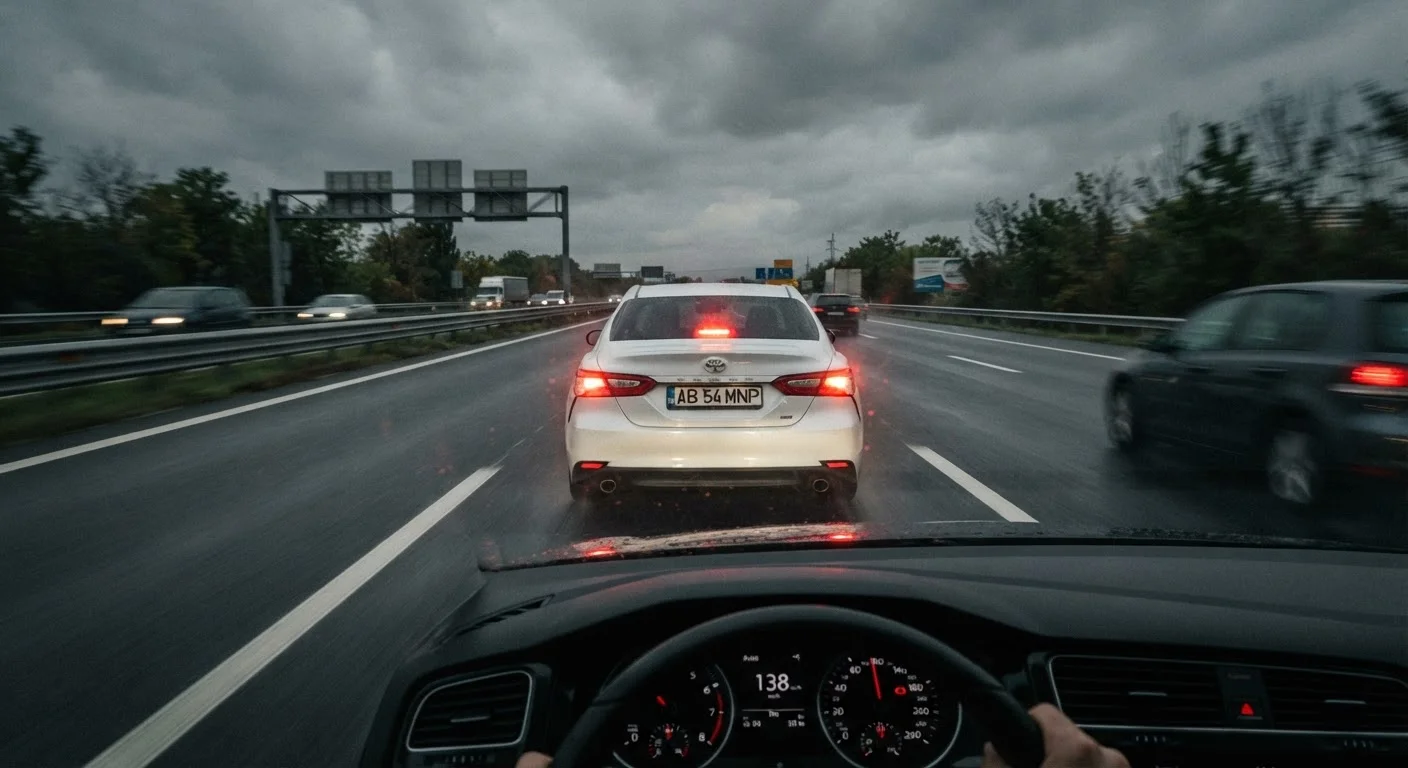
The Physics Behind Following Distance
Most drivers instinctively feel they can stop quickly if the car ahead brakes suddenly. That intuition is almost always wrong, and the gap between perception and physics is where rear-end collisions happen.
Stopping a vehicle involves two distinct phases: reaction distance — the space covered while your brain registers the hazard and your foot reaches the brake — and braking distance — the additional space needed for the vehicle to actually decelerate to a stop. At 60 mph, research into driver response times consistently places reaction distance alone at around 130–140 feet before any braking force is applied. Add braking distance on dry pavement and total stopping distance can approach 300 feet or more, depending on the vehicle, tyres, and road surface.
Wet roads extend braking distance significantly. Worn tyres, heavy vehicles, and downhill grades all push that number further. When a tailgating driver is working with a following gap of one or two car lengths — perhaps 30–40 feet at highway speeds — the laws of physics simply don't permit a safe stop.
Speed and stopping distance are inseparably linked, which is why the same following gap that feels adequate in a 30-mph zone becomes genuinely hazardous on an interstate.
Common Tailgating Mistakes — and How to Break Them
Understanding why drivers follow too closely is as important as knowing the physical consequences. These are the most persistent errors, grounded in identifiable cognitive and behavioural patterns.
Misjudging stopping distance at highway speeds, assuming a short gap is sufficient.
Why it happens: Human perception of speed and distance is unreliable, particularly on roads where relative motion is consistent and landmarks are sparse. Drivers anchor to how quickly they've stopped in low-speed situations and incorrectly apply that benchmark at 65 mph.
Tailgating as a way to pressure a slower driver to move over or speed up.
Why it happens: Frustration with perceived obstruction triggers an impulsive response. Drivers rationalise that closing the gap communicates urgency without recognising the risk they're creating for themselves and others.
Reducing following distance in heavy traffic to prevent other vehicles from merging.
Why it happens: Drivers perceive a tight gap as protecting their place in the queue. Letting someone merge feels like a loss, so they close the space instinctively.
Not adjusting following distance for adverse weather or reduced road grip.
Why it happens: Drivers calibrate to dry-road experience and don't consciously recalculate when conditions change. Slippery roads can more than double braking distances, but the three-second habit is often applied without modification.
Following large vehicles — trucks or vans — at the same distance used for passenger cars.
Why it happens: Drivers treat all vehicles uniformly without accounting for the fact that large vehicles obscure road visibility ahead and have longer stopping distances themselves. The immediate hazard is also invisible until a gap opens.
Beyond individual mistakes, it's worth noting that tailgating also impairs the following driver's ability to see ahead. A truck or SUV filling your windshield eliminates the sight lines you need to spot hazards two or three vehicles ahead — a problem explored further in our look at what blind spots actually cover.
What the Crash Data Tells Us
~29%
Share of all U.S. crashes that are rear-end collisions
NHTSA data has consistently found rear-end crashes to be among the most frequent collision types on American roads, with following distance and inattention as primary factors.
1.5 sec
Average driver reaction time before braking begins
Traffic safety research places typical alert-driver reaction time between 1.5 and 2.5 seconds — a window during which a vehicle at 60 mph travels well over 100 feet.
2×+
Increase in braking distance on wet vs. dry pavement
Road-safety engineering standards account for significantly longer stopping distances on wet surfaces, underscoring why fixed following habits are insufficient across changing conditions.
Rear-end collisions are among the most reported crash types on U.S. roads, and following-too-closely is consistently cited as a primary contributing factor by law enforcement. The National Highway Traffic Safety Administration (NHTSA) has identified rear-end crashes as a leading category of injury collisions, with driver inattention and inadequate following distance as key contributors.
Crucially, crash severity scales with closing speed. A rear-end impact at 10 mph produces very different forces from one at 35 mph — the kinetic energy involved increases with the square of velocity, meaning even modest speed increases translate to dramatically greater impact forces. This is why maintaining following distance matters even at lower speeds in urban traffic.
Fatigue compounds the problem measurably. A tired driver's reaction time degrades in ways that closely mirror the effect of alcohol impairment, as described in our coverage of fatigue warning signs at the wheel. A tailgating driver who is also fatigued represents a substantially elevated risk.
Practical Rules That Actually Work
The three-second rule is the most durable and widely taught following-distance guideline: pick a fixed roadside marker, watch the car ahead pass it, then count three full seconds. If you pass the same marker before reaching three, you are following too closely. Under adverse conditions — rain, fog, night driving, or heavy loads — extend this to four or five seconds minimum.
Night driving deserves particular attention. Headlights illuminate a limited distance ahead, and hazard detection time shrinks considerably after dark. Our guide to night driving, vision, and glare outlines why speed and following distance adjustments are necessary after sunset.
When another driver is tailgating you, the safest response is to gradually increase your own following distance from the vehicle ahead. This gives you more braking room, reduces the likelihood that you'll need to brake suddenly, and creates time-space for the tailgater to overtake safely if they choose. Speeding up to satisfy a tailgater rarely ends the pressure and introduces new risks.
Consistent following discipline — not just in emergency situations, but as a default habit — is what separates drivers who avoid rear-end collisions from those who don't. Many drivers who consider themselves experienced have simply been fortunate; experience alone does not equal safety when core habits remain flawed.