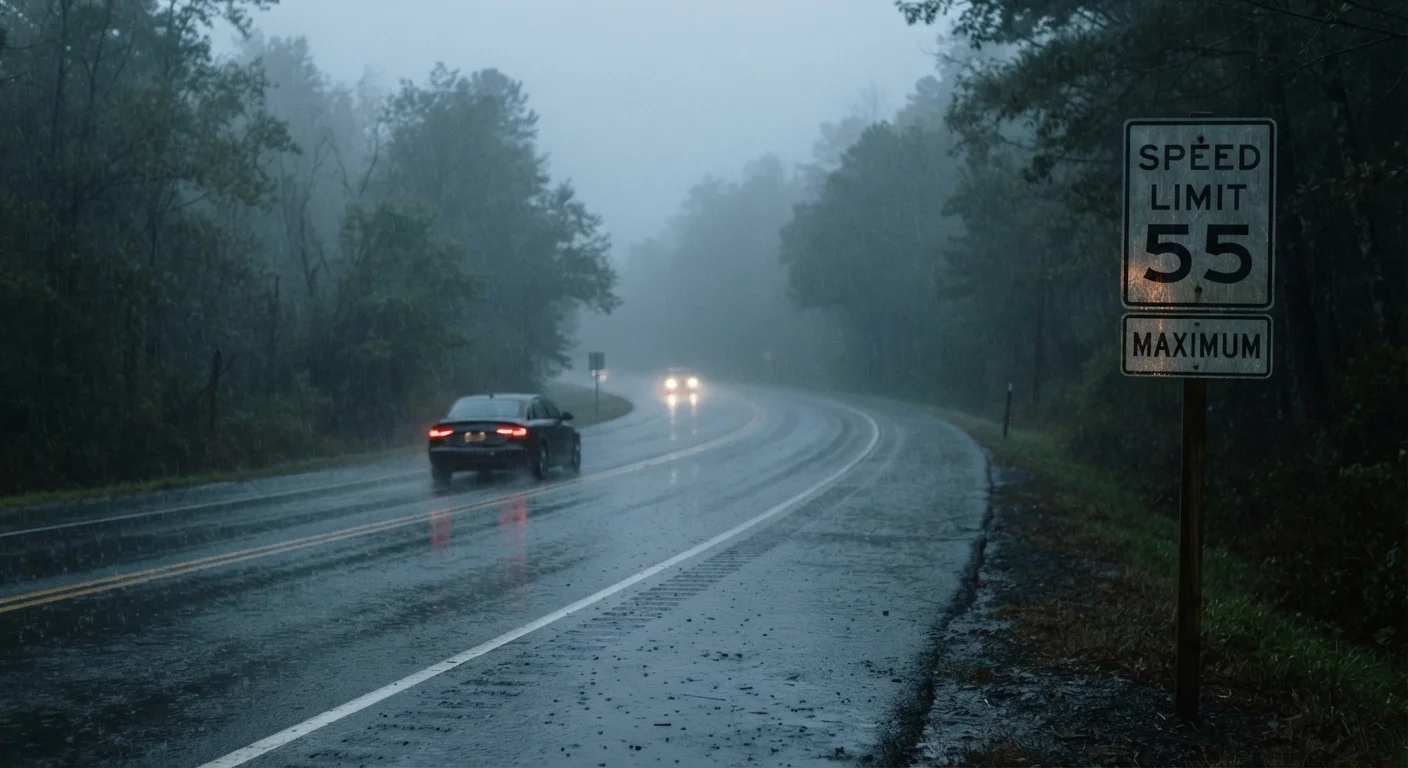
What Speed Limits Actually Represent
A posted speed limit carries the force of law, but it does not carry a guarantee of safety. In the United States, speed limits are established through an engineering process — typically based on traffic studies, road geometry, and the 85th-percentile speed, meaning the speed at or below which 85% of drivers travel under free-flow conditions. That baseline assumes good weather, adequate visibility, normal traffic, and a driver who is alert and unimpaired.
When any of those conditions are absent, the posted number becomes legally relevant but practically insufficient. Driving at 55 mph on a clear, empty freeway is reasonable. Driving at 55 mph through dense fog on that same freeway could be reckless — even if no law technically prohibits it in that moment.
Every US state codifies this distinction. Most include a basic speed law (sometimes called the prima facie rule), which holds that a driver must travel at a speed that is reasonable and prudent for existing conditions — regardless of what the signs say. Courts have found drivers liable for crashes even when travelling at or below the posted limit, if conditions clearly warranted a lower speed.
| Criterion | Posted Speed Limit | Appropriate Speed |
|---|---|---|
| Set by | Government/traffic engineers | Driver judgment, informed by conditions |
| Assumes | Ideal road and weather conditions | Actual current conditions |
| Legal standing | Enforceable maximum | Required under basic speed laws |
| Changes with weather | No — sign stays the same | Yes — must be reduced accordingly |
| Accounts for visibility | No | Yes — core factor |
| Accounts for vehicle condition | No | Yes — worn tyres demand lower speed |
| Liability in a crash | Compliance is not a complete defence | Travelling at appropriate speed supports a prudent-driver defence |
How Speed Amplifies Risk — The Physics
Understanding why appropriate speed matters starts with two physical realities: stopping distance and impact force.
Stopping distance is not linear — it grows with the square of speed. A vehicle travelling at 40 mph requires roughly 80 feet to stop after the driver reacts; at 60 mph, that figure rises to approximately 180 feet under dry conditions. Add a wet or icy surface, and those numbers increase substantially — sometimes more than doubling on ice.
Impact force follows a similar curve. The kinetic energy a vehicle carries — and must dissipate in a crash — is proportional to the square of its speed. A collision at 40 mph releases roughly four times the energy of one at 20 mph. This is why speed is not merely a factor in crash severity; it is often the dominant one.
These physics underpin the advice to reduce speed before curves, not within them. By the time a driver feels a vehicle beginning to understeer or oversteer, speed reduction is far less effective. Appropriate speed is a pre-emptive calculation, not a reactive one.
For a related look at how physics and driver behaviour interact in high-risk scenarios, see why tailgating is more dangerous than most drivers realise.
~29%
US traffic deaths linked to speeding
The National Highway Traffic Safety Administration (NHTSA) consistently attributes roughly 29% of annual US traffic fatalities to speeding-related crashes.
2x+
Stopping distance increase on wet roads
Research from transport safety bodies indicates that stopping distances on wet pavement can exceed double those on dry surfaces at equivalent speeds.
4x
Energy released at double the speed
Because kinetic energy is proportional to the square of velocity, a vehicle at 40 mph carries approximately four times the energy of one at 20 mph, per established physics.
Reading Conditions: A Practical Framework
Choosing an appropriate speed requires actively assessing several variables each time driving conditions change. These are the main factors to weigh:
- Visibility: If you cannot see far enough ahead to stop safely within your sight distance, you are over-driving your headlights or the available daylight. Slow down until your stopping distance matches what you can see.
- Road surface: Wet, icy, loose gravel, or debris-covered surfaces reduce traction significantly. There is no universally safe percentage to subtract from the posted limit — conditions vary too widely. Instead, test traction gently and early, before you need it urgently.
- Traffic density: Dense, merging, or unpredictable traffic requires a larger safety buffer. Reducing speed creates more reaction time and reduces the severity of any contact. This is closely linked to the risks described in following-distance research.
- Vehicle condition: Worn tyres, degraded brake pads, or a vehicle with a known handling issue all reduce the speed at which you can stop or manoeuvre safely. The posted limit was set for roadworthy vehicles — yours may not currently qualify.
- Driver state: Fatigue, distraction, or unfamiliarity with a road all extend effective reaction time. A tired driver at the speed limit may be functionally impaired relative to conditions.
None of these factors requires guesswork. Skilled, experienced drivers process this information continuously and adjust speed as naturally as they adjust steering. The goal is a margin — space and time to respond to the unexpected.
Basic Speed Law: A US-Wide Principle
Every US state has some form of a basic speed law requiring drivers to travel at a speed that is 'reasonable and prudent' for conditions, regardless of the posted limit. The specific wording and penalties vary by state. Drivers who cause crashes while travelling at the posted limit but in clearly hazardous conditions can still face civil or criminal liability. Checking your state's vehicle code will show the exact language that applies to you.
Balancing Safety and Traffic Flow
One legitimate concern about driving below the posted limit is traffic flow disruption. A vehicle travelling 15 mph below the limit on a high-speed roadway can itself create hazards — forcing sudden lane changes and increasing the risk of rear-end collisions from drivers who expect consistent speeds. Most states have minimum speed provisions on controlled-access highways for exactly this reason.
The resolution is not to choose between safety and flow, but to recognise that appropriate speed is calibrated — not simply as slow as possible. In poor conditions, the entire traffic stream typically adjusts downward together. Problems arise when a single driver adopts a speed dramatically inconsistent with surrounding traffic, whether too fast or too slow.
If conditions deteriorate sharply and a speed safe for those conditions would create a hazard in traffic, the right response is to exit the highway, pull off safely, and wait. This is especially true in sudden whiteout conditions or flash flooding — scenarios where no moving speed is truly safe.
Ultimately, the posted speed limit and appropriate speed are not in conflict. The limit defines the legal ceiling; appropriate speed defines where a thoughtful, informed driver actually operates within that ceiling. On a clear summer afternoon with good tyres, those two numbers may be identical. On a winter night with black ice and failing visibility, they almost certainly are not.