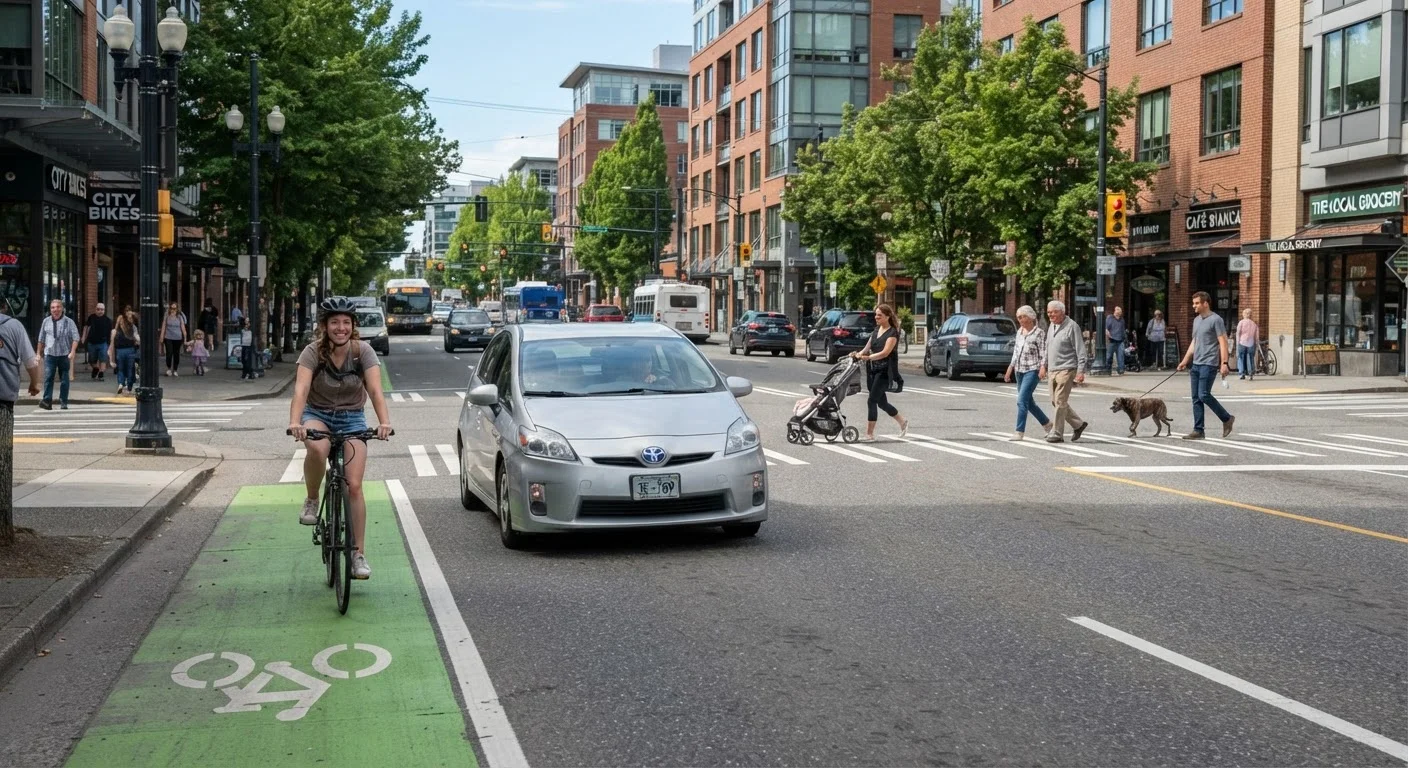
Why Vulnerable Road Users Require a Higher Standard of Care
Cyclists and pedestrians lack the protective shell that a vehicle provides. In a collision, the physics are unambiguous: a 3,500-pound vehicle striking a person on foot or on a bicycle transfers enormous energy with little absorption. Even at moderate speeds, injuries are frequently serious.
This is why the concept of a hierarchy of road users — recognised in the US Highway Code and many state guidelines — places the greatest responsibility on those operating the most dangerous vehicles. Drivers aren't simply asked to be cautious as a courtesy; the asymmetry of risk makes it a practical and legal duty.
Speed and Collision Severity Are Directly Linked
Research consistently shows that pedestrian fatality risk rises sharply as vehicle impact speed increases. At 20 mph, most pedestrians struck by a vehicle survive; at 40 mph, the majority do not. Reducing speed in pedestrian-heavy areas is one of the most effective interventions available to any driver.
Urban areas have seen a persistent rise in cycling and walking as transportation modes. More people sharing road space means that defensive, attentive driving habits matter more, not less. Techniques that reduce risk for vulnerable users — correct overtaking distances, junction awareness, and signal discipline — are equally relevant to drivers at every stage of experience.
Poor weather compounds these risks. Reduced visibility affects a driver's ability to spot a cyclist or pedestrian earlier. For guidance on adjusting your approach in wet or foggy conditions, see driving in rain, fog, and ice.
Step-by-Step: Evidence-Based Practices for Sharing the Road
The steps below reflect guidance from road safety bodies, traffic research, and state driving regulations. They are arranged in the order you would encounter each situation from the moment you set off.
What you will need
Scan actively for vulnerable road users before you need to react
Cyclists and pedestrians can appear quickly and from unexpected directions. Effective scanning means looking well ahead — not just at the car in front — and checking both sides of the road as you approach junctions, parked vehicles, driveways, and crosswalks. Look for movement on sidewalks that might indicate someone about to step into the road.
Avoid fixating on a single point. Use a systematic left-to-right sweep, particularly in urban environments and school zones.
Apply the 1.5-metre overtaking rule for cyclists
When passing a cyclist, many US states specify a minimum passing distance — commonly 3 feet (roughly 0.9 metres), though some states mandate more. Road safety guidance generally recommends at least 1.5 metres of lateral clearance as a practical standard, particularly at speeds above 30 mph. If safe clearance isn't available, wait behind the cyclist until there is enough space to pass properly.
Do not attempt to squeeze past in a narrow lane. Move to the centre of the road — or cross the centre line if it is safe to do so — to give adequate room.
Slow down and check twice at junctions and crosswalks
The majority of serious cyclist and pedestrian collisions happen at or near junctions. Approach crosswalks and intersections with your foot closer to the brake, and carry out a secondary check for vulnerable road users after you've assessed vehicle traffic. Pedestrians and cyclists can be obscured by pillars, parked vehicles, or other road users.
At uncontrolled crossings — those without traffic lights — pedestrians stepping onto the crossing have priority in most US states. Yield and wait until the crossing is fully clear before moving.
Signal early and complete vulnerable-user checks before turning
Turn signals should go on well before the manoeuvre — not as you begin it. This gives cyclists and pedestrians time to react. Before turning, check your mirrors and blind spots specifically for cyclists who may be alongside or approaching from the rear. On a right turn, check the nearside for pedestrians in the crosswalk; on a left turn, check for cyclists continuing straight.
For more on how blind spots affect your visibility, see what your blind spots actually cover.
Eliminate in-vehicle distractions in areas with pedestrian and cyclist traffic
Distraction reduces hazard detection time significantly. Phone use — even hands-free — degrades attention to peripheral events, which is precisely where cyclists and pedestrians often appear. In urban areas, school zones, or wherever foot traffic is likely, keep your eyes on the road and your attention undivided.
Adjust navigation, music, or climate controls before moving or ask a passenger to help. A momentary glance down at a screen is enough to miss a pedestrian stepping off the kerb.
Use the Dutch Reach when exiting a parked vehicle
Dooring — opening a vehicle door into the path of an oncoming cyclist — causes a significant number of urban cycling injuries each year. The Dutch Reach technique requires reaching for the door handle with your far hand, which rotates your upper body and naturally directs your gaze back along the road before the door opens.
Make this a habit for all occupants, not just the driver. Rear passengers exiting on the traffic side face the same risk.
Use the Dutch Reach to Avoid Dooring
When exiting a parked car, reach for the door handle with your far hand — right hand if you're in the driver's seat on the left. This naturally rotates your shoulder and head toward the road, bringing approaching cyclists into your line of sight before the door swings open. It takes seconds and can prevent a serious collision.
These habits also support broader road safety. Following distance discipline — relevant when a cyclist is ahead and you're waiting to pass — is covered in detail in our article on why tailgating is more dangerous than most drivers realise. For complex junctions where vulnerable users and vehicles converge, roundabout priority rules provides additional context.