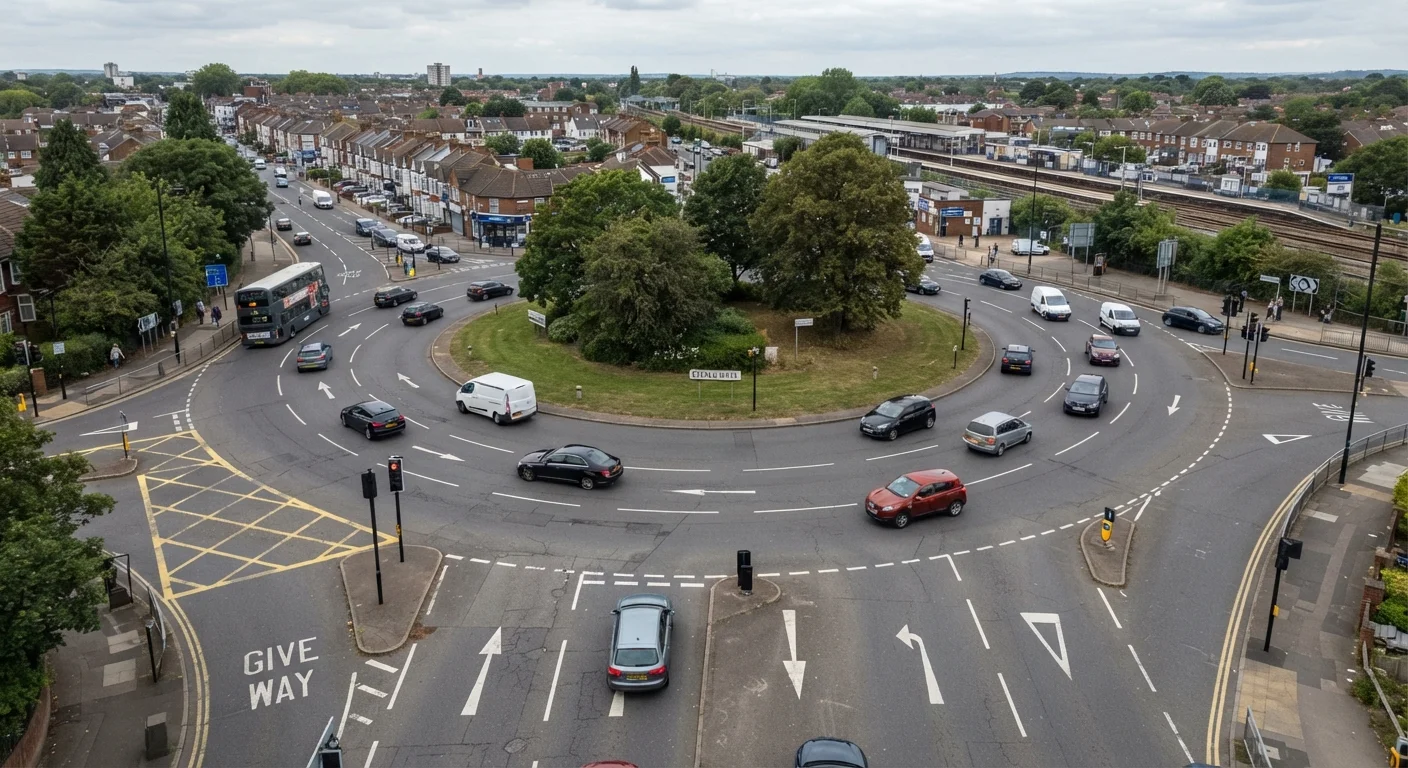
The Core Priority Rule — and Why Drivers Still Get It Wrong
The fundamental rule at every roundabout in the UK is straightforward: traffic already on the roundabout has priority over traffic waiting to enter. Drivers approaching must give way to vehicles coming from the right, as instructed by the Highway Code (Rule 185). Yet roundabout collisions remain common, and the vast majority stem not from ignorance of this rule but from its inconsistent application under real driving conditions.
Several factors compound the confusion. Many roundabouts carry give-way lines set well back from the actual merge point, making it hard to judge when a gap is safe. At larger, faster roundabouts, speed differentials between entering and circulating vehicles shrink the available decision window. And when traffic is heavy, drivers misread a momentary slowdown as an invitation to enter — sometimes correctly, sometimes catastrophically.
A secondary source of crashes is the assumption that priority changes based on which exit you intend to take. It does not. Whether you are taking the first exit or completing a full loop, circulating traffic always holds priority. Confusion about this point is especially acute at signalised roundabouts, where some approach lanes receive a green light but circulating traffic does not stop — an arrangement that catches unfamiliar drivers off guard.
| UK legal priority rule | Give way to traffic from the right (already on the roundabout) (Highway Code, Rule 185) |
| Most common roundabout crash type | Entering vehicle fails to yield to circulating traffic (Transport Research Laboratory analysis) |
| Collision angle eliminated by roundabouts | Head-on and right-angle (T-bone) collisions (Federal Highway Administration comparative studies) |
| Signal for first exit | Left on approach; maintain throughout (Highway Code, Rule 186) |
| Signal for right or far exits | Right on approach; switch to left after passing the exit before yours (Highway Code, Rule 186) |
| Lane-change rule inside roundabout | Prohibited unless marked — follow painted lane markings (Highway Code, Rules 185–188) |
Lane Discipline: The Rules That Matter Most
Poor lane choice causes a disproportionate share of roundabout incidents. The Highway Code provides clear guidance, but its application varies by roundabout design.
Standard two-lane roundabouts
- First exit (turning left): Approach in the left lane, signal left on approach, maintain the signal through the roundabout, and exit in the left lane.
- Straight ahead (second exit): Approach in the left lane unless road markings indicate otherwise. Signal left after passing the exit before yours.
- Right or full circuit (third exit or beyond): Approach in the right lane, signal right on approach, keep signalling right until you pass the exit before yours, then signal left to exit.
Multi-lane roundabouts
At larger junctions, painted lane markings on the approach and within the roundabout take precedence over the default rules above. Follow those markings precisely. Changing lanes inside a roundabout is one of the leading causes of side-swipe collisions — the driver in the outer lane cutting across the inner lane to reach an exit, often without checking mirrors or signalling.
Lane discipline on motorways follows a similar logic: your road position communicates your intentions to others and determines whether a gap exists safely. Getting it right at roundabouts is no different.
Mini-roundabouts
The same priority and lane rules apply, but the smaller diameter compresses decision time. Drivers must still give way to the right and signal correctly. Mounting the central island is permitted only when the vehicle's size makes it unavoidable — it is not a shortcut.
Where Confusion Most Often Leads to Collisions
Research published by Transport Research Laboratory (TRL) and analysis from the Department for Transport consistently identify a cluster of scenarios where roundabout risk is highest:
- Entering without yielding — The most frequent crash type. Drivers misjudge the speed of circulating vehicles or assume the gap is larger than it is, then accelerate into the path of oncoming traffic.
- Lane-change conflicts inside the junction — Drivers who approach in the wrong lane attempt to correct course mid-roundabout. This is particularly dangerous because the driver making the correction typically cannot see vehicles in their blind spot at close range.
- Rear-end collisions on approach — A driver stops or slows sharply to yield; the following driver, travelling too close, cannot react in time. Tailgating reduces stopping distance to dangerous levels — approach queues to roundabouts are a classic setting for this failure.
- Conflicts with cyclists and pedestrians — Drivers exiting a roundabout sometimes fail to yield to pedestrians on the crossing immediately after the exit or cut across a cyclist travelling in the same lane. Sharing the road with cyclists and pedestrians requires active checks at every exit, not just at entry.
- Speed mismatched to junction size — Drivers who fail to slow sufficiently on approach reduce their reaction time and increase lateral forces in the turn, raising the likelihood of loss of control or an inability to yield in time.
Frustration at slow-moving roundabout queues can also tip into aggressive behaviour. Road rage and aggressive driving at congested junctions escalates risk for everyone present.
Give-way line
A dashed white line painted across an approach lane indicating that drivers must yield to traffic already on the roundabout before entering. It is a legal instruction, not merely advisory.
Circulating traffic
Vehicles already travelling within the roundabout. Under UK law, circulating traffic has priority over vehicles waiting to enter from any approach.
Lane discipline
The practice of selecting the correct lane on approach, maintaining it through the junction, and exiting without straddling or changing lanes mid-manoeuvre.
Mini-roundabout
A small roundabout typically marked by a white painted circle or low dome. The same priority rules apply as at standard roundabouts, but the compact size demands faster decision-making.
Signalised roundabout
A roundabout where traffic lights control entry on some or all approaches. A green light permits entry but does not override the duty to yield to circulating traffic where signing requires it.
Spiral marking
Lane markings on some modern roundabouts that guide drivers through the junction in a spiral path, removing the need to change lanes mid-circuit to reach the correct exit.
Practical Habits That Reduce Risk
Understanding the rules is necessary but not sufficient. The following habits convert knowledge into consistently safer behaviour:
- Read the road early. Identify the roundabout type, lane markings, and any signs indicating priority changes before you reach the give-way line. Late decisions force sudden steering or braking.
- Match approach speed to visibility. At roundabouts where the circulating lane is not fully visible on approach — common at raised-centre designs — slow down enough to stop if a vehicle is already there.
- Signal in time, not at the moment of action. Signalling early gives other drivers and cyclists time to respond. A last-second signal is functionally the same as no signal.
- Check your mirrors before exiting. A cyclist may have entered the roundabout behind you and be travelling alongside your vehicle as you exit. A left-side mirror check before turning off the roundabout takes under a second and can prevent a serious collision.
- Do not force gaps. If a gap disappears while you are assessing it, wait. The cost of hesitation is seconds; the cost of misjudgement can be severe.
Roundabouts, when navigated correctly, are demonstrably safer than equivalent traffic-light junctions — they eliminate head-on and right-angle collisions, reduce vehicle speeds, and enforce natural yielding behaviour. The statistics support their design. The crashes that do occur are almost always attributable to failures in priority awareness, lane discipline, or speed management — all correctable with deliberate practice and honest self-assessment.