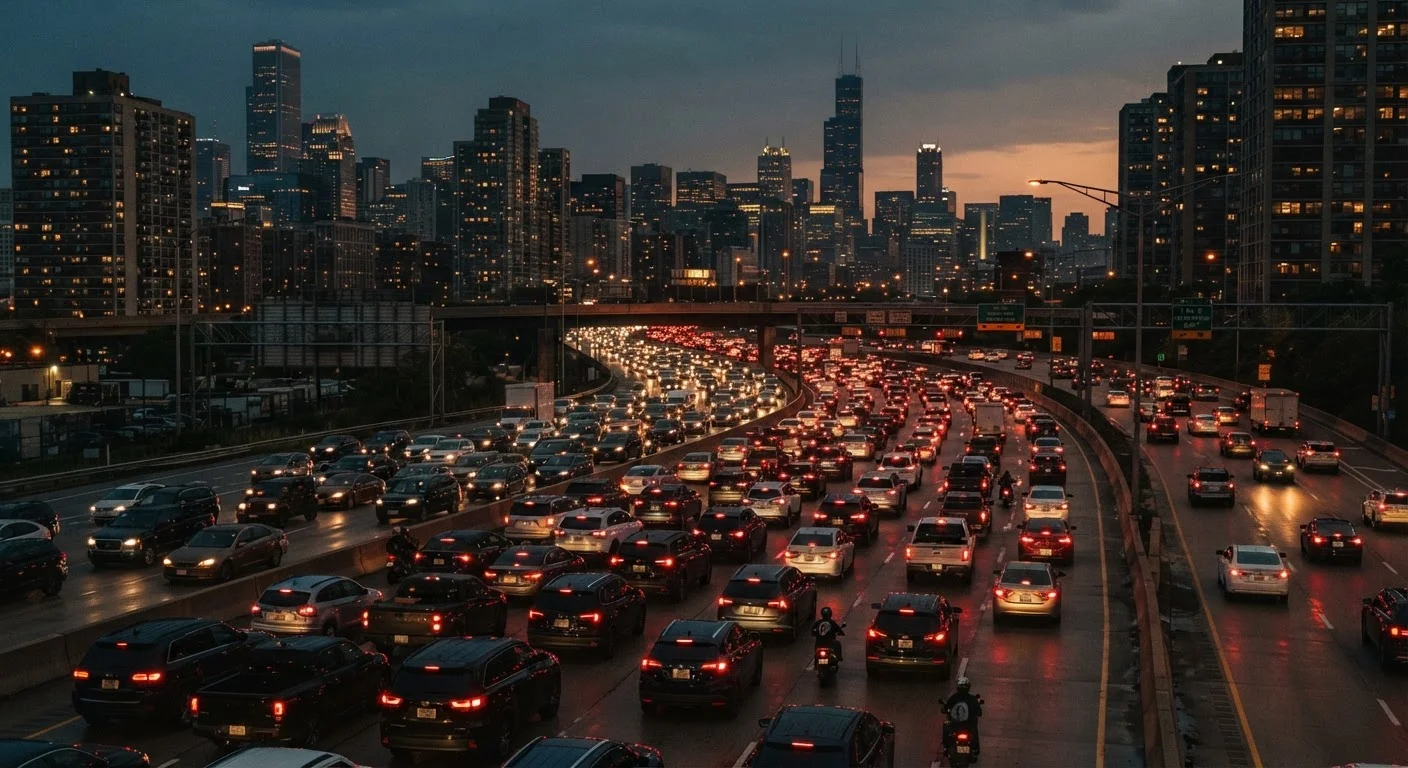
What Drives Aggressive Behaviour Behind the Wheel
Driving is one of the few situations where ordinary people regularly experience anonymity, time pressure, and a perceived loss of control — all at the same time. That combination creates fertile ground for frustration to escalate into aggression.
Research from the AAA Foundation for Traffic Safety identifies several consistent triggers:
- Heavy congestion and delays — Stop-and-go traffic breeds impatience, especially when drivers feel they are being impeded unnecessarily.
- Running late — Time pressure compresses a driver's tolerance for minor inconveniences, turning ordinary traffic into perceived obstacles.
- Perceived disrespect — Being cut off, having someone fail to signal, or receiving a horn blast can feel like a personal slight, even when the other driver acted carelessly rather than maliciously.
- Anonymity — Inside a vehicle, people behave differently than they would face-to-face. The physical barrier of the car reduces normal social restraints.
- Stress from outside the vehicle — Drivers who are already emotionally activated by work, family, or personal conflict have a lower threshold for frustration on the road.
Understanding these triggers does not excuse the behaviour — but it does make the pattern predictable, and predictable behaviour is easier to interrupt.
How Aggressive Driving Raises Crash Risk
Aggressive driving is not just unpleasant — it is genuinely dangerous. The AAA Foundation for Traffic Safety has reported that aggressive driving is a contributing factor in more than half of all fatal crashes in the United States. That figure reflects a real, measurable cost in lives.
The mechanisms are straightforward. Tailgating — one of the most common aggressive behaviours — removes the stopping distance that gives drivers time to react. Following too closely is already one of the leading causes of rear-end collisions; add emotional arousal and impaired judgment, and the risk compounds further.
Aggressive lane changes, weaving through traffic, and running yellow or red lights all reduce the margin for error at speed. And when two aggressive drivers interact — each escalating in response to the other — the situation can deteriorate rapidly.
>50%
Fatal crashes involving aggressive driving
The AAA Foundation for Traffic Safety has reported that aggressive driving is a contributing factor in more than half of all fatal US traffic crashes.
80%
US drivers who experienced road rage
An AAA survey found that approximately 80% of drivers reported experiencing significant anger, aggression, or road rage while driving in a given year.
37%
Drivers who made angry gestures at other motorists
The same AAA Foundation research found more than a third of drivers admitted to making angry gestures at other drivers, a common road rage behaviour.
There is also a secondary risk: other drivers reacting to aggressive behaviour. A sudden braking or swerving response from a driver being tailgated can cause a chain-reaction crash involving vehicles that had nothing to do with the original conflict. The ripple effect extends well beyond the two parties initially involved.
De-escalation: What the Evidence Supports
The most effective de-escalation strategy is one you control entirely: your own response. You cannot manage another driver's behaviour, but you can break the escalation cycle by refusing to participate in it.
Practical steps that work
- Do not retaliate. Returning a horn blast, a gesture, or a bright-light flash signals to the other driver that the conflict continues. It does not resolve it.
- Avoid eye contact. Direct eye contact can be interpreted as a challenge. Look at the road ahead rather than at the other driver.
- Create distance. If another driver is behaving aggressively, slow down or change lanes to put space between you. This is not weakness — it is sound risk management.
- Do not block their path. If someone is trying to pass or get around you, let them. Holding your ground in a conflict with a hostile driver has no safe upside.
- If threatened, drive to safety. Do not stop in an isolated area. Drive to a public place, a petrol station, or a police station. Call 911 when it is safe to do so.
Build Time Into Every Journey
One of the most consistent triggers for aggressive driving is running late. Building an extra 10–15 minutes into your departure time removes time pressure before you even start the engine. If you arrive early, the cost is minor; if traffic is heavy, the buffer could prevent a dangerous reaction on the road.
Planning ahead — building buffer time into journeys, using navigation apps to check for congestion before departure — reduces the time-pressure trigger significantly. Drivers who leave early are measurably less reactive on the road.
For newer drivers, high-traffic environments can be especially stressful. The principles in motorway driving guidance for new licence holders apply to managing lane discipline and anticipation — skills that reduce the likelihood of inadvertently provoking other drivers.
Managing Your Own Frustration Before It Escalates
Self-awareness is a genuine driving skill. Recognising the early signs of frustration — a tightening grip on the wheel, a sharp intake of breath, an urge to accelerate — allows a driver to intervene before those feelings translate into dangerous behaviour.
A few habits that help:
- Name it. Simply acknowledging 'I am annoyed right now' activates the prefrontal cortex — the part of the brain involved in rational decision-making — and can reduce the intensity of the emotional response.
- Lower the stimulation level. Loud, aggressive music amplifies arousal states. Switching to something calmer, or turning audio off altogether in heavy traffic, is a small change with a measurable effect on stress.
- Use the two-second check. When you feel the urge to react aggressively, pause for two seconds. Most reactive impulses pass or reduce in intensity within that window.
- Attribute charitably. Most driving errors are exactly that — errors, not deliberate provocations. Assuming the other driver is distracted or made a mistake (rather than targeting you specifically) reduces the likelihood of a personalised response.
These habits are especially relevant in environments where frustration peaks, such as rush-hour congestion or situations covered in adverse weather driving, where conditions already demand full attention.
Road safety is a shared responsibility. Sharing the road with cyclists and pedestrians demands the same restraint and attentiveness — because vulnerable road users have the least protection when driver behaviour becomes erratic or hostile.