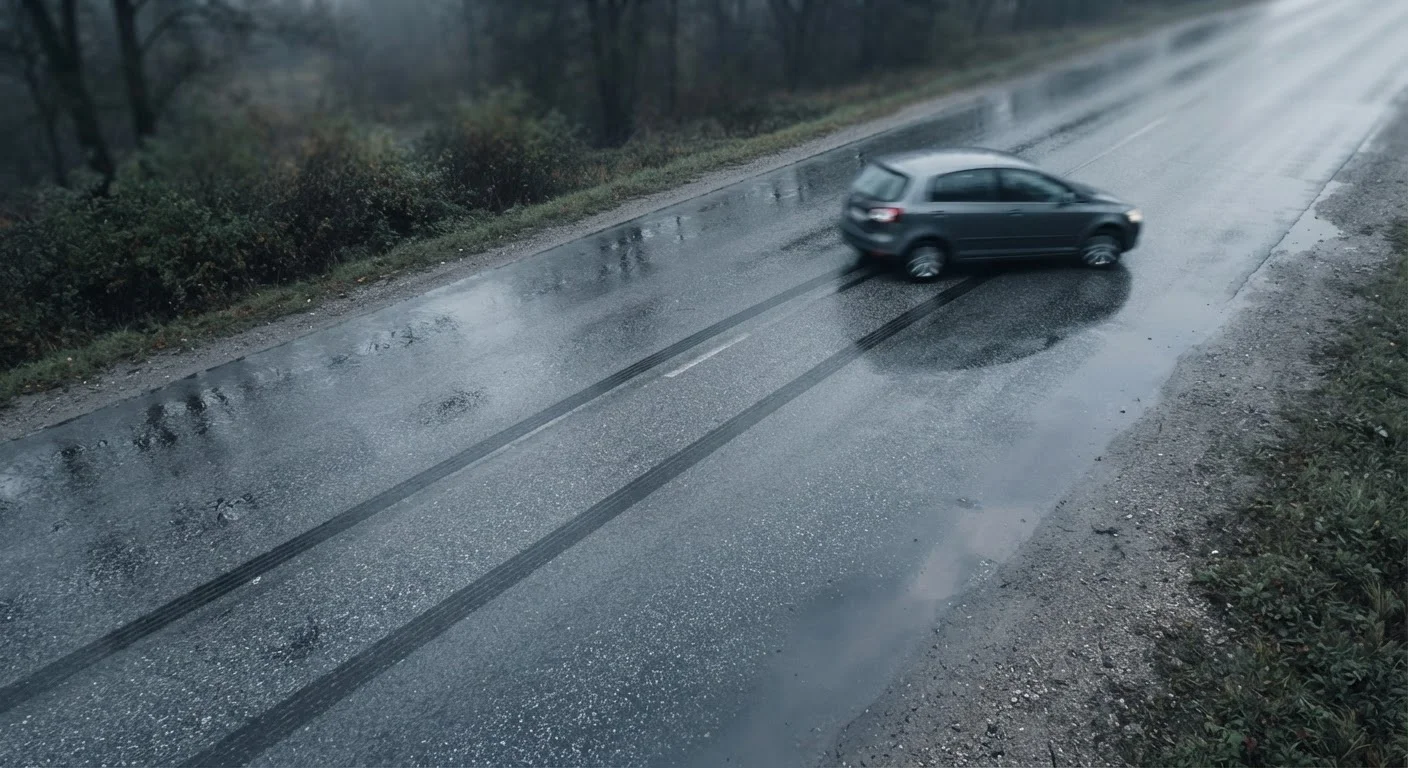
Two Phases, One Critical Number
Every stop a driver makes involves two distinct phases that together form the total stopping distance. The first is reaction distance — the ground covered while the driver's brain registers a hazard, decides to brake, and the foot physically reaches the pedal. The second is braking distance — the ground covered while the brakes are applied and friction decelerates the vehicle.
Neither phase can be skipped. Even a perfectly responsive braking system starts working only after the driver has reacted, and a split-second delay can translate to dozens of feet. Understanding both phases separately helps drivers appreciate why a safe following gap must account for far more than just the car's mechanical ability to slow down.
At 55 mph, a vehicle travels roughly 81 feet per second. An average reaction time of 1.5 seconds means the car has already moved about 121 feet before the brakes begin working. Add braking distance on top of that, and the combined total frequently surprises even experienced drivers when they see the numbers written out.
The Three-Second Rule Is a Minimum
Many driver education programs teach the three-second following rule — pick a fixed roadside marker, and make sure at least three seconds pass between the car ahead passing it and your vehicle reaching the same point. This is a minimum for dry, daylight conditions at moderate speeds. In rain, fog, darkness, or at highway speeds, safety authorities generally recommend extending this to four to six seconds. The rule exists precisely because stopping distances are longer than most drivers instinctively expect.
The Physics of Speed and Braking
The relationship between speed and braking distance is not linear — it is exponential. This is because a moving vehicle's kinetic energy increases with the square of its speed. In practical terms, a car traveling at 60 mph has four times the kinetic energy of the same car at 30 mph, and it needs roughly four times the stopping distance, not twice.
This is why even moderate speed increases have an outsized impact on risk. Going from 30 mph to 40 mph — a 33% speed increase — roughly doubles the braking distance required. That mathematical reality is what makes speed one of the most powerful levers in road safety. It also explains why driving below the posted limit is often the appropriate choice in conditions that compromise stopping ability.
Tire-to-road friction, called the coefficient of friction, is the other critical variable. Dry asphalt provides a high coefficient, meaning brakes can generate strong deceleration force. Wet asphalt reduces that grip, and ice or packed snow reduces it further still — sometimes dramatically. This is why adapting your speed and following distance in adverse weather is not a suggestion but a physical necessity.
Human Factors: What Reaction Time Really Costs
Laboratory studies generally put an alert driver's reaction time at around 1.5 seconds from hazard perception to brake application. That figure, however, assumes a driver who is rested, undistracted, and watching the road. Real-world conditions routinely push this number higher.
Distraction — even glancing at a phone for two seconds at 55 mph — means the vehicle travels over 160 feet with no corrective action at all. Fatigue slows neural processing and can double reaction time. Even mild impairment from alcohol or certain medications meaningfully extends the time before brakes engage. Because reaction distance grows directly with time, any factor that delays response translates immediately into additional feet of exposure.
Age also plays a role. Older drivers may have slightly longer reaction times, though experience and compensatory habits — such as scanning further ahead — can partially offset this. The takeaway is that the human side of stopping distance is variable and influenced by daily choices about rest, focus, and sobriety.
1.5 sec
Average driver reaction time before braking
Widely cited in highway safety research as a baseline for alert, undistracted drivers under normal conditions.
4×
Braking distance increase when speed doubles
Derived from the kinetic energy formula (KE = ½mv²); braking distance scales with the square of speed, not linearly.
2×+
Stopping distance increase on wet roads
Reduced tire-to-road friction on rain-slicked asphalt can more than double stopping distance compared to dry conditions.
88 ft/sec
Distance covered per second at 60 mph
At 60 mph a vehicle travels approximately 88 feet every second, meaning reaction time alone accounts for 130+ feet before braking begins.
Road and Vehicle Variables That Change the Equation
Beyond speed and reaction time, several vehicle and road factors shift total stopping distances significantly. Tire condition is among the most important. Worn tread reduces the rubber's ability to channel water and maintain contact with the road surface, extending wet-weather braking distances. Under-inflation also reduces the effective contact patch and changes the deceleration profile.
Brake condition matters equally. Glazed or thin brake pads reduce the friction applied to rotors, limiting deceleration force. Properly maintained brakes working with adequate tire tread represent the vehicle's full stopping potential — and even then, that potential varies with road temperature, gradient, and surface texture.
Vehicle weight adds another layer. Heavier vehicles carry more kinetic energy at any given speed, requiring more force and distance to stop. This is why drivers of trucks, SUVs, or vehicles carrying heavy loads should consciously extend their following gaps. It's also why tailgating is especially dangerous — the physics offer no margin for error when following distance collapses.
Anti-lock braking systems (ABS) are worth noting: they prevent wheel lockup, maintaining steering ability during hard braking. On slippery surfaces they can reduce stopping distance, but they are not a substitute for adequate following distance. Modern stability systems build on ABS but similarly complement — rather than replace — the need for safe spacing.
Night driving adds another complication: reduced visibility shortens the time available to perceive a hazard, which effectively compresses the margin between hazard detection and the start of braking, even if reaction time remains constant.
This article provides general educational information about vehicle physics and driving safety. Always follow applicable traffic laws and consult a qualified driving professional for personalized guidance.