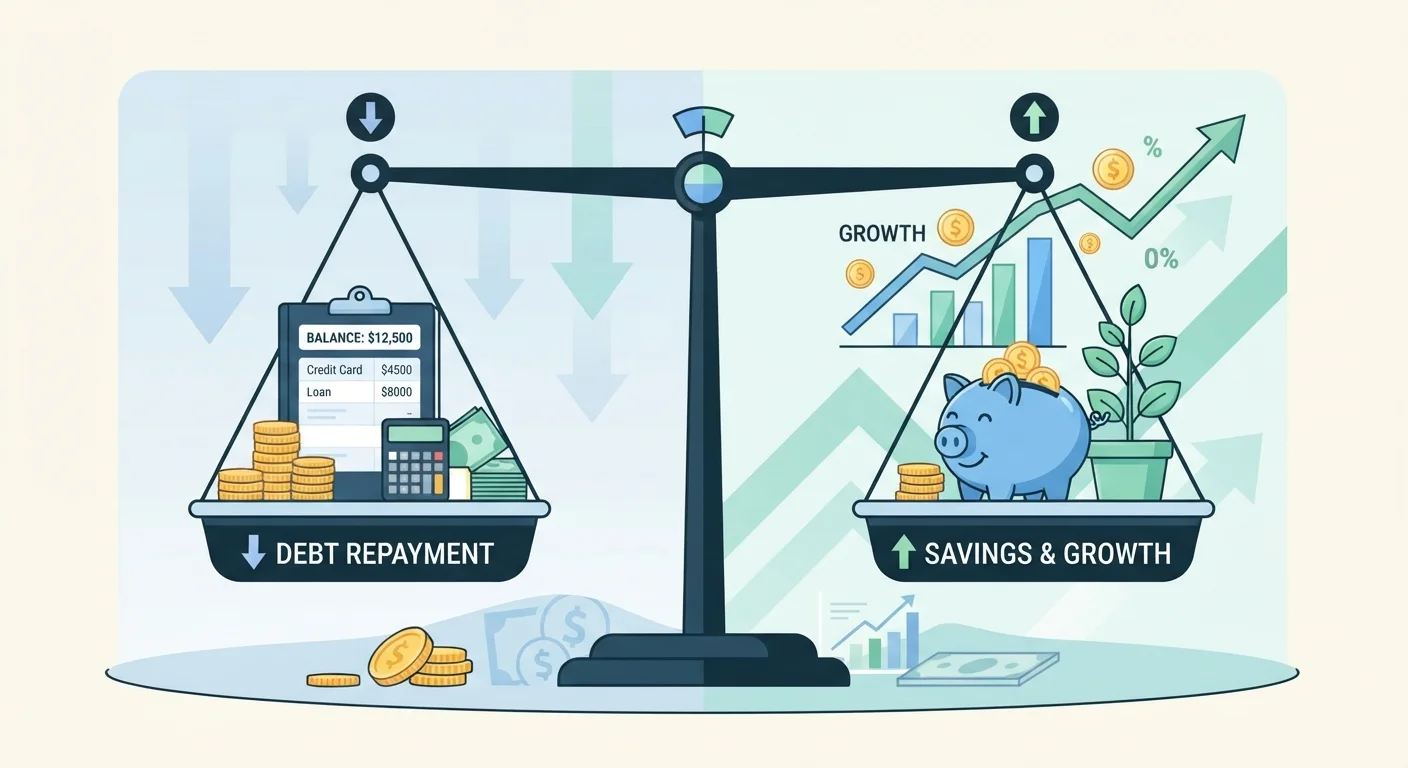
The Core Trade-Off: Interest Rates as the Starting Point
The tension between paying off debt and building savings is fundamentally a math problem — but one with real emotional weight. At its core, the question is: does the cost of your debt exceed what your savings can earn?
When debt carries a high interest rate — say, 20% APR on a credit card — every dollar left unpaid effectively costs you 20 cents per year. A savings account, even a high-yield one, is unlikely to match that return. In those cases, prioritizing debt payoff is generally the more financially efficient choice.
On the other hand, low-rate debt — such as a federal student loan at 4% or a mortgage around 6% — may cost less than the potential long-term growth from investing or saving, particularly if an employer offers a 401(k) match. In that scenario, building savings in parallel can make sense.
A useful rule of thumb: if your debt's interest rate exceeds roughly 7–8%, focus aggressively on payoff first. Below that threshold, a parallel savings strategy may be worth considering. This isn't a guarantee of outcome — it's a framework for thinking through your own numbers.
| Debt-First Approach | Parallel Savings Approach | Hybrid Approach | |
|---|---|---|---|
| Best suited for | High-interest debt (7%+ APR) | Low-rate debt with employer match | Most households seeking balance |
| Interest cost | Minimized — fastest payoff | Higher — debt lingers longer | Moderate — prioritizes costly debt |
| Emergency resilience | Low until debt is cleared | Higher with savings buffer | Moderate with small fund in place |
| Behavioral sustainability | Can feel rewarding but limiting | Balanced, less restrictive | Structured, adaptable over time |
| Retirement growth | Delayed if match is skipped | Captured early via employer match | Match captured; broader saving deferred |
| Risk of new debt | Higher without emergency buffer | Lower with savings cushion | Low once minimal fund is built |
The Case for Paying Off Debt First
Directing all available extra income toward debt offers a straightforward benefit: you eliminate a guaranteed cost. Unlike investment returns, which are uncertain, the interest savings from paying off debt are locked in.
This approach also reduces financial fragility over time. Carrying significant debt limits your flexibility — it ties up monthly cash flow and can create stress that affects broader decision-making. Research in behavioral economics suggests that debt's psychological burden is often disproportionate to its dollar value, making faster payoff emotionally rewarding in ways that sustain motivation.
If you're weighing which debts to tackle first, two widely used methods — the debt avalanche and debt snowball offer structured frameworks, each with different trade-offs between math and motivation.
The primary risk of a debt-only focus: if an unexpected expense arises and you have no savings buffer, you may be forced to take on new debt — effectively resetting your progress. That's why few financial educators recommend eliminating savings entirely.
The Case for Saving in Parallel
Building savings while carrying debt is not financial recklessness — in certain situations, it's a sound strategy. The most compelling case involves employer-sponsored retirement accounts with matching contributions. If your employer matches, for example, 50% of contributions up to 6% of your salary, passing that up to pay down debt represents a significant foregone return.
A parallel savings approach also builds a buffer that prevents new debt. Without any emergency fund, a car repair or medical bill can push someone back into credit card debt — often at a higher interest rate than the debt they were paying down. Understanding the difference between an emergency fund and liquid savings can help clarify which type of cushion to build first.
The downside of this approach is slower debt payoff, meaning you pay more in interest over time. For high-rate debt, this trade-off often isn't worth it. For those managing lower-rate debt with stable income, the benefits of building savings simultaneously can outweigh the added interest cost.
A balanced simultaneous approach is more achievable than many people assume — but it requires intentional budgeting to avoid spreading resources too thin.
The Hybrid Approach: A Middle Path for Most Households
For many people, the practical answer isn't a binary choice — it's a structured hybrid. A common version of this approach looks like:
- Build a minimal emergency fund first — typically $500 to $1,000 — before accelerating debt repayment. This provides a circuit breaker against new debt.
- Capture any employer retirement match — contribute enough to your 401(k) or similar plan to receive the full match, then direct remaining extra dollars to debt.
- Attack high-interest debt aggressively — once the basic safety net is in place and matched contributions are secured, apply the bulk of available cash flow to debt with the highest interest rate.
- Expand savings after high-rate debt is cleared — once costly debt is gone, redirect that cash flow toward a fuller emergency fund (typically three to six months of essential expenses) and broader savings goals.
This sequence aligns with established principles in sound debt repayment planning and reflects what many consumer financial educators recommend as a starting framework.
If income is constrained, carving out even a small savings margin each month can make the hybrid approach feasible without requiring dramatic lifestyle changes.
This article provides general financial education and is not personalized financial advice. For guidance tailored to your situation, consider consulting a licensed financial professional.