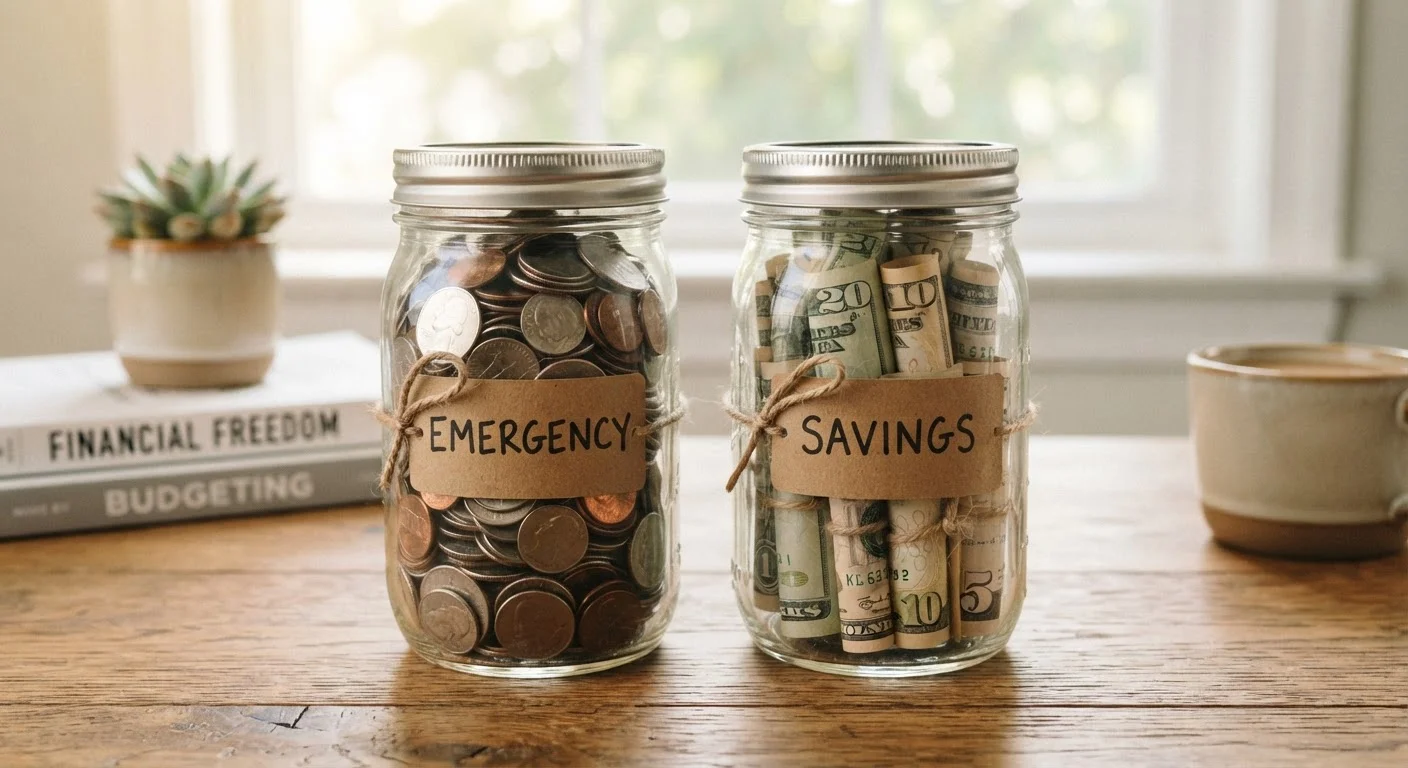
What Each Term Actually Means
The phrases emergency fund and liquid savings are often used interchangeably in casual conversation — but they represent meaningfully different financial concepts. Understanding that distinction helps you allocate money more intentionally and avoid the common mistake of blending purposes in a single account.
An emergency fund is a ring-fenced cash reserve dedicated to genuine financial emergencies: an unexpected job loss, a medical bill not covered by insurance, a major car repair that prevents you from getting to work, or an urgent home repair such as a burst pipe. The defining characteristic is that this money has one job — absorbing shocks that would otherwise force you into high-interest debt or disrupt your broader financial plan. It is not a general-purpose savings pool.
Liquid savings, by contrast, is a broader category. It refers to any cash or cash-equivalent asset that can be accessed quickly and without penalty — think a high-yield savings account, a money market account, or even a short-term CD (certificate of deposit) that matures soon. Liquid savings might include your emergency fund, but it can also include money earmarked for a vacation, a home appliance replacement, or a down payment on a vehicle. The key attribute is accessibility, not purpose.
For a plain-language breakdown of related financial vocabulary, see our budgeting glossary for adults.
| Criterion | Emergency Fund | Liquid Savings |
|---|---|---|
| Primary purpose | Cover unforeseen financial crises | Fund accessible short-term goals |
| Spending trigger | True emergencies only | Planned or flexible withdrawals |
| Typical target size | 3–6 months of essential expenses | Goal-specific amount |
| Account type | High-yield savings or money market | High-yield savings or money market |
| Separation from checking | Strongly recommended | Helpful but flexible |
| Access speed | Within 1–3 business days | Within 1–3 business days |
| Replenishment expectation | Refill after every use | Deplete when goal is reached |
How Much You Need in Each
Sizing these two reserves correctly is where many households struggle. A widely cited benchmark for emergency funds is three to six months of essential living expenses — meaning the non-negotiable costs such as housing, utilities, groceries, insurance, and minimum debt payments. The Consumer Financial Protection Bureau (CFPB) echoes this range as a starting point, noting that those with variable income, dependents, or health vulnerabilities may benefit from a larger cushion.
To calculate your target, add up your monthly essential expenses — your fixed and variable expenses — and multiply by three, four, or six depending on your risk tolerance and income stability. Someone with a stable salaried job and dual household income might feel secure at three months; a self-employed individual or single-income household should generally aim higher.
For liquid savings beyond the emergency fund, the target depends entirely on your goals. If you're saving for a $2,400 vacation 12 months away, your liquid savings target for that bucket is $2,400. These are goal-specific and time-bound — quite different from the open-ended, always-available nature of an emergency fund.
57%
Americans unable to cover a $1,000 emergency
A Bankrate survey found that fewer than half of US adults could pay an unexpected $1,000 expense from savings without borrowing.
3–6 months
Recommended emergency fund duration
The Consumer Financial Protection Bureau cites three to six months of essential expenses as the general benchmark for emergency reserves.
$500–$1,000
Starter emergency fund target
Many financial educators recommend this initial milestone to break the cycle of using credit cards for small unexpected expenses.
Where to Keep Each Type of Account
Both emergency funds and liquid savings are typically held in accounts that prioritize safety and accessibility over growth. Common choices include high-yield savings accounts, money market accounts, and checking accounts — all of which are insured by the FDIC (Federal Deposit Insurance Corporation) up to $250,000 per depositor, per institution.
Many financial educators suggest keeping your emergency fund in a separate account from your everyday checking or liquid savings. Physical separation creates a psychological barrier that makes it less tempting to dip into for non-emergencies. It also makes it easier to track whether your safety net is fully funded. You can learn more about how emergency funds fit into a broader financial plan in our article on why an emergency fund comes before investing.
For liquid savings tied to specific goals, some savers use accounts that allow sub-account labeling — a feature offered by several online banks — to visually separate a vacation fund from a home repair fund from a car fund, all without opening multiple institutions. What matters most is that the money earns at least modest interest, remains FDIC-insured, and can be accessed within one to three business days.
For a broader look at how savings concepts connect to net worth and debt metrics, see our plain-language savings and debt glossary.
What Counts as a True Emergency?
A good rule of thumb: an emergency is an expense that is unexpected, necessary, and urgent — and would cause serious hardship if left unaddressed. A medical copay after an accident qualifies. A concert ticket or seasonal sale does not. Defining your criteria in advance, before a tempting situation arises, is one of the most effective ways to protect your emergency fund from gradual depletion.
Building Both: A Practical Starting Point
If you're starting from zero, the conventional guidance is to prioritize your emergency fund first — even a modest starter reserve of $500 to $1,000 can prevent small setbacks from becoming high-interest debt. From there, you can build toward the three-to-six-month benchmark while simultaneously opening a separate liquid savings account for your first short-term goal.
A useful structural approach is to automate contributions. Direct a fixed portion of each paycheck to your emergency fund until it's fully funded, then redirect a portion to liquid savings goal accounts. This treats both as non-negotiable line items in your budget rather than whatever's left over at month's end.
The Saving & Debt hub offers additional practical strategies for growing savings at every income level. The most important step is establishing clear boundaries: decide in advance what qualifies as an emergency before you're in the middle of one, and stick to it. That discipline is what keeps your financial firewall intact when you actually need it.
This article is for general informational and educational purposes only and does not constitute personalized financial advice. Consult a licensed financial professional for guidance specific to your situation.