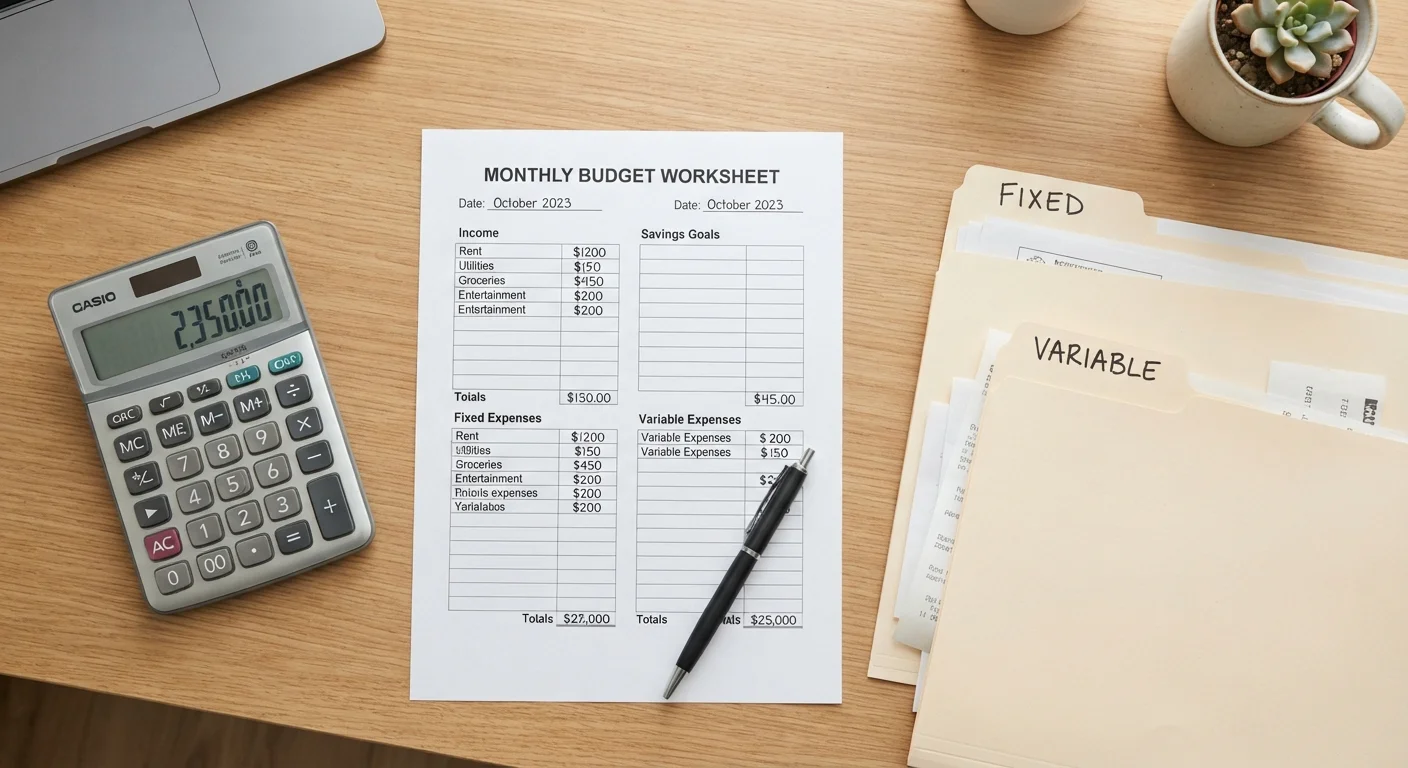
Why This Distinction Is the Starting Point for Any Budget
Before you can build a budget that actually holds up month after month, you need to know what your money is committed to versus what's still up for negotiation. That's exactly what the fixed vs. variable split reveals.
When you map every expense to one of these two categories, a picture emerges: a firm spending floor you can't move without significant life changes, and a flexible zone where your daily decisions have real financial consequences. Without that map, it's easy to feel like money simply disappears — and equally easy to cut in the wrong places when you need to trim costs.
This framework underpins many widely used budgeting approaches. The 50/30/20 rule, for instance, groups needs (mostly fixed) at 50% of take-home pay, wants (largely variable) at 30%, and savings or debt repayment at 20%. You can't apply that structure meaningfully until you've sorted your spending by type. If you're weighing more structured approaches, see how zero-based and percentage-based budgeting compare to find the method that fits your situation.
Fixed Expenses: Your Budget's Non-Negotiable Layer
A fixed expense is any recurring cost that arrives at a predictable, consistent amount — usually tied to a contract, loan agreement, or standing subscription. Whether you have a great month financially or a difficult one, the charge stays the same.
Common fixed personal expenses include:
- Rent or mortgage payments — typically the largest fixed cost for most households
- Auto loan or lease payments
- Minimum debt payments (student loans, personal loans)
- Insurance premiums (health, auto, renters/homeowners)
- Flat-rate subscriptions billed monthly or annually
The predictability of fixed expenses is both a convenience and a constraint. They're easy to plug into a budget because you know the exact number. But they also represent obligations you generally can't reduce quickly. If your fixed expenses consume too large a share of your income, you'll have very little room to save or absorb an unexpected cost — which is why building and maintaining an emergency fund alongside fixed commitments matters so much.
Audit Your Fixed Expenses Once a Year
Fixed doesn't mean permanent. Set a recurring annual reminder to review every fixed commitment — insurance premiums, subscription services, loan terms — and evaluate whether each still reflects your needs and priorities. Refinancing debt or canceling unused subscriptions can meaningfully lower your fixed spending floor and restore budget flexibility.
Variable Expenses: Where Your Choices Live
Variable expenses are costs that change in amount from month to month, driven by how much you consume, where you shop, or what circumstances arise. This category is where budgeting decisions have the most immediate impact.
Typical variable personal expenses include:
- Groceries — amounts shift with meal planning habits and store choice
- Gas and transportation costs beyond a car payment
- Dining out and entertainment
- Clothing and personal care
- Household supplies and home maintenance
- Medical co-pays and out-of-pocket health costs
Because variable expenses respond directly to behavior, they're the primary lever for adjusting spending when income drops or savings goals increase. However, they can also be deceptively hard to track — small purchases across many categories add up quickly without a clear record. This is a central reason that tracking spending before building a full budget is often recommended as a first step.
33%
Average share of income spent on housing
According to the U.S. Bureau of Labor Statistics Consumer Expenditure Survey, housing consistently represents the largest single fixed expense category for American households.
~$5,111
Average annual household food spending
The BLS Consumer Expenditure Survey reports average annual food-at-home spending near this figure, illustrating how significant variable grocery costs are even before dining-out expenses are added.
57%
Adults without a formal monthly budget
A Gallup survey found that a majority of U.S. adults do not prepare a detailed household budget, often because they haven't categorized their spending in a way that makes budgeting feel actionable.
Semi-Variable Expenses and Irregular Costs
Not every expense fits cleanly into fixed or variable. Semi-variable expenses — sometimes called mixed costs — have a fixed base component combined with a usage-sensitive portion. Utility bills are the clearest example: your electricity provider may charge a fixed connection fee plus a rate per kilowatt-hour consumed. The base is predictable; the rest depends on your habits and season.
Separately, irregular expenses are costs that occur infrequently but are entirely predictable if you plan for them — annual car registration, quarterly insurance premiums, holiday gifts, or back-to-school supplies. These aren't truly variable (you know they're coming) but they don't appear every month either. The solution is to estimate the annual total and divide it into a monthly savings allocation, treating it as a fixed line item. For a deeper look at this category, see how to plan for seasonal and irregular expenses.
If your income itself varies month to month — common for freelancers and gig workers — the challenge is compounded. Budgeting on an irregular income requires anchoring your plan around your lowest expected earnings and treating fixed expenses as the first priority before anything else is allocated.
Using This Framework to Strengthen Your Budget
Once you've categorized your expenses, the ratio of fixed to variable spending tells you something important: how resilient your budget is. A household where 80% of take-home pay is locked into fixed obligations has very little margin to respond to change. A household where fixed costs represent 45–50% of income retains meaningful flexibility.
Here's how to put the framework to practical use:
- List every expense and label it fixed, variable, or semi-variable. Use three months of bank and credit card statements to capture your real spending pattern, not an idealized version of it.
- Total your fixed expenses first. This is your spending floor — the minimum your budget must cover before any discretionary decision is made.
- Set target ranges for each variable category. Based on your income and savings goals, decide how much each variable category should receive. These become your monthly guardrails.
- Assign irregular expenses a monthly reserve. Divide annual irregular costs by 12 and treat that amount as fixed savings each month.
- Review the ratio periodically. If fixed expenses creep up through new subscriptions or financing, reassess whether the tradeoff is worth the reduced flexibility.
It's worth noting that this framework applies beyond personal budgets. Business owners use the same fixed vs. variable distinction to understand how costs behave as revenue changes — a concept explored further in our guide to fixed and variable costs in business.
This article is for general informational and educational purposes only and does not constitute personalized financial, tax, or legal advice. Consider consulting a qualified financial professional for guidance specific to your circumstances.