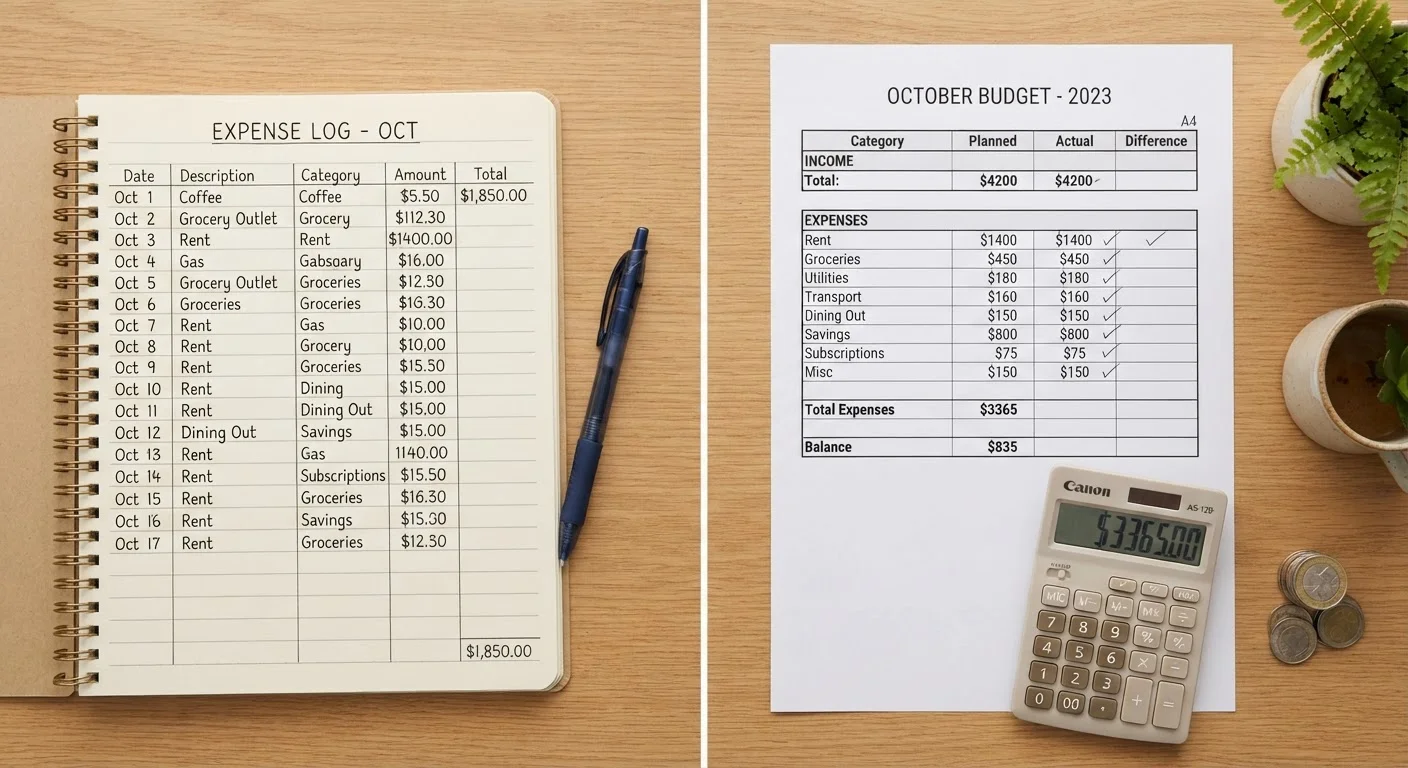
What Each Approach Actually Does
A spending tracker is a record of transactions you've already made. You log each purchase — manually in a notebook, through a spreadsheet, or via a banking app — and categorize it afterward. The goal is visibility: you're building a picture of where your money actually went.
A full budget works in the opposite direction. Before the month begins, you allocate your expected income across specific categories — housing, groceries, transportation, savings, debt payments, and so on. Every dollar is assigned a job in advance. Frameworks like the 50/30/20 rule or zero-based budgeting (see Zero-Based Budgeting vs. the 50/30/20 Rule) are examples of full-budget structures that guide how those allocations are made.
The core distinction: tracking is descriptive (what happened), while budgeting is prescriptive (what should happen). Both have real value, but they serve different purposes.
The Case for a Spending Tracker
For anyone just beginning to engage with their finances, a spending tracker has a low barrier to entry. There's no income projection required, no category limits to set, and no sense of failure if you overspend a line item — because there are no line items to begin with. You simply observe.
That observation is genuinely powerful. Many adults discover, often with surprise, how much discretionary spending accumulates in categories they hadn't consciously monitored. Tracking creates the data foundation that a future budget would need anyway.
Tracking also suits people whose income or expenses are highly variable month to month. If you're a freelancer, gig worker, or someone with irregular pay, building a forward-looking budget can feel like guessing. Tracking what comes in and goes out first — over two or three months — gives you the averages needed to budget realistically later.
Use Two to Three Months of Tracking First
Before building a full budget, track your spending for at least two to three months without any limits. This gives you real averages for each category rather than guesses. Budget targets grounded in actual data are far more realistic — and far more likely to stick.
The main limitation of tracking alone is that it doesn't prevent overspending. Awareness without a plan is insight without action. If you consistently notice you're spending more than you'd like in a category but don't set a limit, the pattern tends to persist.
The Case for a Full Budget
A full budget is the tool of choice when you have financial targets that require deliberate allocation. Saving for an emergency fund, paying down credit card debt, contributing to a retirement account, or setting aside money for irregular and seasonal expenses — none of these happen reliably without a plan that reserves money for them before the month's spending begins.
Budgets also introduce accountability. When you've decided in advance that $400 goes toward groceries, a $520 grocery month triggers a concrete question: what changed, and should the limit be revised or the spending reined in? That feedback loop is harder to create with tracking alone.
The tradeoff is effort. A well-constructed budget requires you to know your income with reasonable accuracy, categorize all expected expenses, and revisit the plan monthly. The monthly budget checklist for households can simplify that review process, but the upfront investment of time is real. People who find the setup overwhelming often abandon budgets within a few weeks.
| Spending Tracker | Full Budget | |
|---|---|---|
| Primary function | Records past spending | Plans future spending |
| Setup time | Minimal — start immediately | Moderate — requires income & category planning |
| Best for savings goals | Limited — no reserved allocations | Strong — savings assigned before spending |
| Handles variable income | Well — no projections needed | Harder — estimates required upfront |
| Prevents overspending | No — only reveals patterns | Yes — limits set in advance |
| Maintenance effort | Low — log and review | Higher — monthly plan & reconciliation |
| Ideal starting point | Beginners or irregular earners | Those with clear goals & stable income |
How to Choose — or Combine Both
The decision comes down to where you are financially and what you're trying to accomplish. Consider starting with a spending tracker if:
- You have no clear picture of your current spending patterns
- Your income varies significantly each month
- You've tried full budgets before and found them unsustainable
Move toward a full budget — or add one alongside your tracker — when:
- You have a specific savings goal with a deadline
- You're actively repaying debt and need to protect a set monthly payment
- Your tracker data has given you enough baseline information to set realistic limits
Many people find the most durable system is a hybrid: use your tracker's historical data to set budget categories each month, then compare actual spending against those targets at the end of the period. This is the approach underlying structured frameworks like zero-based and percentage-based budgeting.
If you're ready to put a full plan on paper for the first time, Your First Household Budget: A Practical Starting Point walks through the setup process step by step. For broader money habits that reinforce either approach, the financial wellness hub offers additional context.
This article is for general informational and educational purposes only. It does not constitute personalized financial advice. For guidance tailored to your specific circumstances, consider consulting a licensed financial professional.