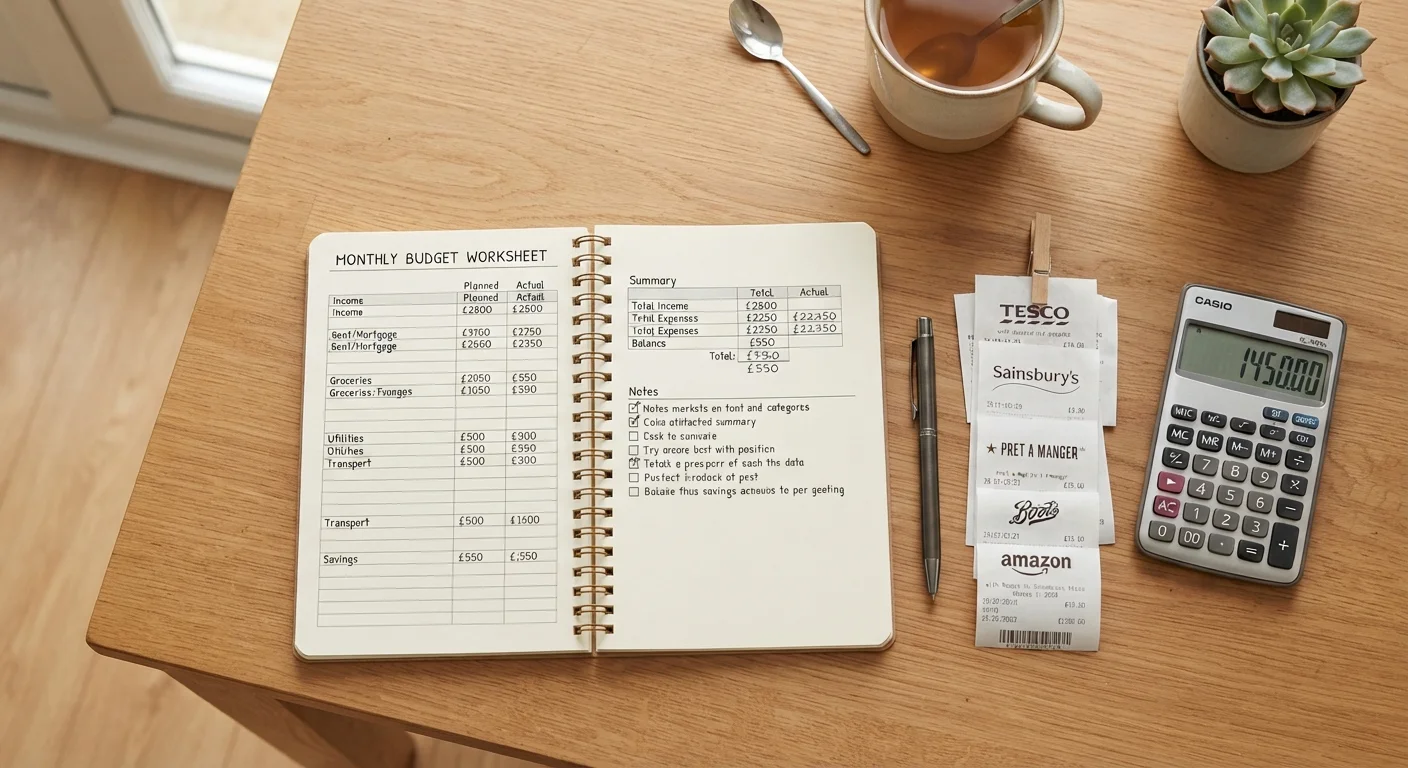
Why a Household Budget Matters
A household budget is simply a written plan for how your money will move each month. Without one, spending decisions happen by default — which is rarely aligned with your actual goals. Research from the Federal Reserve's Survey of Household Economics and Decisionmaking has consistently found that many US adults experience financial fragility, meaning an unexpected expense can cause immediate hardship. A budget doesn't eliminate financial risk, but it creates visibility: you can see where your money is going, spot problems early, and make deliberate trade-offs.
Budgeting for a household differs meaningfully from managing business finances. If you're also navigating a side venture, see our guide on business budgeting basics — the principles overlap in places, but the priorities are distinct. For now, the focus is your personal household: one clear plan, grounded in your real numbers.
This article provides general financial education and is not personalised financial advice. For guidance specific to your situation, consider speaking with a licensed financial professional.
Step 1: Calculate Your Real Monthly Income
Your budget must be built on take-home pay — the amount deposited into your bank account after taxes, Social Security, Medicare, and any pre-tax deductions like a 401(k) contribution. Using gross income (your salary before deductions) is one of the most common first-budget errors and leads to a plan that looks balanced on paper but runs short in practice.
List every reliable income source:
- Primary employment (after-tax)
- Secondary employment or part-time work
- Freelance or gig income — if variable, use a conservative average over the past six months
- Child support, alimony, or other consistent transfers, if applicable
If your income varies month to month, set your budgeting baseline at your lowest typical monthly amount. Treat any surplus in stronger months as a bonus to route toward savings or debt — not as permission to spend more.
Take-home pay
The amount of money you actually receive after all taxes and deductions are withheld from your paycheck. This is the figure your budget should be built on.
Fixed expense
A recurring cost that stays the same each month, such as rent or a car payment, making it easier to plan for in advance.
Variable expense
A cost that happens regularly but changes in amount from month to month, like grocery or utility bills.
Periodic expense
A predictable cost that doesn't occur every month — such as an annual insurance premium or a vehicle registration fee — but needs to be budgeted for in advance.
50/30/20 rule
A budgeting framework that divides after-tax income into three categories: 50% for needs, 30% for wants, and 20% for savings and debt repayment.
Emergency fund
A dedicated savings reserve set aside to cover unexpected expenses or income disruption, commonly recommended as covering three to six months of essential expenses.
Step 2: Map Every Expense
Before categorising anything, spend 10 minutes pulling three months of bank and credit card statements. Seeing actual spending — not estimated spending — is the foundation of a budget that holds.
Sort expenses into three groups:
- Fixed expenses
- Costs that are the same each month: rent or mortgage, car payment, insurance premiums, loan minimums. These are non-negotiable in the short term.
- Variable expenses
- Costs that recur monthly but fluctuate: groceries, gas, utilities, dining out, personal care. Average these over three months for a realistic figure.
- Periodic expenses
- Costs that hit infrequently but predictably: annual subscriptions, car registration, holiday gifts, semi-annual insurance payments. Total the year and divide by 12 to set aside the right monthly amount.
Periodic expenses are the category most first-time budgeters forget — and why many budgets feel like they're working until suddenly they aren't. Owning a car adds meaningful periodic costs; the real cost of car ownership hub breaks these down in detail if you want a more complete picture of vehicle-related line items.
Step 3: Apply a Simple Budgeting Framework
Once you have your income and expense totals, a framework helps you judge whether your allocation is reasonable. The 50/30/20 rule — originally popularised in personal finance literature — divides after-tax income as follows:
- 50% toward needs: Housing, utilities, groceries, minimum debt payments, basic transportation
- 30% toward wants: Dining out, streaming services, hobbies, clothing beyond basics
- 20% toward savings and debt repayment: Emergency fund contributions, retirement savings, paying down debt above minimums
Treat these percentages as diagnostic targets, not absolute rules. High-cost-of-living areas may see housing alone consume 40% of take-home pay, which means other categories need to flex. The value of the framework is in revealing imbalance — if you're spending 55% on needs and 5% on savings, you have a clear signal that something needs to shift.
Start With One Month of Real Data
Before finalising any budget category, pull your actual bank and credit card statements from the previous month rather than estimating from memory. Most people underestimate what they spend on variable categories like dining and subscriptions by 20–30%. Real data makes your first budget far more accurate — and more likely to stick.
For couples managing money together, budget structure often needs additional thought around joint versus individual spending. Our guide on household budgeting as a couple covers the main approaches for shared finances.
Step 4: Track, Review, and Adjust
Setting a budget is the beginning, not the finish line. Most first budgets include at least a few line items that are noticeably off — that's normal and expected. The goal in month one is not perfection but observation.
At the end of each month, compare what you planned against what you actually spent in each category. Note where you went over, where you had surplus, and whether any irregular expenses appeared that weren't in your plan. Then adjust your category amounts for the following month to reflect what you're learning.
A structured monthly budget checklist can make this review faster and more consistent. Over time — typically three months — your estimates get more accurate and the review takes less effort.
After your basic budget is stable, the natural next step is putting it to work: building savings and reducing debt. The Saving & Debt hub covers practical strategies for both. For a broader look at all the financial building blocks that connect to budgeting, see our complete financial wellness reference.
Common First-Budget Mistakes to Avoid
Even with the right framework, a few recurring patterns trip up first-time budgeters:
- Budgeting on gross income. Always use take-home pay. Gross figures make your budget look healthier than it is.
- Forgetting periodic expenses. Annual subscriptions, registration fees, and seasonal costs need a monthly reserve — even when the bill isn't due yet.
- Setting targets too tight. A budget so restrictive it requires perfection will break at the first imperfect week. Build in a small buffer or a modest discretionary category so the plan can absorb normal life.
- Tracking only digitally without reviewing. Automated expense trackers are useful, but they don't replace a monthly sit-down to assess what the numbers mean and whether your priorities are being reflected.
- Ignoring small recurring charges. Subscription creep — multiple small monthly charges that individually seem trivial — can quietly consume hundreds of dollars annually. Review all recurring charges at least once a quarter.
Budgeting is also a place where home maintenance spending deserves a dedicated line. Expenses like a running toilet may seem minor, but small repairs left unaddressed become larger costs — our guide to fixing a running toilet illustrates how routine home upkeep fits into your overall spending plan.