The False Choice Most People Make
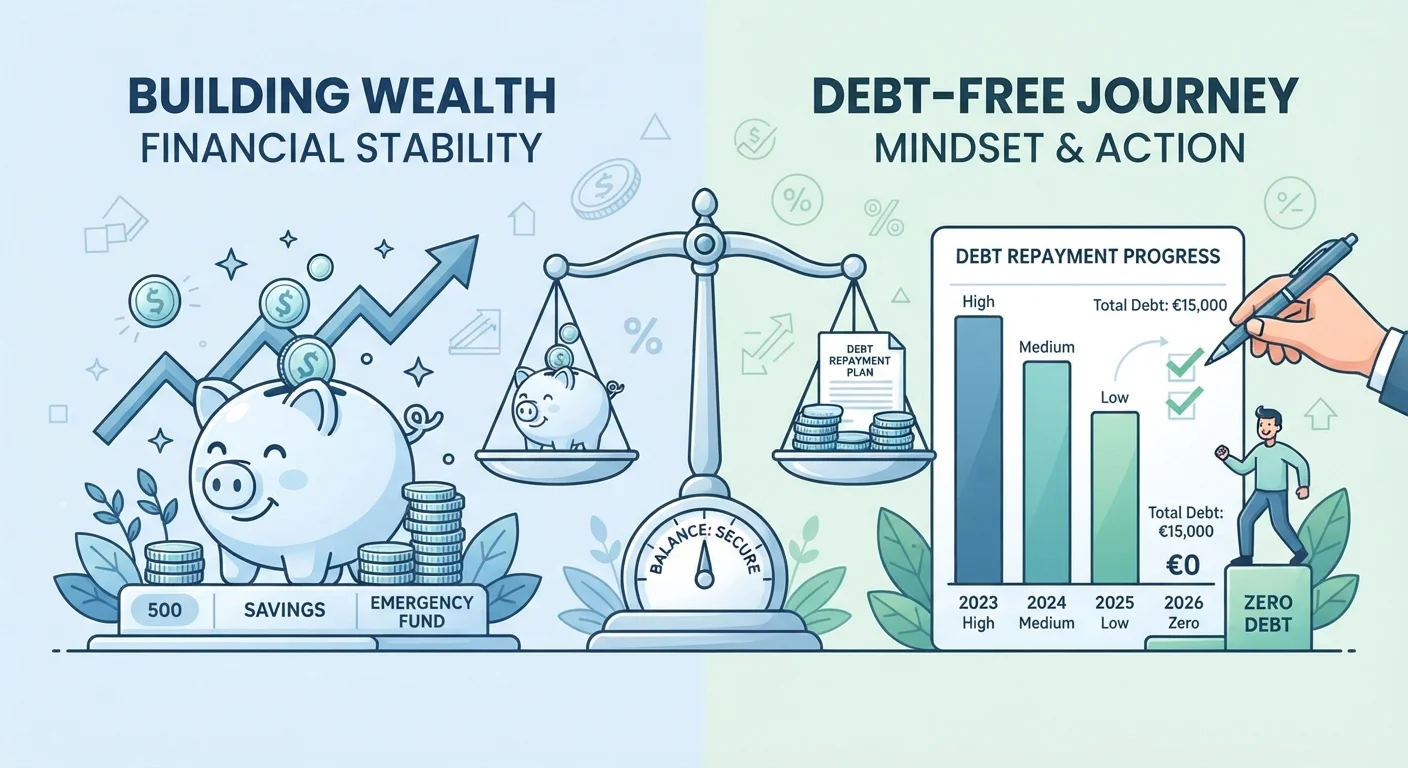
Ask most people how to handle debt and savings simultaneously, and the most common answer is: "Pay off the debt first, then start saving." It feels logical — why earn 4% on savings when you're paying 20% on credit card debt? But this all-or-nothing framing ignores several real-world dynamics that make the "debt first" approach riskier than it looks.
The core problem is that life doesn't pause while you pay down debt. Car repairs happen, medical bills arrive, and income can dip unexpectedly. Without any savings cushion, each disruption becomes a reason to reach for credit again — effectively canceling out the progress you've made. Personal finance isn't just math; it's a system that has to function under pressure.
A balanced approach — directing some money to debt repayment and some to savings simultaneously — is not only possible, it's often the more resilient strategy for the majority of households. The key is knowing which myths are blocking you from getting started.
Myth
You should pay off all debt before saving a single dollar.
Fact
Most financial educators recommend building a small emergency fund even while carrying debt, to avoid taking on new debt when unexpected expenses arise.
Paying off debt before saving any money assumes your financial life will remain stable throughout the payoff period — an assumption that rarely holds. Without even a modest emergency fund (commonly suggested as $500–$1,000 to start), a single unexpected expense like a car repair or medical copay forces most people back to a credit card, adding new high-interest debt. This cycle can extend the payoff timeline by months or even years.
Building a small buffer alongside debt repayment costs relatively little in additional interest but provides significant protection against regression. Once a basic emergency fund is in place, you can redirect that savings allocation toward extra debt payments. The saving and debt hub explores this balance in detail.
Myth
Contributing to a retirement account makes no sense while carrying debt.
Fact
If your employer offers a retirement match, contributing enough to capture it typically makes financial sense even while paying off debt.
Forgoing an employer 401(k) match to accelerate debt repayment is one of the most commonly cited financial missteps. An employer match — where the company contributes a percentage of your own contribution — represents an immediate, guaranteed return that often equals 50% to 100% on those dollars before any investment growth occurs. Very few debt interest rates are high enough to make skipping this worthwhile.
The practical guideline many financial educators suggest: contribute at least enough to capture the full employer match, then direct remaining dollars toward high-interest debt. Contributions above the match threshold can reasonably wait until high-interest debt is cleared, but abandoning the match entirely is a cost most households pay without realizing it.
Myth
The mathematically optimal strategy is always the right one.
Fact
Research consistently shows that the approach people actually stick with produces better real-world outcomes than one that's theoretically optimal but abandoned early.
Pure interest-rate math says you should always attack the highest-rate debt first (the debt avalanche method) and save nothing until every balance is cleared. In practice, financial behavior is driven by motivation and habit as much as arithmetic. Studies in behavioral finance, including work associated with researchers at Northwestern University's Kellogg School of Management, suggest that paying off smaller balances first — even if they carry lower rates — can sustain motivation in ways that keep people engaged with their payoff plan.
A hybrid approach — maintaining small savings contributions while targeting high-interest debt — works similarly. It keeps savers in the habit of saving, which is a critical long-term financial behavior, while still reducing the most expensive debt. Avoiding the common missteps that derail payoff plans is just as important as choosing the right strategy, as where people go wrong when getting out of debt illustrates.
Myth
If you can't save a significant amount, there's no point in starting.
Fact
Saving small amounts consistently builds the habit and the balance over time — and even modest savings reduce financial vulnerability significantly.
The belief that savings must start at a meaningful threshold — often framed as three to six months of expenses — discourages many people from beginning at all. In reality, the Federal Reserve's surveys on household finances have repeatedly shown that a large share of US adults would struggle to cover a modest unexpected expense without borrowing. Even accumulating a few hundred dollars in a dedicated savings account meaningfully reduces that vulnerability.
Starting with whatever is available — even $10 or $20 per paycheck — establishes the behavioral pattern of saving before spending. That habit compounds in value over time, independent of the dollar amount. Strategies for paying off debt while budgeting for daily life can help identify where those initial savings dollars can realistically come from.
Building a Framework That Does Both
Once you've cleared the mental hurdles, the practical question becomes: how do you actually allocate limited income across competing financial needs? A workable starting point is a modified version of the classic budgeting basics framework — one that carves out dedicated lanes for both obligations.
A common structure used by financial educators breaks monthly take-home pay into three priority tiers:
- Essential debt minimums and bills first. Meeting minimum payments protects your credit score and avoids penalty fees. This is non-negotiable.
- A small, fixed savings contribution second. Even $25–$50 per paycheck directed to an emergency fund builds the buffer that prevents new debt. Automating this transfer removes the temptation to skip it — though it's worth understanding the trade-offs first, as explored in automating your finances.
- Aggressive extra payments on the highest-cost debt third. Any remaining discretionary dollars go toward reducing balances, prioritizing the highest interest rate first. This is consistent with the debt avalanche method, one of the two approaches detailed in the debt avalanche and snowball methods.
This framework deliberately avoids sacrificing one goal entirely for another. As each debt is paid off, its former minimum payment can be redirected — both to accelerate the next debt and to grow the savings contribution.
If money feels extremely tight, making room for savings when money feels tight offers practical strategies for creating even a small monthly margin. And for a deeper comparison of the trade-offs between these two goals, paying off debt vs. building savings at the same time walks through the nuances in detail.
The goal isn't to be perfectly optimized — it's to build a system that keeps moving forward even when circumstances change. Households that maintain some savings during debt repayment tend to be more consistent over time, because they're not forced to restart from zero every time an unexpected expense appears.
This article is for general informational purposes only and does not constitute personalized financial, tax, or investment advice. Consult a qualified financial professional for guidance tailored to your individual situation.