Why Kitchen Organization Usually Falls Apart
Most kitchen organization attempts follow the same pattern: a big Saturday cleanout, labels everywhere, everything in its place — and then, three weeks later, the junk drawer is back, the counter is buried, and the spice rack is a mystery. The problem is almost never effort. It's that the system wasn't designed to survive real daily life.
A kitchen that stays organized isn't necessarily a minimalist one. It's one where putting things away is easier than leaving them out, and where every item has a home that genuinely makes sense. If you've ever reorganized the same space twice in a year, it's worth reading our take on common organization myths that backfire — many popular approaches actually work against long-term maintenance.
Core Habits That Keep Kitchens Functional
The following practices aren't about achieving a magazine-worthy kitchen. They're about reducing friction so that staying organized costs you less energy than letting things slide.
Store items at the point of use, not by category alone.
When tools and ingredients live close to where you actually use them, putting them away becomes the path of least resistance. Category-based storage (all baking supplies together, all tools in one drawer) sounds logical but often means walking across the kitchen repeatedly — which is why things end up left out.
Assign every item a specific, consistent home.
Vague zones like 'the utensil drawer' lead to disorganization because anything can technically belong there. When each item has one designated spot, putting it away requires no decision-making — and decisions are where tidying breaks down.
Keep countertops to daily-use items only.
Counter space is prime real estate and the most visible part of any kitchen. When items that rarely get used live on the counter, they create visual clutter and physically reduce your prep area. This makes cooking feel harder, which reduces motivation to cook — and creates more mess overall.
Use containers and dividers that fit your actual storage dimensions.
Organizers that don't fit the space properly shift around, waste room, and eventually get abandoned. Measuring before buying containers is the single most effective way to avoid the common trap of buying more storage products than you actually need.
Label storage in shared kitchens or complex pantries.
Labels remove the guesswork of where things belong, which is critical when more than one person uses the kitchen. Without labels, people default to wherever seems convenient in the moment — and systems collapse.
Conduct a quarterly kitchen edit to remove what you no longer use.
Kitchens accumulate items passively — duplicate tools, expired pantry goods, gadgets tried once. Over time, excess creates congestion that makes the whole system harder to navigate. Regular editing keeps the number of items manageable and storage genuinely functional.
The Daily Reset: Small Effort, Big Payoff
One of the highest-leverage habits in any organized kitchen is the daily reset — a brief, intentional sweep at the end of cooking or before bed. This doesn't mean deep cleaning. It means returning items to their designated spots, wiping the main prep surface, and clearing the sink of dishes.
Five to ten minutes of consistent resetting prevents the compounding effect where small messes become overwhelming ones. Think of it like financial compound interest working in reverse: ignored clutter accumulates fast. A kitchen that gets a nightly reset is also far easier to cook in the next morning, which supports broader goals like eating well on a busy schedule.
Editing Your Kitchen: The Habit Most People Skip
Organization isn't a one-time event — it requires periodic editing. Every few months, it's worth pulling out a drawer or cabinet and asking honestly: Do I use this? Does it work? Does it belong here? Items that don't pass that test take up space and make everything else harder to find.
This is especially true in kitchens shared with others. If different household members have different standards for what goes where, the system will drift quickly. Agreeing on a few shared rules — where the cutting boards live, what stays on the counter — can prevent a lot of friction. For households navigating different habits, our article on organizing shared spaces covers practical strategies worth considering.
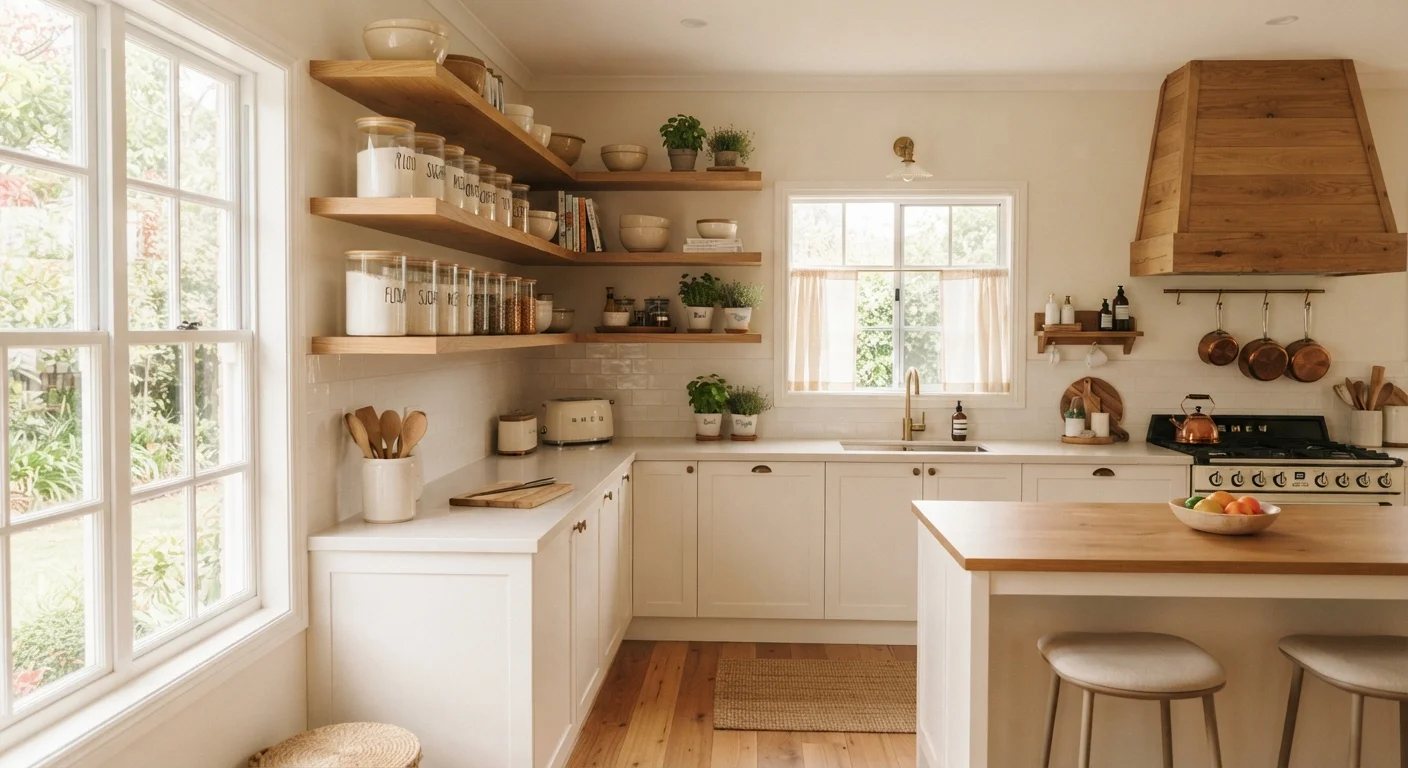
If your kitchen has open shelving, editing becomes even more important, since everything is always visible. The real-world tradeoffs between open shelving and closed cabinets are worth understanding before committing to either approach.
Applying These Habits in Smaller Kitchens
Compact kitchens require even more deliberate systems because there's less margin for clutter. In a small space, a single pile on the counter can make the entire kitchen feel unusable. The upside is that smaller kitchens are easier to reset quickly — a five-minute tidy genuinely covers the whole room.
If you're working with limited square footage throughout your home, the broader strategies in our guide on small-space organization across every room can help you apply these same principles everywhere. The kitchen habits here — use-based storage, regular editing, and daily resets — translate directly to bathrooms, entryways, and bedrooms.
This article provides general home organization guidance for informational purposes. Results will vary based on your specific space, household size, and habits.