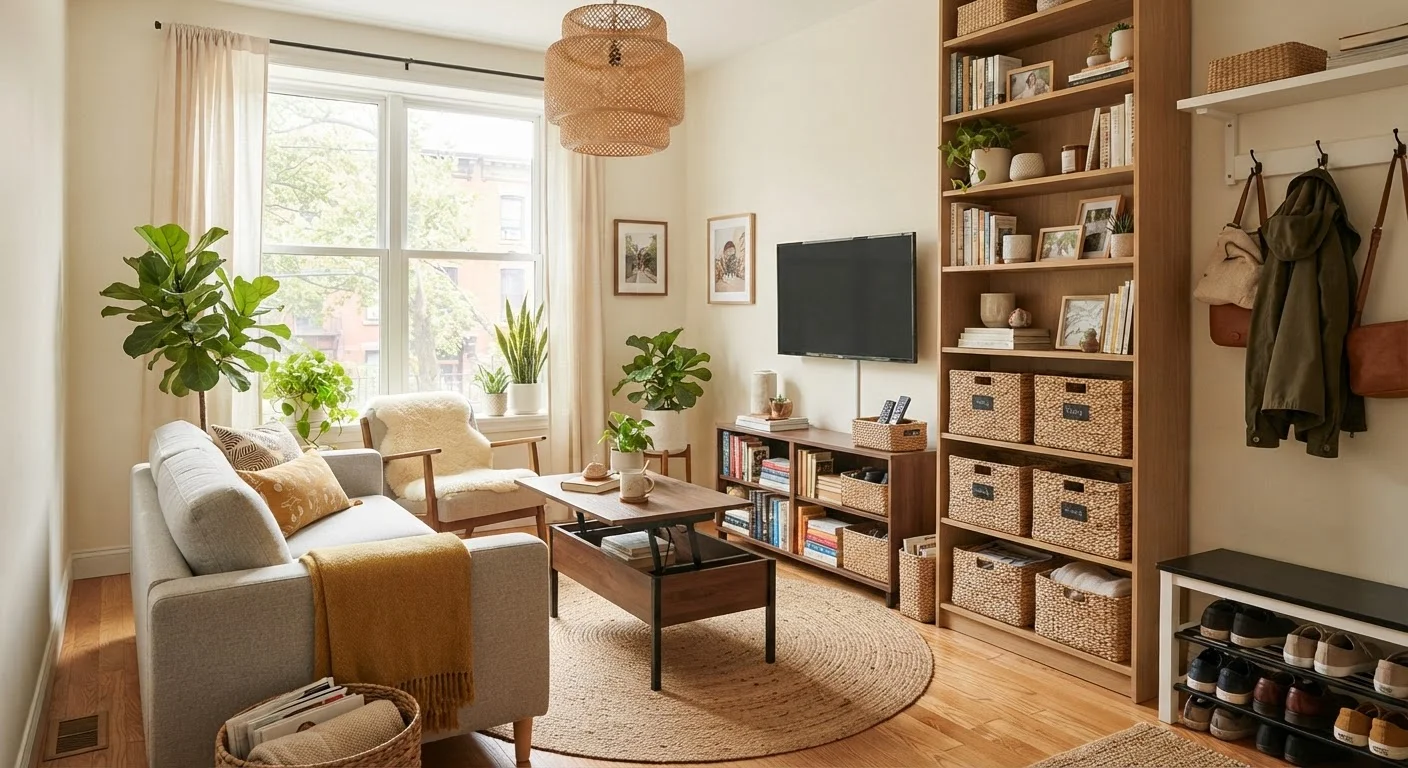
Why Small-Space Organization Is a Different Challenge
Organizing a compact apartment or smaller home isn't simply a scaled-down version of organizing a larger one. The constraints are qualitatively different: less margin for error, fewer dedicated storage rooms, and rooms that typically have to serve multiple purposes simultaneously. A bedroom in a small apartment may also be a home office and a reading nook. A kitchen might double as a laundry area. When space is scarce, organizational decisions have cascading effects across the entire home.
The good news is that small spaces can actually be easier to keep organized — once thoughtful systems are in place — because there's simply less room for disorder to hide. The challenge is building those systems room by room, tailored to how you actually live. Before you invest in storage solutions, it's worth reading about common organization myths that lead people to buy containers before they've addressed the root issue: too much stuff for the available space.
The foundational principle for small-space organizing is edit first, organize second. Reducing what you own is always more effective than adding storage for items you rarely use. Once your inventory matches your square footage, the room-by-room strategies below become far more effective.
The Kitchen: Maximum Function in Minimal Square Footage
Compact kitchens reward systems that keep countertops clear and make full use of cabinet interiors and wall space. Start by auditing duplicates — most small kitchens don't need three spatulas or four mixing bowls. What remains should be organized by frequency of use: daily tools within easy reach, occasional items stored higher or deeper.
- Use cabinet doors: The inside of cabinet doors can hold spice racks, cutting boards, or cleaning supplies using inexpensive door-mount organizers.
- Stack vertically inside cabinets: Shelf risers and stackable cookware maximize the full height of cabinet interiors, converting unused air space into usable storage.
- Magnetic strips for knives and metal tools: A wall-mounted magnetic strip keeps frequently used knives accessible without taking up a knife block's worth of counter space.
- Drawer dividers: Utensil drawers without dividers become a jumbled time sink. Simple, adjustable dividers let you retrieve what you need without digging.
If your kitchen has a pantry cabinet or deep shelving, consider a pull-out or turntable organizer (often called a lazy Susan) for canned goods and jars. Items stored behind other items effectively don't exist in a small kitchen — visibility is essential.
Audit Before You Organize
Before adding any kitchen storage solution, remove everything from one cabinet or drawer at a time and evaluate each item honestly. Duplicate tools, rarely used gadgets, and expired pantry items are common in small kitchens and consume prime space. Organizing what remains is almost always easier — and cheaper — than finding storage for everything.
The Bedroom: Sleep Space That Also Has to Do More
In a small home, bedrooms rarely get to be just bedrooms. They often house work surfaces, exercise gear, or overflow storage. The key is to create clear visual and functional boundaries so the room doesn't feel chaotic.
Under-bed storage is one of the highest-value opportunities in any bedroom. Low-profile rolling bins or vacuum-seal bags are well-suited for seasonal clothing, extra linens, or rarely accessed items. Measure the clearance under your bed before purchasing any containers.
Closet organization deserves its own audit. Most closets can hold significantly more when organized with double-hang rods (for shirts and folded pants), shelf dividers, and over-door shoe pockets. If your closet has a single hanging rod and a single shelf, you're likely using less than half its potential capacity.
For bedrooms that double as workspaces, a fold-down wall desk or a narrow desk tucked into a closet nook can define the work zone without dominating the room. When the workday ends, closing the closet door or folding the desk surface signals a mental shift that supports better sleep. This kind of life-stage thinking is explored more fully in our guide on organizing for different life stages.
Living Areas: Multi-Use Zones Without the Clutter
The living room in a small home is often the most overloaded space — it's expected to function as a social area, entertainment zone, potential guest room, and sometimes a workspace. Zoning is the core strategy here: visually and functionally carving the room into distinct areas even without walls.
Furniture selection matters enormously. An ottoman with interior storage serves triple duty as a footrest, coffee table, and hidden bin. A sofa with a built-in chaise that lifts to reveal storage can replace a separate storage bench. Every piece of furniture that only does one job is a piece worth reconsidering in a small space.
When choosing furniture for a small living room, measure the negative space — the walkable floor area — before and after any proposed piece. If a sofa reduces walkable space below 36 inches of clearance, it will make the room feel cramped regardless of how much storage it offers.
Traffic flow directly affects how spacious a room feels and how easily it can be tidied. Furniture that impedes movement tends to accumulate items draped over it rather than stored properly.
Before buying any organizing product, photograph the problem area and live with it for one week, noting exactly what accumulates and why. The pattern almost always reveals whether you need better storage or fewer possessions.
Most organizational purchases solve the symptom rather than the cause. A week of observation identifies whether the issue is storage capacity, habit, or simply owning too many items for the space.
Vertical shelving is the living room's greatest organizational asset. Floor-to-ceiling shelving units create substantial storage and display space without consuming floor area. The open shelving vs. closed cabinets trade-off is particularly relevant here: open shelves look spacious but require consistent maintenance, while closed cabinets are more forgiving of daily entropy.
For households where multiple people share the space with different tidiness habits, dedicated personal zones — even just a designated shelf or basket per person — can reduce friction significantly. Our article on organizing shared spaces covers this dynamic in detail.
The Bathroom: Small Room, Big Storage Demands
Bathrooms in apartments and smaller homes often offer minimal built-in storage, yet they need to accommodate toiletries, cleaning supplies, medications, towels, and grooming tools. The strategy here is almost entirely vertical and over-door.
- Over-toilet shelving: The space above the toilet is almost always unused. A freestanding over-toilet shelving unit or a wall-mounted cabinet can store towels, toiletries, and backup supplies without requiring any floor space.
- Tiered shelf organizers inside cabinets: A single under-sink cabinet becomes dramatically more useful with a tiered riser, which gives you two levels of storage in the same footprint.
- Drawer organizers for small items: Hair ties, razors, and cotton rounds are small enough to disappear into a junk drawer. Small trays or cups inside drawers keep them findable.
- Towel hooks vs. towel bars: Hooks take up significantly less wall space than towel bars and are easier to use consistently — an important factor when you want towels hung rather than dropped on the floor.
Decluttering expired products is a bathroom-specific habit worth building into a quarterly routine. Expired medications, old makeup, and half-empty products that won't be finished consume prime storage space without serving any function.
Entryways and Transitional Spaces
In many small homes, the entryway is a narrow strip of floor rather than a dedicated room — yet it handles the daily chaos of shoes, bags, coats, keys, and mail. Without a system, this transitional zone becomes the first place clutter accumulates and the last thing guests see.
A wall-mounted coat rail with hooks at varying heights handles coats, bags, and hats without requiring a freestanding coatrack. Underneath, a small shoe bench with interior storage or a tiered shoe rack keeps footwear contained. A shallow wall shelf with a small dish or hook for keys eliminates the daily key-search ritual.
For homes without a defined entryway, a small rug and a consistent set of hooks near the door creates a functional landing zone psychologically. The goal is a single decision point: everything that enters the home gets sorted here before it migrates further inside.
Mail and paper are a particular challenge. A wall-mounted sorter with labeled slots — action required, to file, recycle — prevents papers from spreading across every horizontal surface in the home.
Habits That Keep Small Spaces Organized Long-Term
Systems only work if they're maintained, and in a small home, a single day of neglect is more visible than in a larger one. The most effective organizing habit for small spaces is the one-in, one-out rule: when a new item enters the home, an equivalent item leaves. This keeps inventory stable without requiring periodic overhauls.
Daily reset routines — spending five to ten minutes before bed returning items to their designated places — prevent the gradual drift that turns an organized space into a chaotic one. This isn't about perfection; it's about reducing the activation energy required to restore order.
Labeling storage containers and designated zones removes ambiguity for everyone in the household. When every item has a clear, consistent home, putting things away requires no decision-making, which means it actually happens. For a deeper look at comparing decluttering approaches before you set up your systems, the decluttering methods comparison is a useful reference.
Finally, revisit your systems seasonally. What works in summer may not work in winter when coats, boots, and gear change the storage equation entirely. Small adjustments made proactively are far less disruptive than a full reorganization forced by accumulated clutter.
This article provides general home organization guidance for informational purposes only. Results will vary based on individual home layouts, household size, and personal habits.