Why One System Doesn't Fit All
A college student stacking textbooks on a windowsill and a grandparent converting a spare bedroom into a craft room are both organizing — they're just solving completely different problems. Organization isn't a single skill with one right answer. It's a shifting practice that should respond to who you are, how you live, and what your home is actually being used for right now.
The trouble is that most people approach organization as if there's a universal standard to reach. They invest in matching bins, follow a trending system, and then feel defeated when it doesn't hold up through a move, a new baby, or a retirement. That frustration often isn't a personal failure — it's a mismatch between the system and the life stage.
Understanding how organizational demands change across key transitions can help you build habits and storage approaches that actually stick. For a deeper look at the vocabulary used in home organization planning, see our practical reference guide — concepts like "zones of use" become especially useful when rethinking a space for a new phase of life.
Solo Living: Simplicity and Mobility First
When you're living alone — whether in a first apartment, a studio, or a rented room — the main organizational challenge is usually space scarcity combined with frequent moves. At this stage, the most practical approach centers on portable, multifunctional storage rather than built-in or permanent solutions.
Prioritize items that do double duty: an ottoman with internal storage, a bed frame with under-bed drawers, a folding desk that collapses when not in use. Keep categories broad and simple — trying to maintain an elaborate filing system for one person in a one-bedroom apartment often creates friction rather than reducing it.
For compact living environments, our guide to small-space organization strategies covers room-by-room approaches that maximize function without requiring expensive built-ins.
Portable, multifunctional storage beats elaborate systems when you're living solo and moving often.
Shared Households and Cohabiting Couples: Merging Two Systems
Moving in with a partner or roommates introduces a challenge that has less to do with storage and more to do with negotiation. Two people rarely have identical habits around where things belong, how frequently surfaces should be cleared, or what even counts as clutter.
The practical fix is to establish shared zones with agreed-upon rules and personal zones where each person has autonomy. A shared kitchen can have a jointly maintained pantry system while each person keeps their own section of a bathroom cabinet without interference. Shared spaces benefit from visual clarity — open shelving or labeled containers reduce the need for everyone to memorize where things go.
Avoid the trap of one person's system being imposed on the other as the default. If that happens, the system will be maintained by one person and resented by the other.
Shared zones need agreed rules; personal zones need personal autonomy — that balance prevents resentment.
Young Families: Managing High-Volume, High-Turnover Stuff
The arrival of children is one of the most disruptive events any home organization system will face. Children generate an enormous volume of items — toys, clothing, school papers, sports equipment — and those items change rapidly as kids grow. A storage solution that works for a toddler is often useless by age eight.
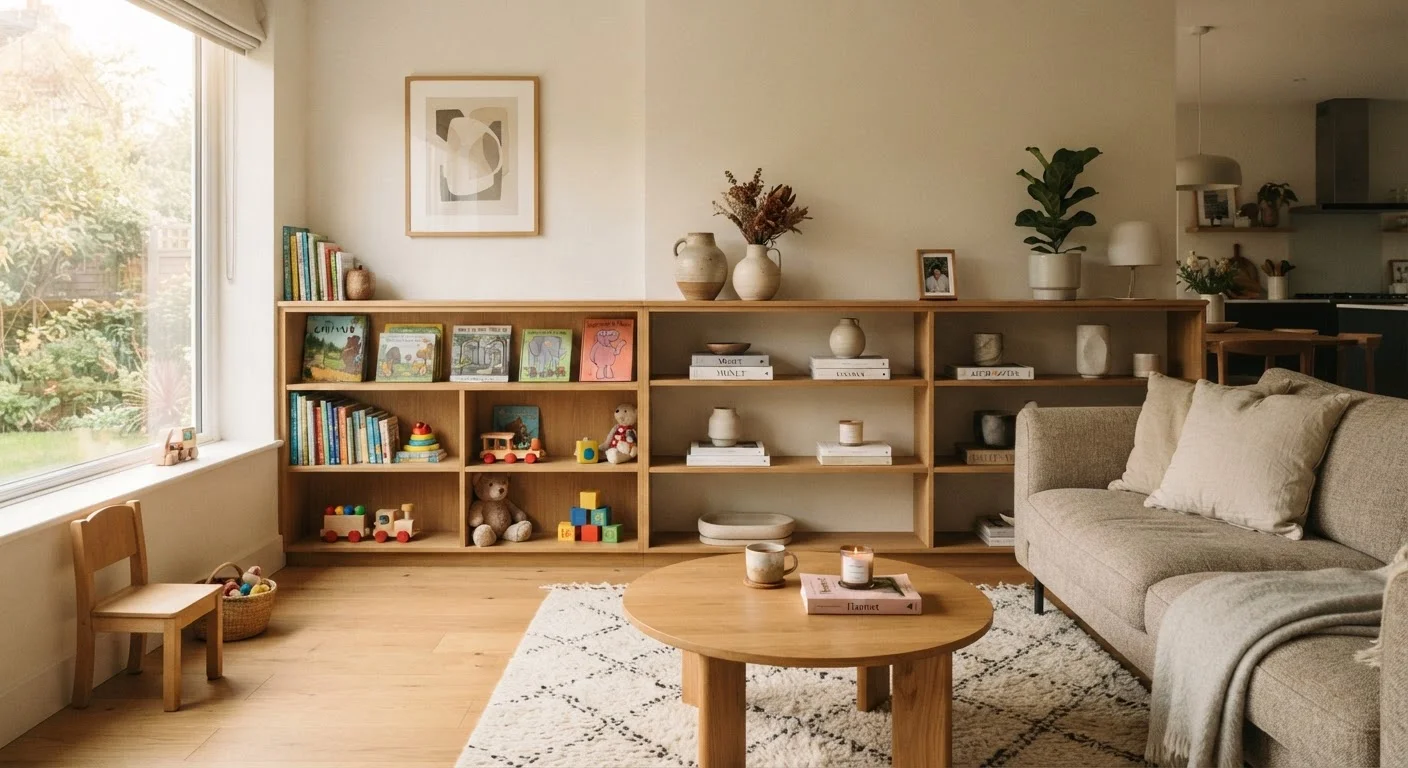
At this stage, durability and accessibility matter most. Low, open bins that children can reach and return items to independently are more effective than high shelves or lidded boxes that require adult assistance. Rotating toys (keeping only a portion accessible and storing the rest) can significantly reduce visible clutter without requiring a larger home.
Paper management becomes a distinct challenge in family homes. A simple weekly habit of sorting school papers at a fixed location — discarding, acting on, or filing — prevents the piles that otherwise accumulate on counters and tables. See our room-by-room home organization guide for strategies covering every major living space.
Low, open bins that children can use independently outperform adult-designed storage in family homes.
Mid-Life and Growing Households: Scaling Up Without Chaos
As households grow and careers develop, homes often accumulate more — more people, more hobbies, more equipment, more commitments. Mid-life organization tends to suffer not from a lack of storage, but from a lack of clear categories and consistent return habits.
This is the stage where dedicated zones become essential: a specific entry area for bags and keys, a homework station separate from the adult workspace, a designated place for sports or hobby gear. Without clear zones, items migrate to flat surfaces — counters, tables, stairs — and the house feels perpetually unsettled.
It's also worth auditing storage every six to twelve months. Children's clothing and gear turn over quickly, and keeping outgrown items "just in case" tends to consume valuable space that current-use items need.
In growing households, clear zones matter more than total storage — items migrate when no zone exists.
Empty Nest and Pre-Retirement: Rightsizing the Home
When children leave and household size shrinks, many homes are suddenly overstocked for the number of people using them. Rooms designed for children sit unused; kitchen storage reflects cooking for six rather than two; attics and garages hold decades of accumulated possessions that no longer serve any active purpose.
The organizing priority at this stage shifts from managing active chaos to rightsizing — intentionally reducing total volume to match the life you're actually living. This is a gradual process that benefits from a room-by-room approach rather than a single overwhelming purge.
Repurposing rooms is a significant opportunity: a former child's bedroom might become a dedicated hobby room, home office, or guest space — but that repurposing works best when it's deliberate rather than defaulting to storage overflow. This life stage also tends to intersect with broader questions about how life patterns are shifting; research on evolving adult milestones reflects how these transitions vary widely from person to person.
Empty nesters benefit from rightsizing possessions to match actual household use, not former family size.
Later Life: Accessibility and Low-Maintenance Systems
As physical mobility and energy levels change, organization priorities shift again toward accessibility and ease of maintenance. Systems that require bending, climbing, or significant physical effort become barriers rather than solutions.
Practical adjustments include moving frequently used items to between-waist-and-shoulder height, replacing heavy storage containers with lighter alternatives, and reducing the total number of possessions to a level that can be managed comfortably without assistance. Drawer organizers, pull-out shelves, and clear-front storage reduce the effort of finding items without requiring reorganization.
Low-maintenance systems — ones that are easy to restore after disruption — matter more than elaborate organizational structures. A home that can be kept tidy with minimal effort is a significant contributor to daily comfort and independence.
Accessibility and low-maintenance design matter most when physical effort and energy reserves change.
Adapting as Life Keeps Changing
No organization system should be permanent. Life stages rarely announce themselves with clear boundaries — they arrive gradually through accumulating changes in how you use your space. The most resilient approach is to do a light audit of your home at least once a year, asking a simple question: does this setup reflect how we actually live right now?
If you're navigating a shared household where different people have different tidiness standards, our guide to organizing when everyone has different habits offers practical strategies for building systems that work across multiple preferences. And if a previous approach left you with more storage containers than clarity, it may be worth reviewing common organization myths before investing in new solutions.
The goal isn't a perfect home — it's a functional one that supports the life you're living today, not the life you had five years ago or plan to have five years from now.
Schedule a Brief Annual Home Audit
Set aside an hour once a year to walk through each room and ask whether your current storage setup reflects how the space is actually being used. Life changes gradually, and small mismatches accumulate before they become obvious problems. Catching them early — before a room becomes a default dumping ground — saves significantly more time than a reactive overhaul later.