Why Time, Not Willpower, Is the Real Barrier
Most people who struggle to eat well during busy periods aren't lacking motivation — they're lacking margin. When the gap between work, family obligations, and rest narrows to almost nothing, food decisions default to whatever requires the least effort. That's not a character flaw; it's a predictable response to cognitive overload.
Nutrition research consistently shows that environmental design shapes eating behavior far more reliably than intention alone. In other words, what's convenient is what gets eaten. The practical implication: rather than relying on discipline after a long day, the more effective strategy is reducing the number of decisions required in the first place.
This framing shifts healthy eating from a daily act of willpower into a system you build once and benefit from repeatedly. The strategies below are grounded in that principle — low daily effort, high cumulative return.
Best Practices for Eating Well When Time Is Short
These approaches are designed to work within real constraints — no elaborate meal plans, no specialized equipment required. Consistency with a few of these will do more for your nutritional quality than periodic all-in overhauls.
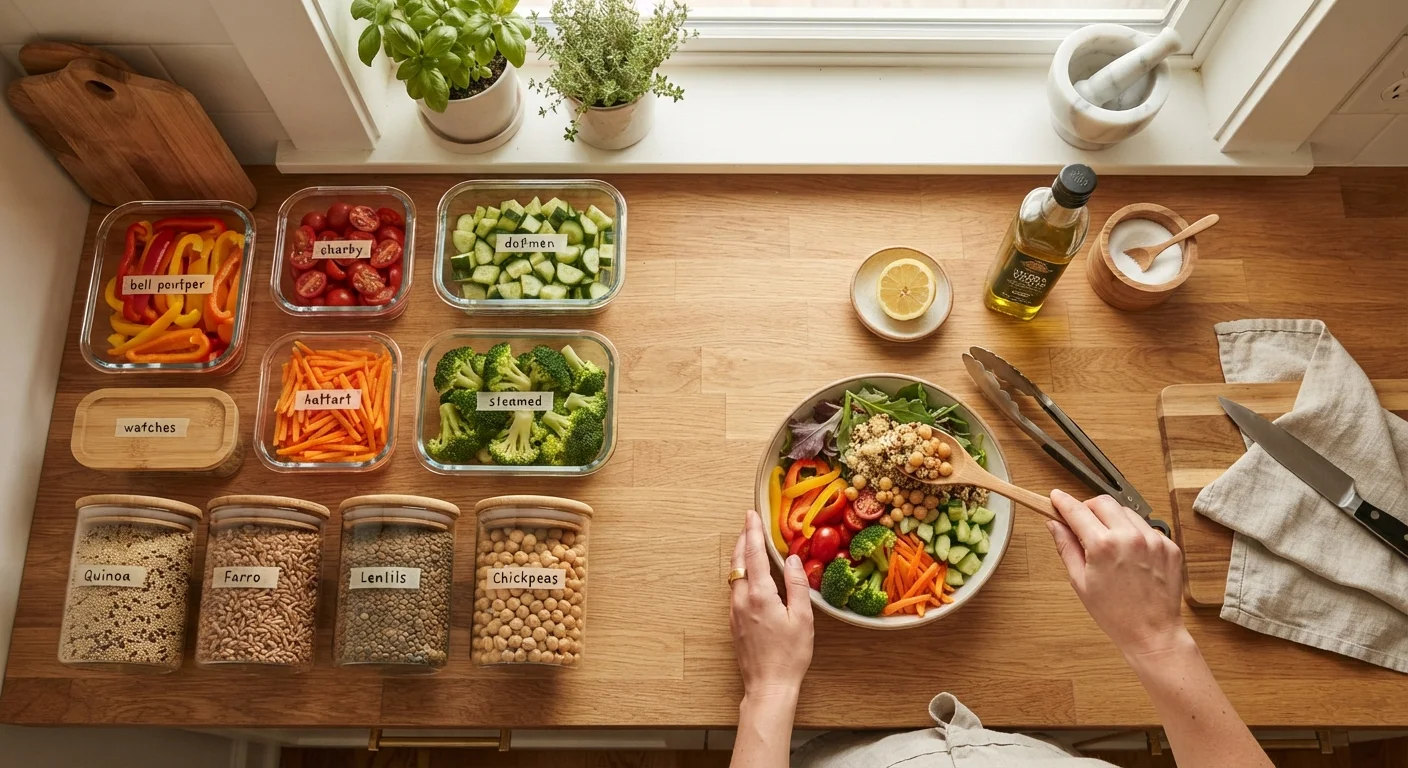
Cook a small set of versatile base ingredients once or twice a week rather than full meals.
Preparing complete meals in advance often creates decision fatigue about what to make and when to eat it. Cooking flexible components — a grain, a protein, a roasted vegetable — lets you assemble varied meals quickly without the monotony. This approach also reduces food waste because components can be mixed differently each day.
Keep frozen vegetables and canned legumes as permanent pantry staples.
Frozen vegetables are typically harvested and frozen at peak ripeness, preserving most of their nutritional value. Canned legumes — lentils, chickpeas, black beans — are high in fiber and plant protein and require no cooking. Together, these two categories can form the nutritional backbone of a fast, balanced meal. Understanding the nutritional trade-offs between plant-based and omnivorous eating can help you decide how to balance these staples with other protein sources.
Anchor each meal around a protein source and a fiber-rich food.
Protein and dietary fiber are the two dietary factors most consistently linked to sustained fullness and stable energy between meals, according to general nutritional guidance. Choosing meals that include at least one of each reduces the likelihood of energy dips that drive unplanned snacking on lower-nutrient foods. This doesn't require calorie counting — it's a structural heuristic that simplifies decision-making.
Organize your kitchen so nutritious options are the easiest to reach.
Behavioral research suggests that visibility and accessibility strongly predict food choices — if the first thing you see when opening the refrigerator is cut vegetables or fruit, those foods get eaten more frequently. Conversely, foods stored inconveniently are consistently underutilized. Spending 15 minutes rearranging your kitchen can yield nutritional dividends far exceeding the time invested. The kitchen organization habits that hold up over time article covers the broader principles of maintaining a functional kitchen with minimal ongoing effort.
Use meal timing patterns that fit your schedule rather than forcing a conventional structure.
There is no universally correct number of meals per day. What matters for most adults is total nutritional quality over the course of a day, not adherence to a specific meal frequency. If your schedule makes a traditional three-meal structure impractical, working with your natural rhythm — rather than fighting it — tends to produce more consistent results. What nutrition research actually says about meal timing is a useful reference for understanding where the evidence is solid and where it remains uncertain.
For a structured way to evaluate whether your week's eating is covering the nutritional bases, the practical weekly eating checklist offers a useful audit framework.
Quick Wins You Can Start This Week
Not every improvement requires a full system rebuild. These high-leverage moves can improve your nutritional baseline without a significant time investment.
It's also worth noting that what you eat pairs with how you move and recover. The Fitness & Movement hub and Mental Wellbeing hub cover the complementary pillars of daily health if you're looking to extend these habits further.
This article is for general informational and educational purposes only and is not a substitute for personalized nutrition or medical advice. Consult a qualified healthcare professional or registered dietitian for guidance specific to your health needs.