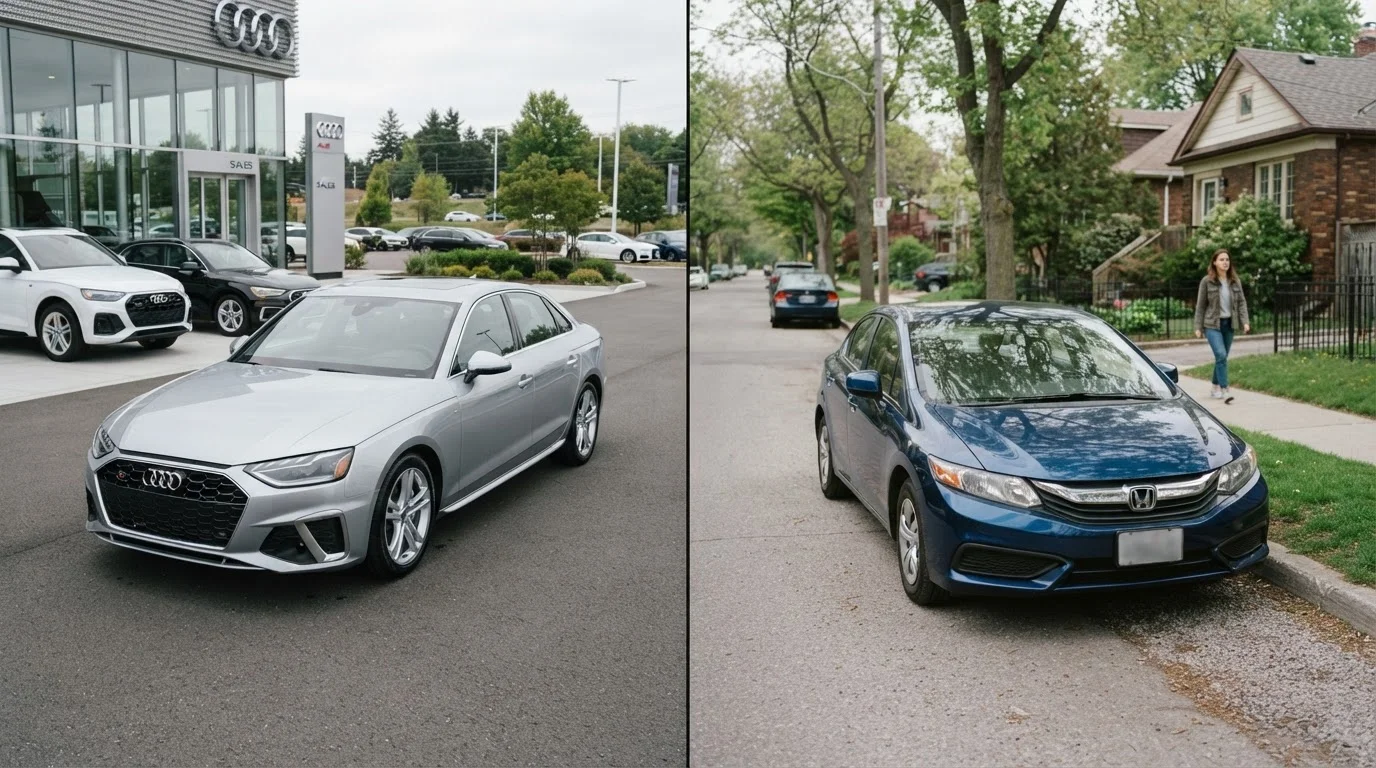
Depreciation: Where New Cars Take the Hardest Hit
Depreciation is consistently the largest single cost of car ownership, yet it rarely appears in the monthly payment conversation at a dealership. New vehicles typically lose between 15% and 25% of their value within the first 12 months of ownership, and roughly 50% within the first five years — though actual figures vary by make, model, and market conditions. For a $40,000 vehicle, that first-year loss alone could represent $6,000–$10,000 walking out the door.
Used cars, by contrast, have already absorbed much of that curve. A vehicle that is two to four years old has shed its steepest depreciation, meaning the buyer sidesteps a significant paper loss. If you plan to sell or trade in within a few years, this matters enormously. Understanding how depreciation works before you sign any purchase agreement is essential to making an accurate comparison.
The practical implication: if you intend to own a vehicle for ten or more years, the depreciation gap between new and used narrows considerably, since both will have low residual value at that horizon. Shorter ownership windows favor used.
Financing Rates: The Counterintuitive Advantage of New Cars
One cost that surprises many buyers: used car loans generally carry higher interest rates than new car loans. Lenders view used vehicles as higher-risk collateral because they're harder to value precisely and depreciate less predictably. According to Federal Reserve data, the average interest rate on a used car loan has historically run one to three percentage points above new car rates, though this gap fluctuates with broader credit market conditions.
Manufacturers also periodically offer promotional financing on new vehicles — sometimes as low as 0% APR for qualified buyers — which is never available on used car purchases. On a five-year, $30,000 loan, even a 2-percentage-point rate difference can add up to roughly $1,500–$2,000 in additional interest paid on a used vehicle, partially offsetting the lower purchase price.
If you're comparing financing options, understanding how dealer and bank financing compare can help you secure better terms regardless of which type of vehicle you choose.
| New Car | Used Car (2–4 Years Old) | Certified Pre-Owned | |
|---|---|---|---|
| Depreciation risk | Highest — steepest in year one | Lower — curve already absorbed | Moderate — some curve remains |
| Typical loan interest rate | Lower; promo rates possible | Higher by 1–3 percentage points | Varies; often similar to used |
| Warranty coverage | Full factory warranty | None or partial remaining | Extended warranty included |
| Insurance cost | Higher replacement value | Lower on older models | Moderate — newer used vehicle |
| Short-term maintenance risk | Low — under warranty | Moderate — history unknown | Low — factory reconditioned |
| Purchase price | Highest | Lowest | Moderate premium over used |
| Sales tax liability | Higher — based on full price | Lower — reduced purchase price | Moderate |
Warranty, Reliability, and the Hidden Maintenance Equation
New cars come with manufacturer warranties — typically a 3-year/36,000-mile bumper-to-bumper and a 5-year/60,000-mile powertrain warranty on most mainstream brands. That coverage materially reduces financial risk from mechanical failure during the ownership period. Used vehicles may have no remaining warranty at all, or only a partial powertrain warranty if purchased within the original term.
Certified Pre-Owned (CPO) programs offer a middle path: factory-reconditioned used vehicles with extended warranty coverage, often adding two or more years beyond the original manufacturer warranty. CPO vehicles carry a price premium over standard used cars, but that premium may be worth it for buyers who want protection without a new-car price tag.
On maintenance, the math often favors new cars in the short term. Older vehicles may require more frequent repairs, and parts for discontinued or high-mileage models can be expensive. However, used vehicles in the 3–6 year age range — if well-maintained and with a clean vehicle history report — typically still fall within a relatively low-cost maintenance window. Always obtain a pre-purchase inspection from an independent, qualified mechanic before buying any used vehicle. Hidden ownership costs like registration fees, inspection costs, and unexpected repairs hit used-car buyers with less warning.
Insurance, Taxes, and the Full Ownership Picture
Insurance premiums are generally higher on new vehicles because their replacement cost is greater. Comprehensive and collision coverage on a new car will cost more than on a three-year-old equivalent model, all else equal. Conversely, if a used vehicle is older, some owners choose to drop comprehensive coverage, reducing premiums — though that decision carries its own risk calculus.
Sales tax is calculated on the purchase price, so a used vehicle with a lower price tag also generates a lower tax bill at the point of sale. Registration fees in many states are tied to vehicle value or model year, again favoring used vehicles in the early years of ownership.
When you run the full numbers — depreciation, financing cost, insurance, taxes, maintenance, and fuel efficiency (newer vehicles often have better fuel economy or electrification options) — the picture becomes considerably more complex than sticker price suggests. Calculating the true annual cost of ownership is the most reliable way to make this comparison for your specific situation. Drivers who plan carefully before purchase are consistently better positioned to avoid financial strain down the road — see the financial case for total cost of ownership planning for a structured approach.
This article provides general financial information for educational purposes only and is not personalized financial or purchasing advice. Consult a qualified financial professional for guidance suited to your individual circumstances.