How Each Financing Route Actually Works
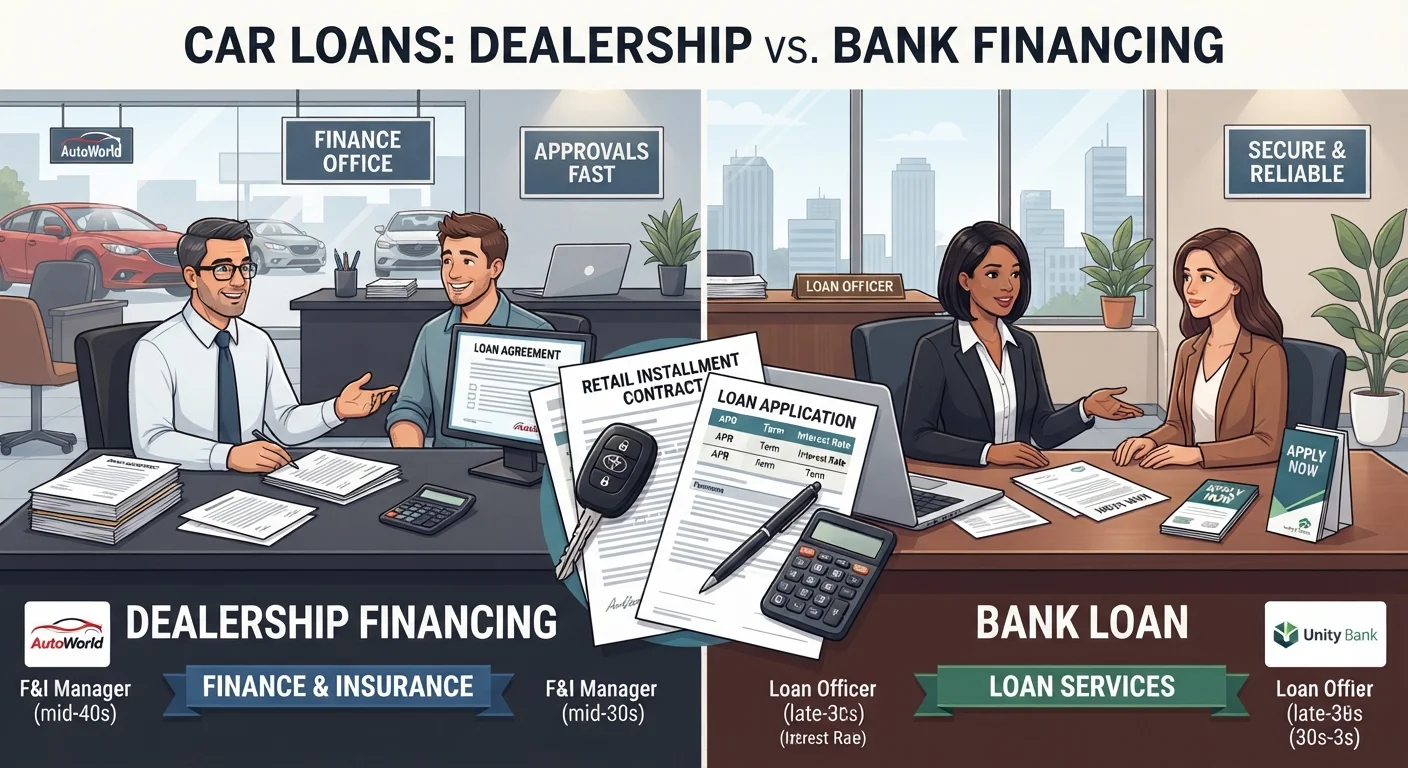
When you finance through a dealership, you're typically not borrowing directly from the dealer. Instead, the dealer submits your application to one or more third-party lenders — banks, captive finance arms owned by manufacturers, or other institutions — and presents you with an offer. The dealer often has the ability to mark up the rate above what the lender actually requires, pocketing the difference as additional revenue. This markup is legal and common, though federal consumer protection guidance has addressed disclosure practices around it.
A bank or credit union loan works differently. You approach the lender directly, receive a pre-approval or firm offer, and arrive at the dealership already knowing your rate and maximum loan amount. The car negotiation and the financing negotiation remain separate — a structural advantage that many buyers underestimate.
Before comparing numbers, it's worth getting familiar with the core vocabulary involved. Our guide to car finance terminology covers APR, loan term, and related concepts in plain language.
Where the Numbers Diverge
The most important figure in any auto loan is the Annual Percentage Rate (APR) — the true yearly cost of borrowing, expressed as a percentage. Even a seemingly small difference in APR compounds significantly over a multi-year loan term.
Consider a simplified example: on a $30,000 loan over 60 months, the difference between a 5.9% APR and a 7.4% APR amounts to roughly $1,300 in additional interest paid over the life of the loan. That gap is well within the range of what a dealer markup could add.
| Criterion | Dealer Financing | Bank / Credit Union Loan |
|---|---|---|
| Rate transparency | Rate revealed at point of sale | Rate confirmed before dealership visit |
| Potential for rate markup | Yes — dealer may add margin | No — you borrow directly from lender |
| Manufacturer incentive rates | Available through captive lenders | Not available |
| Application process | Handled at dealership | Applied for independently in advance |
| Negotiating leverage | Lower — financing and price discussed together | Higher — loan is already confirmed |
| Credit union access | Not directly | Yes, with membership eligibility |
| Speed to drive away | Fast — same-day common | Requires advance planning |
Manufacturer-subsidised rates represent a genuine exception. When an automaker's captive lender offers 0% or sub-2% financing as a sales incentive, those rates are typically unavailable anywhere else. However, they usually require strong credit scores and may not be combinable with other rebates. Confirming the full terms before committing is essential.
Your credit score shapes what either channel will offer you. Understanding what feeds into that score helps explain why two buyers sitting in the same dealership can receive very different rate quotes. See our explainer on what credit scores actually reflect for a deeper look.
The Hidden Leverage in Pre-Approval
Arriving at a dealership with a bank pre-approval in hand changes the dynamic of the entire conversation. You know your ceiling rate. If the dealer can beat it — perhaps through a manufacturer promotion — you take that deal. If they can't, you use your pre-approval. Either way, you've introduced competition into the process.
Without pre-approval, buyers often negotiate the car price and the financing simultaneously, making it easier for the monthly payment figure to obscure the true cost of borrowing. A lower monthly payment that results from stretching the loan term to 72 or 84 months can mean paying thousands more in interest overall compared with a shorter-term loan at the same rate.
Monthly Payment vs. Total Cost
A lower monthly payment is not automatically a better deal. Extending a loan from 60 to 72 months on the same balance and rate adds a full year of interest charges. Always calculate the total amount repaid over the full loan term, not just the monthly figure, before comparing offers. Lenders are required by federal law to disclose the total of payments, so that number will appear in any formal loan agreement.
This connects to broader debt management principles. The loan you choose for a vehicle becomes part of your overall debt picture — something worth weighing alongside savings goals. Our piece on balancing debt repayment with saving addresses how to think through that trade-off.
Making the Right Call for Your Situation
Neither route is universally superior. Dealer financing wins when manufacturer incentive rates are genuinely exceptional and you meet the qualification criteria. Independent bank or credit union financing wins when you want transparency, competitive rate comparison, and clear separation between the purchase negotiation and the loan.
A practical approach: gather at least one pre-approval from a bank or credit union before visiting any dealership. Use that figure as your reference point. Then let the dealer's finance office make their case. If they offer something better, take it. If they don't, you already have a confirmed fallback.
If you're also weighing whether to finance at all versus other arrangements, our comparison of buying vs. leasing over time lays out how those total costs differ. And if the vehicle type — new or used — is still an open question, new vs. used car financial trade-offs walks through how financing rates typically differ between the two.
This article provides general financial information for educational purposes only and does not constitute personalised financial or lending advice. Consult a qualified financial professional before making borrowing decisions specific to your circumstances.