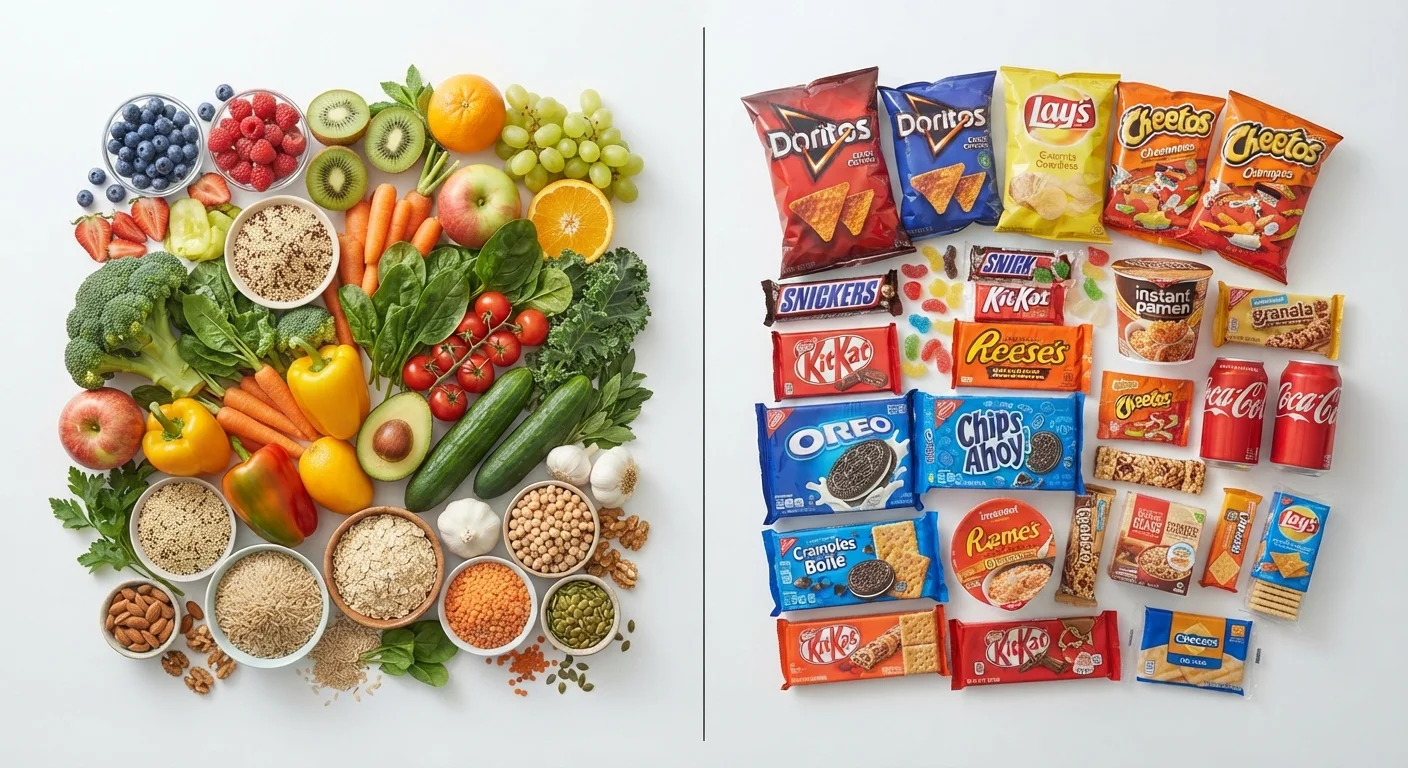
Defining the Terms: What Makes a Food 'Whole' or 'Processed'?
The word whole food refers to any food eaten in — or very close to — its natural form. Think of a raw apple, a handful of almonds, a piece of salmon, or a bowl of steel-cut oats. These foods have not undergone significant industrial transformation. Their fiber, vitamins, minerals, and naturally occurring compounds remain largely intact.
Processed food is a broader and more layered category. By the strictest definition, almost all food is processed to some degree: grinding wheat into flour, pasteurizing milk, or freezing vegetables all constitute forms of processing. What nutrition researchers typically flag as a concern is a subset called ultra-processed foods — products manufactured with industrial ingredients, additives, colorings, emulsifiers, and flavor enhancers that have no home-kitchen equivalent. Examples include packaged snack cakes, flavored chips, instant noodles, and many fast-food items.
A widely used classification system developed by researchers at the University of São Paulo — known as NOVA — organizes foods into four groups ranging from unprocessed to ultra-processed. This framework has become a common reference point in nutrition epidemiology, though it is worth noting it is a research tool, not a regulatory standard. Understanding where a food sits on this spectrum is more useful than applying a simple good-or-bad label.
The Nutritional Gap: What Processing Changes
When foods undergo heavy processing, several things can happen to their nutritional profile. Refining grains, for example, removes the bran and germ — the parts of the grain that carry most of the fiber, B vitamins, and minerals like iron and magnesium. What remains is largely starch. Some nutrients are added back through enrichment, but the full matrix of naturally occurring compounds is not fully restored.
Ultra-processed products are also frequently formulated with high levels of added sugars, sodium, and refined fats to enhance palatability and extend shelf life. These additions are not inherently toxic in small amounts, but consistent overconsumption is associated with patterns of intake that exceed established dietary guidance for these nutrients. For a closer look at how dietary fats fit into this picture, see a breakdown of saturated, unsaturated, and trans fats.
Whole foods, by contrast, deliver nutrients in what researchers sometimes call a food matrix — a complex physical and chemical structure in which fiber, water, proteins, and micronutrients interact. This matrix affects how quickly nutrients are digested and absorbed. For instance, eating an orange delivers fiber alongside its natural sugars, slowing absorption in a way that drinking a sugar-sweetened beverage does not replicate. Understanding what carbohydrates, proteins, and fats actually do helps put these structural differences into practical context.
| Criterion | Whole Foods | Processed Foods |
|---|---|---|
| Fiber content | High — naturally intact | Often reduced or absent |
| Added sugar | None (natural sugars only) | Frequently high, especially ultra-processed |
| Sodium levels | Naturally low | Often elevated for flavor/preservation |
| Micronutrient density | High — vitamins and minerals intact | Variable; some nutrients lost, some added back |
| Artificial additives | None | Common in ultra-processed products |
| Shelf life | Short — requires refrigeration or prompt use | Long — engineered for stability |
| Preparation time | Moderate to high | Low — ready-to-eat or quick to prepare |
| Cost | Varies; staples (oats, legumes) are affordable | Varies; often low upfront, but nutrient value may be lower |
What Research Suggests About Ultra-Processed Diets
A growing body of observational research links high ultra-processed food consumption with increased risk of several chronic conditions, including obesity, type 2 diabetes, and cardiovascular disease. A frequently cited 2019 cohort study published in JAMA Internal Medicine found an association between greater ultra-processed food intake and higher all-cause mortality risk. It is important to note that most of this evidence is observational — it identifies associations, not direct causation — and dietary patterns are notoriously difficult to isolate from other lifestyle factors.
That said, the consistency of findings across multiple large studies in different countries has led major nutrition bodies, including the American Heart Association, to recommend limiting ultra-processed food intake as part of a heart-healthy dietary pattern. Emerging research is also examining possible links between certain food additives — such as some emulsifiers — and gut microbiome health, though this work is still early-stage.
57%
Share of American daily calories from ultra-processed foods
A nationally representative study published in BMJ Open (2016) estimated that ultra-processed foods accounted for approximately 57.9% of energy intake in the U.S. diet.
14%
Higher all-cause mortality risk linked to ultra-processed intake
A 2019 prospective cohort study in JAMA Internal Medicine found a 14% higher risk of all-cause mortality associated with each 10-percentage-point increase in ultra-processed food consumption.
10x
More fiber in whole grains vs. refined grains
Whole grains like oats and brown rice can contain up to ten times more dietary fiber per serving than their refined counterparts, according to USDA nutritional data.
None of this means every processed food is nutritionally problematic. Canned tomatoes, frozen edamame, plain Greek yogurt, and whole-grain bread with a short ingredient list are all technically processed — and all can be part of a nutritious diet. The key is learning to distinguish minimally processed convenience foods from ultra-processed products, which is a skill that starts with reading labels. Learning to decode a nutrition label is one of the most practical steps toward making this distinction routine.
Building a Practical Approach: Whole Foods First, Without Rigidity
Dietary quality is not an all-or-nothing equation. Most public health nutrition guidance — including the Dietary Guidelines for Americans — does not recommend eliminating processed foods entirely. Instead, the emphasis is on making whole or minimally processed foods the foundation of daily eating, while treating highly processed items as occasional rather than staple choices.
A few practical principles that align with current evidence:
- Anchor meals around whole food ingredients. Building meals from vegetables, legumes, whole grains, eggs, fish, or lean meats naturally crowds out ultra-processed options without requiring rigid elimination.
- Use minimally processed foods strategically. Frozen vegetables, canned beans (rinsed to reduce sodium), plain oats, and unsweetened dairy or plant-based alternatives offer convenience without significant nutritional compromise.
- Read ingredient lists, not just nutrition facts. A short ingredient list of recognizable items typically signals lower processing. A long list featuring additives, hydrogenated oils, or multiple forms of sugar signals the opposite.
- Avoid all-or-nothing thinking. Stress, budget constraints, and time pressures are real. A diet that is 80–90% whole and minimally processed foods, with room for flexibility, is more sustainable — and likely more beneficial — than an unsustainable perfection standard.
For readers interested in how these principles apply across different eating philosophies, a comparison of plant-based and omnivorous dietary patterns offers useful context. Similarly, comparing protein sources across animal and plant foods can help round out food selection across a whole-foods-centered approach.
This article is for general informational and educational purposes only and is not a substitute for personalized medical or dietary advice. Consult a registered dietitian or qualified healthcare professional for guidance tailored to your individual health circumstances.