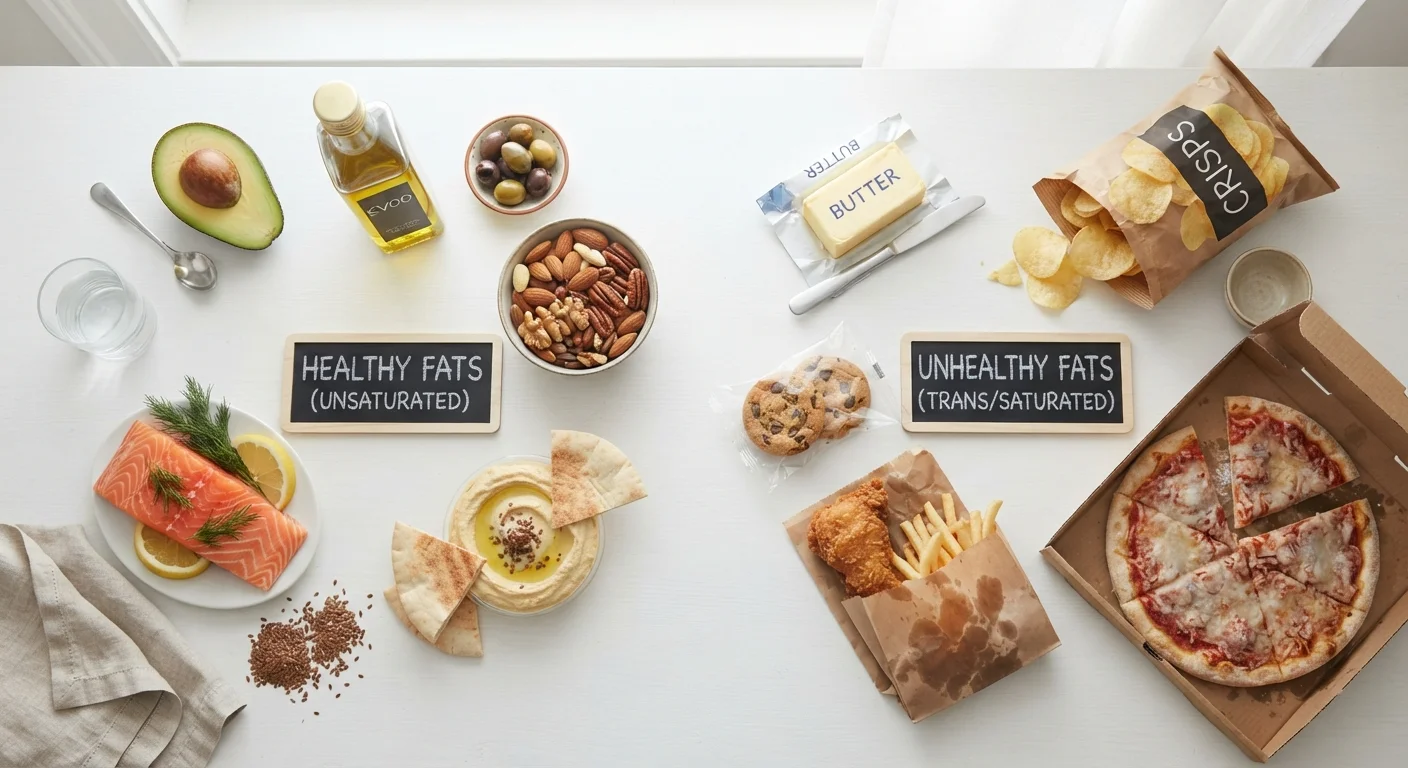
Why Dietary Fat Still Gets Misunderstood
For decades, dietary fat was treated as the enemy of good health. Low-fat product lines flooded grocery store shelves, and the word "fat" itself became shorthand for something to avoid. The science has since grown considerably more nuanced. Fat is an essential macronutrient — it supports cell membrane integrity, hormone production, fat-soluble vitamin absorption (vitamins A, D, E, and K), and sustained energy. The more useful question isn't how much fat you eat, but what kinds.
There are three broad categories of dietary fat worth understanding: saturated, unsaturated, and trans fats. Each has a distinct chemical structure, behaves differently in the body, and carries different implications for cardiovascular health. For a broader look at how fat fits alongside carbohydrates and protein, see Macronutrients Explained.
Saturated fat
A type of dietary fat whose carbon chains are fully saturated with hydrogen atoms, making it solid at room temperature. Found mainly in animal products and some tropical oils, it is associated with elevated LDL cholesterol when consumed in excess.
Unsaturated fat
A fat containing one or more double bonds in its carbon chain, making it liquid at room temperature. Includes monounsaturated and polyunsaturated varieties, both generally considered more favorable for cardiovascular health than saturated fat.
Trans fat
A fat formed when liquid vegetable oils are partially hydrogenated. Industrially produced trans fats raise LDL and lower HDL cholesterol and have been phased out of U.S. food manufacturing due to their well-documented cardiovascular risks.
LDL cholesterol
Low-density lipoprotein cholesterol, commonly called "bad" cholesterol. Elevated LDL levels are associated with a greater risk of plaque buildup in arteries and cardiovascular disease.
HDL cholesterol
High-density lipoprotein cholesterol, often called "good" cholesterol. Higher HDL levels are generally associated with a lower risk of cardiovascular disease.
Omega-3 fatty acids
A class of polyunsaturated fats essential for human health that the body cannot produce on its own. Found in fatty fish, walnuts, and flaxseed, omega-3s are well-studied for anti-inflammatory and cardiovascular benefits.
Partially hydrogenated oil
An industrially processed oil created by adding hydrogen to liquid vegetable oil, producing artificial trans fats. It appears in ingredient lists and is the key marker to watch for when checking for trans fat content.
Saturated Fat: The Nuanced Middle Ground
Saturated fats are named for their chemical structure — their carbon chains are fully "saturated" with hydrogen atoms, which makes them solid at room temperature. Common sources include red meat, full-fat dairy products (butter, cheese, whole milk), coconut oil, and palm oil.
For many years, saturated fat was directly linked to elevated LDL cholesterol (often called "bad" cholesterol) and increased cardiovascular disease risk. That association still holds in mainstream dietary guidelines, but researchers have noted that the picture is more complex. Not all saturated fatty acids behave identically, and what you replace saturated fat with matters as much as the reduction itself. Swapping saturated fat for refined carbohydrates, for instance, may not deliver the heart-health benefit that replacing it with unsaturated fat does.
Current guidance from major public health organizations generally recommends limiting saturated fat to less than 10% of total daily calories, though individuals with existing cardiovascular conditions should discuss personalized targets with a qualified healthcare provider.
| Calories per gram of fat | 9 kcal (Consistent across all fat types) |
| Recommended saturated fat limit | Less than 10% of daily calories (U.S. Dietary Guidelines for Americans) |
| Industrially produced trans fat status in the U.S. | Phased out of manufacturing (FDA ruling, effective 2020) |
| Fat-soluble vitamins requiring dietary fat for absorption | A, D, E, and K |
| Main omega-3 food sources | Fatty fish, walnuts, flaxseed |
| State of saturated fat at room temperature | Solid (Due to fully saturated carbon chains) |
Unsaturated Fat: The Well-Supported Category
Unsaturated fats contain one or more double bonds in their carbon chains, making them liquid at room temperature. They fall into two subcategories:
- Monounsaturated fats (MUFAs) — found in olive oil, avocados, and many nuts. Research consistently associates these with improvements in LDL cholesterol levels and overall cardiovascular markers when they replace saturated fat in the diet.
- Polyunsaturated fats (PUFAs) — include omega-3 and omega-6 fatty acids. Omega-3s, found in fatty fish (such as salmon and mackerel), walnuts, and flaxseed, are particularly well-studied for their anti-inflammatory properties and cardiovascular benefits. Omega-6s are abundant in vegetable oils and processed foods; while essential, the typical American diet tends to supply them in far greater proportion than omega-3s.
When navigating packaged foods, knowing how to read a nutrition label helps you identify where these fats appear. Reading a Nutrition Label Without Getting Confused provides a practical walkthrough of that skill.
Trans Fats: A Clear Scientific Consensus
Trans fats come in two forms. Small amounts occur naturally in some animal products, but the form that drew the most concern was industrially produced trans fat — created by partially hydrogenating vegetable oils to extend shelf life and stabilize texture in processed foods like baked goods, fried foods, and margarine.
The scientific consensus on artificial trans fats is unusually clear: they raise LDL cholesterol, lower HDL cholesterol (often called "good" cholesterol), and are associated with increased inflammation and cardiovascular disease risk. In response, the U.S. Food and Drug Administration determined that partially hydrogenated oils are no longer generally recognized as safe, and their use in U.S. food manufacturing has been effectively phased out.
Despite this, trace amounts can still appear in some products. On a nutrition label, look for "partially hydrogenated oil" in the ingredient list — a product can legally list 0 grams of trans fat per serving if it contains less than 0.5 grams, so the ingredient list remains the more reliable check. Pairing this awareness with a broader understanding of whole versus processed foods provides useful context — see Whole Foods vs. Processed Foods for more.
This article is for general informational and educational purposes only and does not constitute medical or nutritional advice. Consult a qualified healthcare professional before making significant changes to your diet, particularly if you have an existing health condition.