Why These Two Numbers Matter More Than Most Drivers Realise
Tyres are the only part of your vehicle in contact with the road surface. Everything your car does — accelerating, braking, cornering — depends on four contact patches roughly the size of a human hand. The condition of those patches is determined almost entirely by two figures: tyre pressure (measured in PSI, or pounds per square inch) and tread depth (measured in 32nds of an inch in the US).
Under-inflated tyres generate excess heat, degrade handling, increase stopping distances, and wear unevenly. Over-inflated tyres reduce the contact patch, making the ride harsher and the tyre more vulnerable to impact damage. Either condition also hurts fuel economy. According to the US Department of Energy, tyres under-inflated by just 1 PSI per tyre can reduce fuel efficiency by approximately 0.2%. Multiply that across four tyres and the effect adds up quickly.
Tread depth affects how well tyres channel water away from the contact patch. As depth decreases, the risk of hydroplaning — where a film of water lifts the tyre off the road entirely — rises sharply. Worn tyres also take noticeably longer to stop in both wet and dry conditions.
If your dashboard has already flagged a low-pressure warning, see our guide on what dashboard warning lights are actually telling you for context on when to act immediately versus monitoring the situation.
What you will need
What You Need Before You Start
Both checks are straightforward and require only basic tools. Gather these before you begin, and perform the pressure check when tyres are cold — meaning the vehicle has been parked for at least three hours or driven fewer than one mile. Tyre pressure rises as the rubber heats up during driving, which can give a falsely high reading.
Tyre pressure gauge
Measures the current air pressure inside each tyre in PSI for an accurate reading.
Air compressor or tyre inflator
Adds air to under-inflated tyres; most petrol stations have a coin- or card-operated unit.
Tread depth gauge
Provides a precise tread depth reading in 32nds of an inch across the tyre surface.
Penny and quarter coins
Used as quick visual references for estimating tread depth when a gauge is unavailable.
Vehicle owner's manual
Contains the manufacturer's recommended tyre pressure for front, rear, and spare tyres.
How to Check and Adjust Tyre Pressure
Follow these steps in order. The entire process for all four tyres typically takes under ten minutes once you locate your recommended PSI.
Find your vehicle's recommended tyre pressure
Open the driver's door and look for the tyre placard sticker on the door jamb or door edge. It lists the recommended cold inflation pressure in PSI for the front tyres, rear tyres, and often the spare. If the sticker is missing or illegible, the same information is in your owner's manual. Note that front and rear recommendations sometimes differ.
Remove the valve cap and seat the gauge
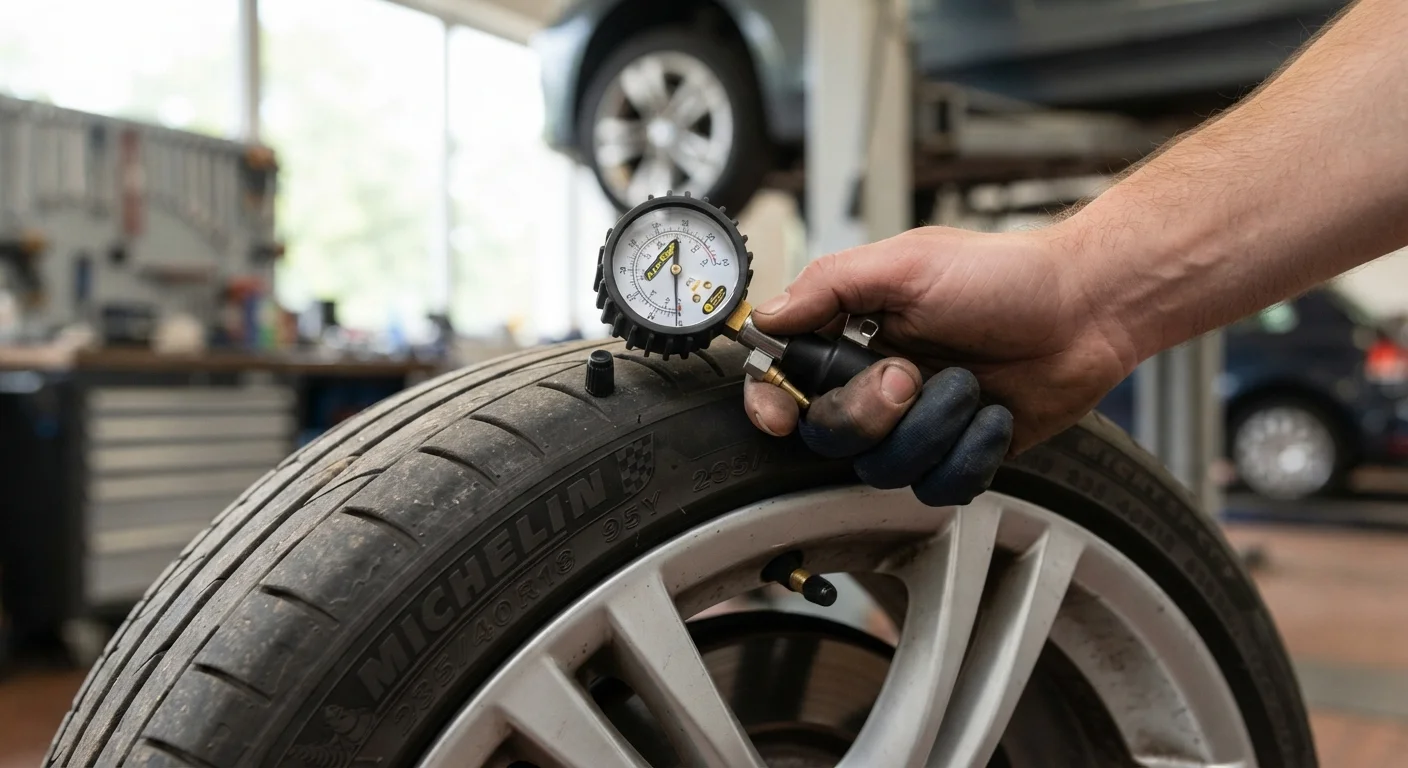
Locate the valve stem on the wheel — a short rubber or metal protrusion. Unscrew the small cap and keep it somewhere you won't lose it. Press the gauge firmly and squarely onto the valve stem. A hissing sound means the seal isn't airtight; reposition and press again until the hiss stops and you get a stable reading.
Read and record the pressure
Note the PSI shown on the gauge. Compare it to the recommended figure from Step 1. Write down the reading for each tyre so you can add or release air precisely. Repeat for all four tyres plus the spare.
Add or release air as needed
If a tyre is under the recommended PSI, attach the air compressor nozzle to the valve stem and add air in short bursts, re-checking with the gauge after each burst. If a tyre is over-inflated, use the small pin on the back of most gauges (or the nozzle on the compressor) to depress the valve centre and release air in small increments, checking frequently.
Replace the valve caps
Once all tyres are at the correct pressure, replace the valve caps finger-tight. Caps keep dirt and moisture out of the valve mechanism — losing them may seem minor, but they do serve a functional purpose. Replace any caps that are cracked or missing.
How to Check Tread Depth — and Know When to Replace
Tread depth decreases gradually, so it rarely feels dramatic until conditions become dangerous. Checking it takes less than two minutes per tyre.
The penny test: Insert a penny into the tread groove with Lincoln's head pointing down into the tyre. If you can see the top of Lincoln's head, the tread is at or below 2/32 inch — the US legal minimum. The tyre should be replaced.
The quarter test: Use a quarter in the same way with Washington's head pointing down. If you can see the top of Washington's head, you're at approximately 4/32 inch — the threshold most tyre safety organisations recommend for replacement, as wet-weather performance degrades measurably below this point.
Tread wear indicators: Modern tyres have small raised bars moulded into the grooves at 2/32 inch. When these bars are flush with the surrounding tread, the tyre is at the legal limit.
Check multiple grooves across the tyre width, not just the centre. Uneven wear — heavier on the edges or the centre — often signals a persistent pressure or wheel alignment issue worth investigating.
Tyre checks are a core item on any seasonal maintenance routine. Our seasonal car maintenance checklist covers tyres alongside fluids, brakes, and visibility items to keep your vehicle road-ready year-round.
Common Mistakes and When to See a Professional
Even drivers who check regularly make a few predictable errors:
- Using the sidewall PSI number. The figure moulded into the tyre sidewall is the maximum pressure the tyre can hold — not the recommended operating pressure for your vehicle. Always use the placard on the driver's door jamb or the owner's manual.
- Checking warm tyres. Driving even a short distance raises tyre temperature and pressure. A warm tyre reading can be 4–6 PSI higher than a cold reading, leading you to believe the tyre is correctly inflated when it isn't.
- Ignoring the spare. A flat spare at the side of a highway is a safety hazard. Check its pressure each time you check the other four.
If you notice rapid or repeated pressure loss, a persistent pull to one side while driving, visible sidewall bulging, or cracking in the tread area, these are signs that need professional assessment — not just a top-up. A qualified tyre technician can inspect for slow leaks, valve stem damage, or structural issues that aren't visible from the outside.
Similarly, severe or uneven tread wear across the tyre surface may indicate wheel alignment or suspension problems that go beyond tyre replacement alone. A mechanic or alignment shop can diagnose the root cause.