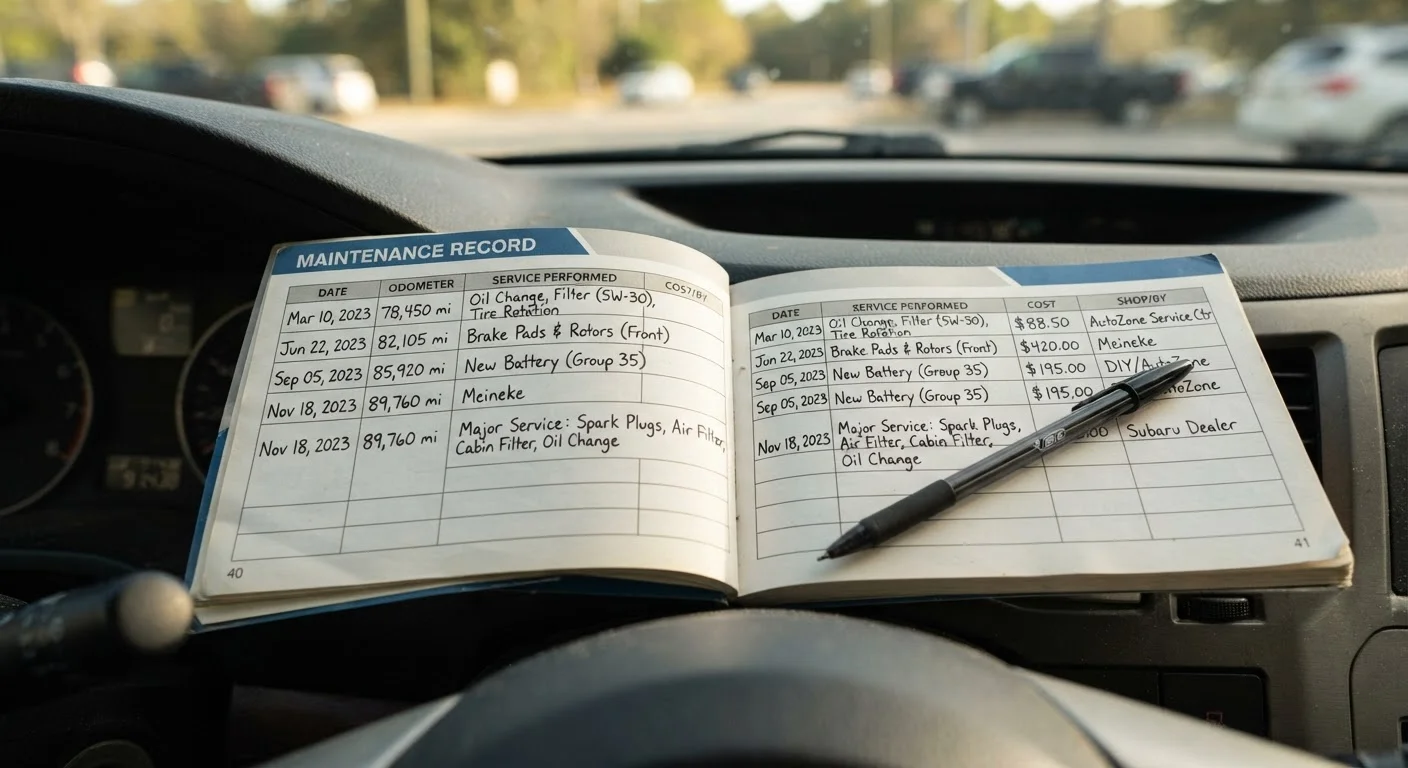
What a Vehicle Maintenance Log Actually Is
A vehicle maintenance log is a running record of every service, repair, inspection, and part replacement performed on your car. At minimum, each entry should capture the date, current odometer reading, work performed, parts used, and cost. It can live in a glove-box notebook, a spreadsheet, or a dedicated smartphone app — format matters far less than consistency.
Most manufacturers publish recommended service intervals in the owner's manual — oil changes, filter replacements, brake inspections, and so on. A log tracks whether those intervals are being met and by whom, giving you a clear picture of your vehicle's upkeep history at any point in its life. For a broader look at everything involved in owning and running a car, see the complete reference for everyday drivers.
The Advantages of Keeping Detailed Records
The case for a maintenance log is strongest when you consider the cumulative value it builds over time.
Supports resale value with verifiable service history
Private buyers and dealers are more confident purchasing a vehicle when maintenance can be documented. A complete log removes guesswork and can reduce buyer hesitation during negotiations.
Reveals recurring mechanical patterns early
Reviewing past entries lets you spot a component that's failing repeatedly, prompting investigation of an underlying cause before it escalates into a costly repair.
Keeps you on schedule with manufacturer intervals
Manufacturer-recommended service intervals are set for performance and longevity. A log makes it easy to see exactly when the next oil change, filter swap, or brake inspection is due.
Strengthens warranty and insurance claims
If a dispute arises over a warranty repair, documented proof that required maintenance was carried out on schedule can be decisive. Some insurance claims also benefit from a clear mechanical history.
Builds a realistic picture of true vehicle costs
Tallying maintenance spend over time gives you an accurate view of what the car actually costs to run — useful when deciding whether to repair or replace an aging vehicle.
One advantage that often surprises drivers is the diagnostic benefit. When a mechanic can see that the same component has been replaced twice in 18 months, that pattern points toward a root cause — whether it's a related failing part, driving conditions, or a previous substandard repair. Without records, that context is simply lost.
Log-keeping also supports your broader vehicle budget. Understanding what you've already spent — and what's coming due — helps avoid unpleasant surprises. Pair your log with a full accounting of annual car ownership costs to get a complete financial picture.
The Drawbacks Worth Acknowledging
A maintenance log is not a perfect tool, and it's honest to name the friction points that cause many drivers to abandon the habit.
Requires consistent effort to remain useful
A log only provides value if it's kept up to date after every service. Gaps in the record can be as misleading as no record at all, especially to a future buyer who assumes completeness.
Paper logs can be lost or damaged
A notebook kept in the vehicle is vulnerable to theft, water damage, or simply being misplaced during a chaotic day. Without a backup, years of entries can disappear permanently.
Doesn't guarantee a higher resale price
While documentation reduces buyer hesitation, resale value is driven by many factors including market demand, vehicle age, and overall condition. A log alone won't offset significant mechanical problems.
Data entry is inconvenient for some drivers
Drivers who rely on quick drop-off service, or who rarely handle their own maintenance admin, may find it difficult to capture all the details needed for accurate entries in real time.
The most common failure mode is inconsistency: a log that captures nine out of ten services provides an incomplete picture and may actually mislead a future buyer who assumes the record is comprehensive. If you use a shop that doesn't return paperwork or itemise work clearly, filling in entries accurately becomes harder. Building a habit of logging immediately after a service visit — not days later — is the practical fix for most of these issues.
Digital Logs Reduce the Loss Risk
Cloud-synced apps and photo receipt storage mean your maintenance history isn't tied to a single piece of paper. If your vehicle is stolen or written off, a digital log remains accessible and can support an insurance claim. Many apps also send service reminders based on the intervals you've recorded, adding a layer of passive accountability.
How a Log Affects Resale Value
Private buyers and used-car dealers both place weight on documented service history. A car with a complete, legible log communicates that the owner took the vehicle's upkeep seriously — reducing the perceived risk of unknown mechanical problems. While no log can guarantee a higher sale price (outcomes vary by market, vehicle age, and condition), the absence of records can give a buyer reason to negotiate harder or walk away entirely.
This is particularly relevant for vehicles with higher mileage, where a buyer's confidence in the engine and drivetrain condition relies almost entirely on what the history can prove. Understanding all the financial dimensions of car ownership — including resale — helps frame why record-keeping is worth the small ongoing effort.
~30%
Impact of service history on used-car buyer confidence
Industry surveys consistently show a significant proportion of used-car buyers cite documented service history as a primary factor in their purchase decision, though exact figures vary by market and vehicle segment.
7,500–10,000 mi
Typical modern oil change interval
Many current vehicles with synthetic oil are rated for 7,500 to 10,000 miles between changes — well beyond the older 3,000-mile guidance — making accurate interval tracking increasingly important.
Building a Log That You'll Actually Maintain
The best system is one simple enough that it doesn't feel like a chore. A few practical approaches that drivers find sustainable:
- Paper logbook in the glovebox: Inexpensive, always accessible, and easy to hand to a mechanic to fill in at service time.
- Smartphone app: Several free apps allow photo uploads of receipts alongside manual entries, automatically calculating intervals based on mileage.
- Shared spreadsheet: Useful for households with multiple drivers using one vehicle — everyone can update it from their phone.
Whatever format you choose, log every service — including those you perform yourself, such as fluid top-ups or wiper blade changes. See commonly overlooked maintenance tasks for a reminder of what often falls through the cracks between scheduled services.
Keeping your log aligned with seasonal upkeep is also straightforward — a seasonal car maintenance checklist gives you natural checkpoints throughout the year to review and update your records.