Why the Organic vs. Paid Question Matters More Than Most Owners Realize
Most small business owners know they need marketing. Far fewer have a clear framework for deciding which type of marketing to invest in at a given moment. The result is a common pattern: spending money on paid ads before the offer is ready, or pouring months into content while the business slowly runs out of runway.
The organic vs. paid decision isn't really about which channel is better in the abstract. It's about matching your marketing approach to your current stage, constraints, and goals. Getting this sequencing wrong is one of the more expensive marketing mistakes a small business can make — and it's largely avoidable. See our common marketing myths small business owners hold for related pitfalls that quietly stall growth.
How Each Channel Actually Works
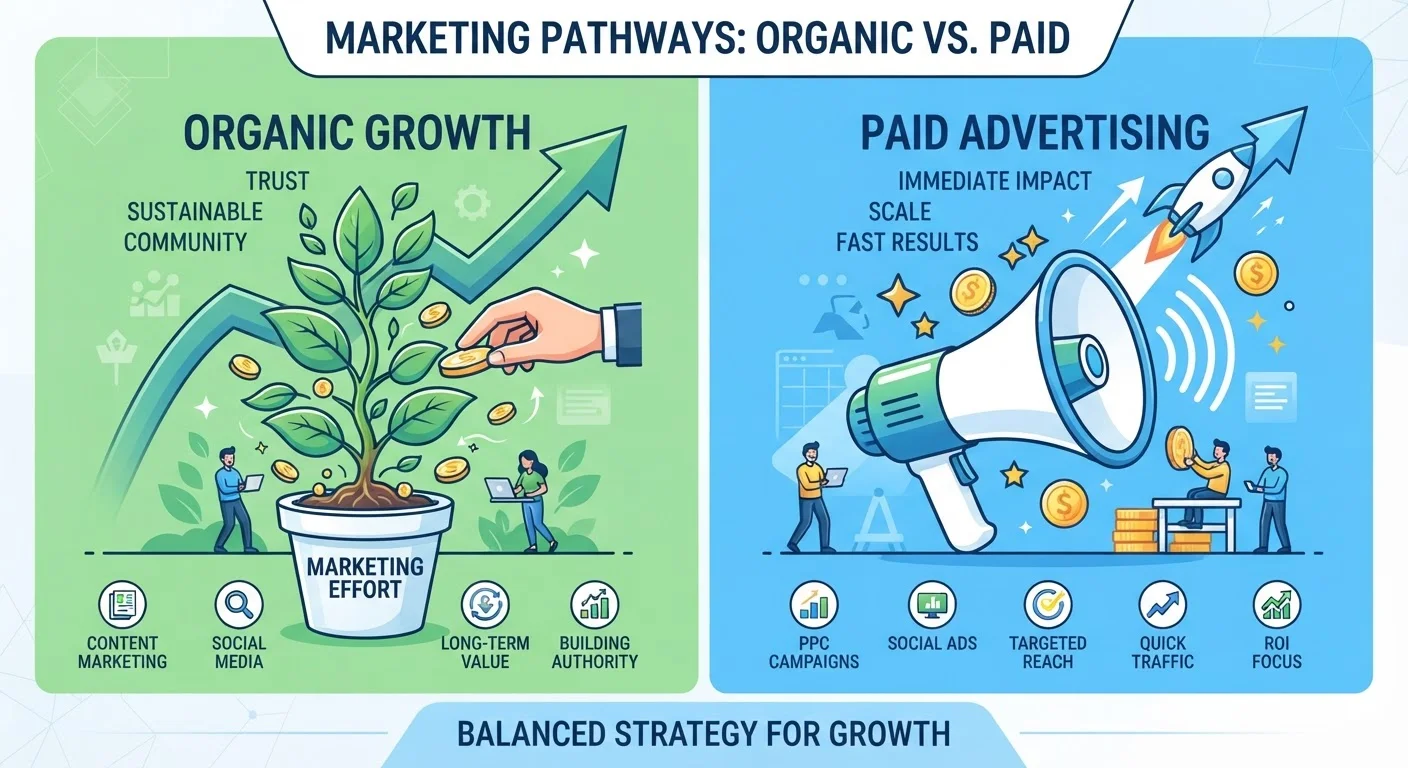
Organic growth covers any channel where you're not paying directly for placement: search engine optimization (SEO), content marketing, social media presence, email list building, referrals, and word-of-mouth. The defining characteristic is that the assets you build — search rankings, subscriber lists, domain authority — continue delivering value over time without ongoing spend. The tradeoff is that results compound slowly, often taking six to twelve months before meaningful traction appears.
Paid advertising means purchasing visibility: search ads, social media ads, display networks, sponsored placements. You set a budget, target an audience, and traffic arrives quickly. The defining characteristic is control and immediacy — you can start, pause, or adjust campaigns within hours. The fundamental tradeoff is that when the budget stops, the traffic stops. There's no compounding residual value in the way a top-ranking blog post delivers ongoing clicks for years.
| Criterion | Organic Growth | Paid Advertising |
|---|---|---|
| Time to results | Months to years | Days to weeks |
| Primary cost | Time and expertise | Media budget |
| Compounding value | High — assets accumulate | Low — stops with spend |
| Scalability | Gradual, hard to force | Fast, budget-limited |
| Best validation stage | Pre-revenue to early traction | Proven offer, growth stage |
| Risk if offer unvalidated | Low — slow feedback loop | High — budget burns fast |
| Measurability | Indirect, long attribution cycles | Direct, near-real-time data |
Understanding these structural differences matters because they determine not just your results but your risk profile. Paid channels are higher short-term cost with faster feedback. Organic channels are lower short-term cost but require patience and consistent execution over a longer horizon.
Stage-by-Stage: Which Engine to Prioritize
Pre-validation (idea to first customers): At this stage, your primary job is learning, not scaling. Organic and manual outreach — direct messages, cold emails, attending industry events, joining relevant communities — costs almost nothing and delivers real-time feedback on whether your offer resonates. Paid ads at this stage can accelerate the wrong direction fast. If your messaging or product-market fit is off, you'll simply burn budget learning what you could have discovered through lower-cost conversations.
Early traction (first revenue to repeatable sales): Once you have some signal that your offer works, the calculus shifts. This is a good time to begin building organic foundations — foundational content, SEO basics, an email list — while testing paid channels at small scale to understand your cost to acquire a customer. See our guide to building repeatable early-stage operations for how to systematize what's working before scaling either channel.
Growth stage (scaling a validated model): With known conversion rates and customer economics, paid advertising becomes a genuine growth lever. You can calculate a target cost-per-acquisition, set budgets accordingly, and scale spend against revenue. Simultaneously, your earlier organic investments start compounding — SEO traffic increases, your email list generates repeat business, referrals grow. This combined-channel stage is where marketing becomes most efficient.
~53%
Share of website traffic from organic search
Research from BrightEdge has consistently found that organic search drives the majority of trackable web traffic across industries, underscoring its long-term reach potential.
6–12 months
Typical timeframe for SEO to show meaningful results
Industry consensus among SEO practitioners places the typical window for new content and optimization efforts to gain significant organic traction at six months or longer.
~45%
Small businesses using paid digital advertising
SBA research and small business surveys suggest roughly half of US small businesses use some form of paid digital advertising, with adoption rates rising as platforms lower minimum spend requirements.
The Hidden Costs Each Side Rarely Advertises
Organic growth is often described as "free," which is misleading. The real costs are time and expertise. Writing useful content, building backlinks, engaging a community, and optimizing for search all require either significant personal hours or the cost of skilled staff or contractors. For a founder already stretched thin, treating organic as costless is a planning mistake.
Paid advertising carries its own hidden costs beyond the media spend. Creative production, landing page testing, campaign management, and the ongoing effort to optimize targeting all add up. Poorly managed paid campaigns can spend substantial budgets with minimal return — particularly when sent to a website or offer that hasn't been tested and refined.
The framing that matters: organic costs time and expertise; paid costs money and management attention. Your honest assessment of which resources you have more of should inform the mix. This question connects directly to the broader funding and resource trade-offs discussed in our bootstrapping vs. outside funding comparison.
This article is for general informational purposes only and does not constitute financial, marketing, or legal advice. Consult a qualified professional for guidance specific to your business situation.