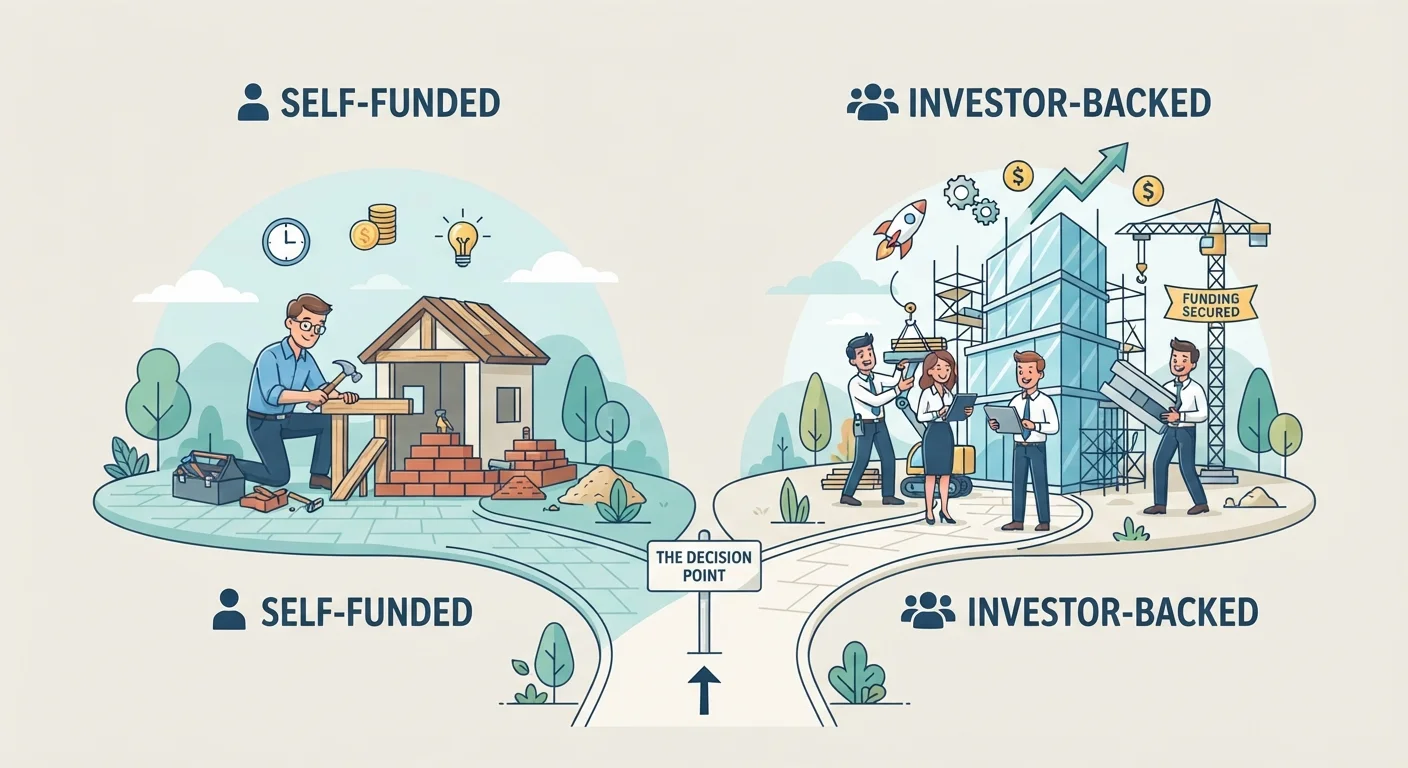
Why This Decision Shapes Everything That Follows
How you fund your business in the early stage isn't just a financial decision — it defines your relationship with the company, who you answer to, and how fast you're expected to move. Founders who bootstrap and founders who raise outside capital are playing by fundamentally different rules, and understanding those rules before committing is one of the most useful things you can do.
This isn't a decision with a universally correct answer. It depends on your industry, your personal finances, the competitive landscape, and what you actually want from the business. The goal here is to lay out the real trade-offs clearly, so you can make the call with open eyes.
Before diving in, it's worth noting: if you haven't yet confirmed that your business idea has real demand, both paths carry elevated risk. See our guide to validating your idea on a small budget before committing significant resources in either direction.
Bootstrapping: What It Really Means
Bootstrapping means funding your business through personal savings, early revenue, or a combination of both — without bringing in outside investors. It doesn't necessarily mean operating on fumes. Many bootstrapped companies are well-capitalised; the defining feature is that the capital comes from the founder rather than from equity investors or formal lenders seeking a stake.
The primary advantage is control. You make every strategic call without a board, without investor expectations, and without diluting your ownership stake. If the business generates $200,000 in year two, that money is entirely yours to reinvest or take as income.
The primary constraint is speed. Growth is bounded by what cash flow supports. If you need to hire, expand inventory, or launch a marketing campaign, you can only move as fast as the business's finances allow. In markets where a competitor with VC backing is spending aggressively, that constraint is a real competitive disadvantage.
Bootstrapping also forces a useful discipline: you must figure out how to generate revenue early, which means you get real market feedback faster. Many bootstrapped founders credit this constraint with teaching them unit economics — the relationship between what it costs to acquire a customer and what that customer is worth — in a way that funded founders sometimes learn too late.
| Criterion | Bootstrapping | Outside Funding |
|---|---|---|
| Ownership retained | 100% (or near it) | Diluted with each equity round |
| Growth pace | Revenue-constrained | Capital-accelerated |
| Decision-making authority | Founder retains full control | Shared with investors or lenders |
| Revenue pressure | Immediate — must sustain operations | Deferred — runway buys time |
| Financial risk to founder | Personal savings at risk | Investor capital at risk (equity); repayment obligations (debt) |
| Best market fit | Niche, steady, or service businesses | High-growth, scalable, large-market businesses |
| Access to networks | Self-sourced | Investors often provide connections and expertise |
Outside Funding: Types, Trade-offs, and What Investors Expect
Outside funding covers a wide range of capital sources: angel investors, venture capital (VC) firms, small business loans, SBA-backed lending programs, revenue-based financing, and crowdfunding, among others. Each comes with different expectations, costs, and structural implications.
Equity investment — angels and VCs taking ownership shares in exchange for capital — is the type most commonly discussed in startup culture, but it suits a narrow slice of businesses. Investors seeking equity generally want to see a large potential market, a scalable model, and a credible path to significant returns. If your business is a profitable but regionally focused service, equity investors are unlikely to be interested, nor should you necessarily want them.
Debt-based options, including SBA loans, business lines of credit, and revenue-based financing, are structured differently: you repay capital over time rather than giving up ownership. These can be appropriate for businesses with predictable revenue or tangible assets, though they carry repayment obligations regardless of whether the business is performing.
The key trade-off with any outside funding is accountability. You answer to someone — whether that's a lender demanding payments or investors expecting growth metrics. That accountability can be useful pressure, but it also constrains your choices in ways bootstrapping does not. For a deeper look at how these trade-offs play out over a business's lifetime, see our analysis of bootstrapping versus external funding trade-offs.
The Factors That Should Drive Your Choice
A few concrete questions help narrow the decision:
- How capital-intensive is your model? A SaaS product built by a technical founder can often be launched for very little. A food manufacturing business cannot. Capital intensity is one of the most honest filters.
- How fast does the market move? In commoditised or slow-moving markets, patience is a competitive asset. In technology-driven or rapidly consolidating markets, speed can determine whether you become a market leader or an also-ran.
- What is your personal financial position? Bootstrapping involves risk to personal resources. Drawing down savings or running a business on a founder's credit cards creates real financial exposure. Be honest about what you can absorb if the business takes longer than expected.
- Do you want to build a lifestyle business or a scalable company? Neither is the wrong answer, but they often point to different funding paths. Investors seeking equity generally aren't interested in a business that will be profitable and stable at $1M in annual revenue — they need a path to a much larger exit.
It's also worth examining the assumptions that often distort this decision. Our piece on common startup myths addresses the widespread but mistaken belief that outside funding is either necessary or a validation of your idea's quality.
These Paths Aren't Permanent
Many businesses start bootstrapped and later raise outside capital once they have traction to negotiate from a position of strength. Others raise early, then pay down investors and return to founder control. The choice you make at launch is important, but it doesn't lock you in forever. What matters most at the early stage is choosing the path that matches your current reality — your capital, your market, and your goals — rather than the path that sounds most impressive.
This article is for general informational purposes only and does not constitute financial, legal, or investment advice. Consult a qualified financial adviser or attorney when making decisions about business financing.