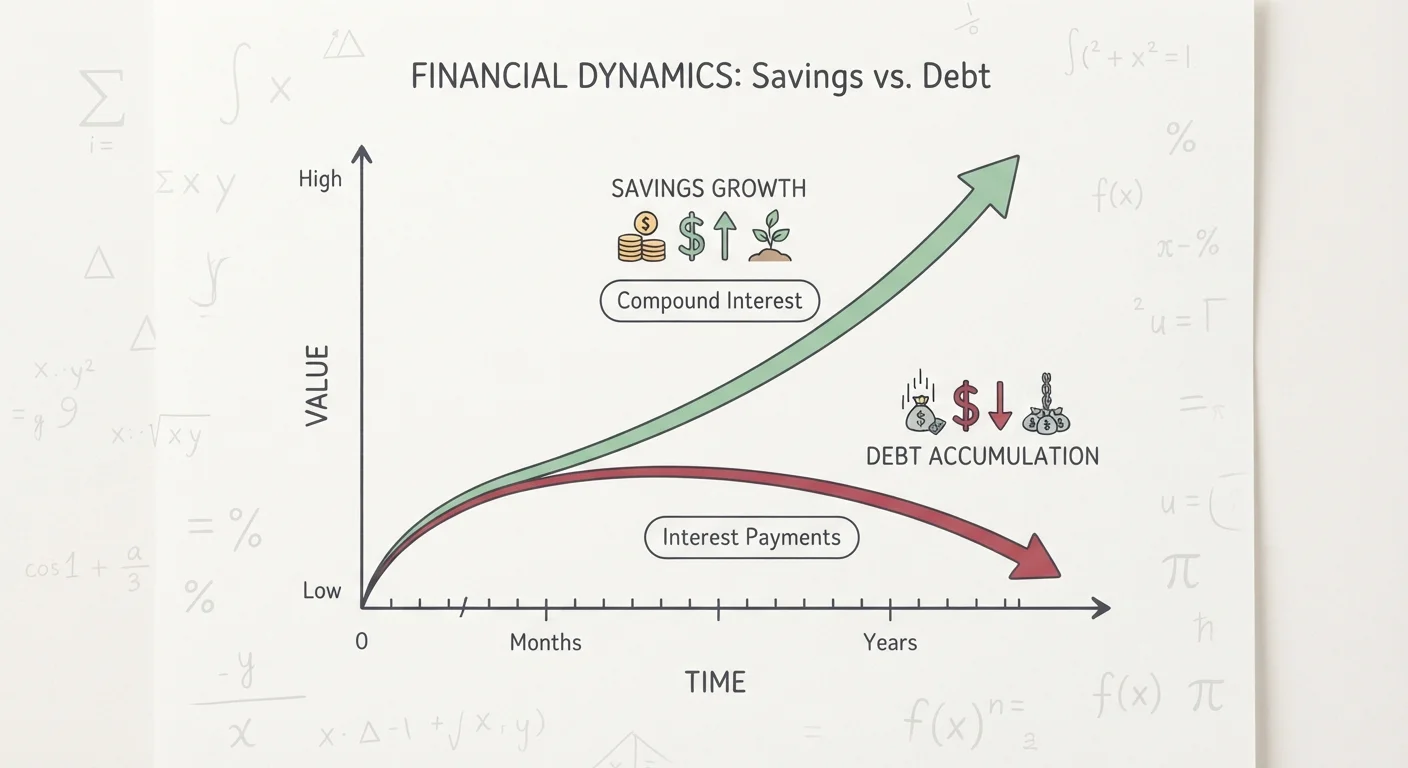
How Compound Interest Actually Works
At its core, compound interest follows a simple logic: once interest is earned or charged, it gets folded back into the balance — and then that larger balance earns (or owes) interest in the next period. This cycle repeats, and with each pass, the amount being added grows slightly larger.
Consider a straightforward savings example. You deposit $1,000 at a 5% annual interest rate, compounded annually. After year one, you earn $50 in interest, bringing your balance to $1,050. In year two, you earn 5% on $1,050 — not $1,000 — so you earn $52.50. By year three, you're earning interest on $1,102.50. The increments seem small at first, but after 30 years at this rate, that $1,000 grows to roughly $4,322 without adding another dollar.
The key variables that shape how quickly compounding works are: the interest rate, the compounding frequency (daily, monthly, or annually), and the length of time money remains in play. Of these, time is often the most underestimated. Compounding rewards patience because the acceleration builds on itself.
For a broader look at how compound interest fits within the wider picture of financial wellness, see this plain-language explainer on compound interest covering savings, debt, and long-term planning.
When Compounding Works Against You: Debt
The same mathematical force that grows savings also grows debt — and it can work much faster in that direction because consumer debt often carries significantly higher interest rates than savings accounts offer.
Credit card debt is one of the most common examples. Many credit cards compound interest daily using the card's daily periodic rate (the annual rate divided by 365). If you carry a $3,000 balance at an 20% annual rate, you're accruing roughly $1.64 in interest per day. That adds up to approximately $600 in interest over a year — but because compounding is occurring daily, the real cost is slightly higher, and if you're only making minimum payments, a portion of each payment may be consumed by interest before touching the principal.
This is the debt trap that many households experience: paying consistently but watching the balance barely move. The Consumer Financial Protection Bureau notes that minimum payments on credit cards are often structured so that repayment can stretch over many years when only minimums are paid.
20%+
Average credit card interest rate in the US
Federal Reserve data has shown average credit card rates consistently exceeding 20% APR in recent years, making credit card debt among the most costly common forms of consumer borrowing.
72
The Rule of 72: doubling-time shortcut
Dividing 72 by an annual interest rate gives an estimate of how many years it takes a balance to double — a useful mental check for both savings growth and debt accumulation.
$600+
Annual interest on a $3,000 credit card balance at 20% APR
This approximation illustrates how carrying a common credit card balance can add hundreds of dollars in annual interest cost, even before compounding is factored in fully.
Understanding this dynamic is the first step toward breaking the cycle. Once you see compounding as a force that must be reversed — by paying above the minimum and targeting high-rate balances — the strategy for escaping debt becomes clearer. Our guide on managing personal debt covers these fundamentals in detail.
The Rate Asymmetry Problem
One of the most important — and frequently overlooked — aspects of compound interest is the gap between the rates at which money grows in savings versus the rates at which debt accumulates. This asymmetry is central to nearly every personal finance decision.
A high-yield savings account in the current environment may offer a meaningfully higher return than traditional accounts, but credit card rates commonly exceed 20% annually. This means that for every dollar you carry in credit card debt, compounding is working against you at a rate far exceeding what most savings vehicles offer. Mathematically, paying down high-interest debt typically delivers a more certain financial return than keeping money in savings — because the interest you avoid paying is effectively a guaranteed gain.
This is why financial educators often suggest a sequenced approach: build a small emergency fund first (to avoid taking on new debt in a crisis), then direct additional resources toward high-rate debt aggressively. The trade-offs between paying off debt and building savings simultaneously are worth examining carefully depending on your situation.
The Rule of 72 offers a useful mental check: divide 72 by the interest rate to estimate how many years it takes a balance to double. At 20%, an unpaid credit card balance doubles in roughly 3.6 years. At a 4% savings rate, your balance doubles in about 18 years. That contrast illustrates why the rate matters so much.
Putting Compounding to Work: Practical Steps
Understanding compound interest as a concept is only useful if it changes behavior. Here are the practical implications for everyday financial decisions:
- Start saving as early as possible. Because compounding accelerates over time, money invested in an early decade produces disproportionately more growth than money invested later, even in identical amounts. Time in the market (or in a savings account) is a core driver of outcomes.
- Prioritize paying more than the minimum on debt. Every dollar above the minimum payment reduces the principal on which future interest is calculated, slowing the compounding effect against you.
- Understand compounding frequency when comparing accounts. APY (Annual Percentage Yield) accounts for compounding frequency and is the most useful figure for comparing savings accounts on a like-for-like basis.
- Target high-rate debt first. Two widely used frameworks — the debt avalanche and debt snowball — take different approaches to sequencing debt payoff. Learn how they differ in our breakdown of the debt avalanche and debt snowball methods.
- Avoid letting interest compound unaddressed. On credit cards especially, carrying even a modest balance from month to month means interest begins accruing on previous interest immediately.
Check Your APY, Not Just the Rate
When comparing savings accounts, always look at the APY (Annual Percentage Yield) rather than just the stated interest rate. APY incorporates compounding frequency, giving you a true apples-to-apples comparison. A higher compounding frequency at the same nominal rate will always produce a higher APY — and more money in your account over time.
For quick definitions of related concepts — including savings rate, net worth, and debt-to-income ratio — the plain-language glossary of savings and debt terms is a useful companion resource.
This article provides general financial education and is not personalized financial, investment, or tax advice. Please consult a licensed financial professional for guidance specific to your situation.