The Narrow View We've Been Sold
Ask most Americans what civic engagement means, and the conversation usually lands on voting. It's understandable — elections are high-profile, emotionally charged, and genuinely important. But framing civic engagement as primarily an Election Day activity leaves out the vast majority of ways communities are actually built and sustained.
The truth is, the decisions that shape your neighborhood's sidewalks, your child's school curriculum, your local emergency response capacity, and your town's air quality are rarely made at the ballot box. They're made at planning commission hearings, school board meetings, zoning appeals, and budget sessions — rooms that are often nearly empty except for a handful of committed residents. That absence of participation is itself a civic choice, and one with real consequences.
Understanding civic engagement in its full scope isn't just an academic exercise. It's a practical toolkit for anyone who wants to live in a community that actually reflects their values.
What Civic Engagement Actually Includes
Researchers and community organizers generally describe civic engagement as falling into several overlapping categories:
- Electoral participation: Voting, registering others to vote, volunteering on campaigns, attending candidate forums, and donating to political causes.
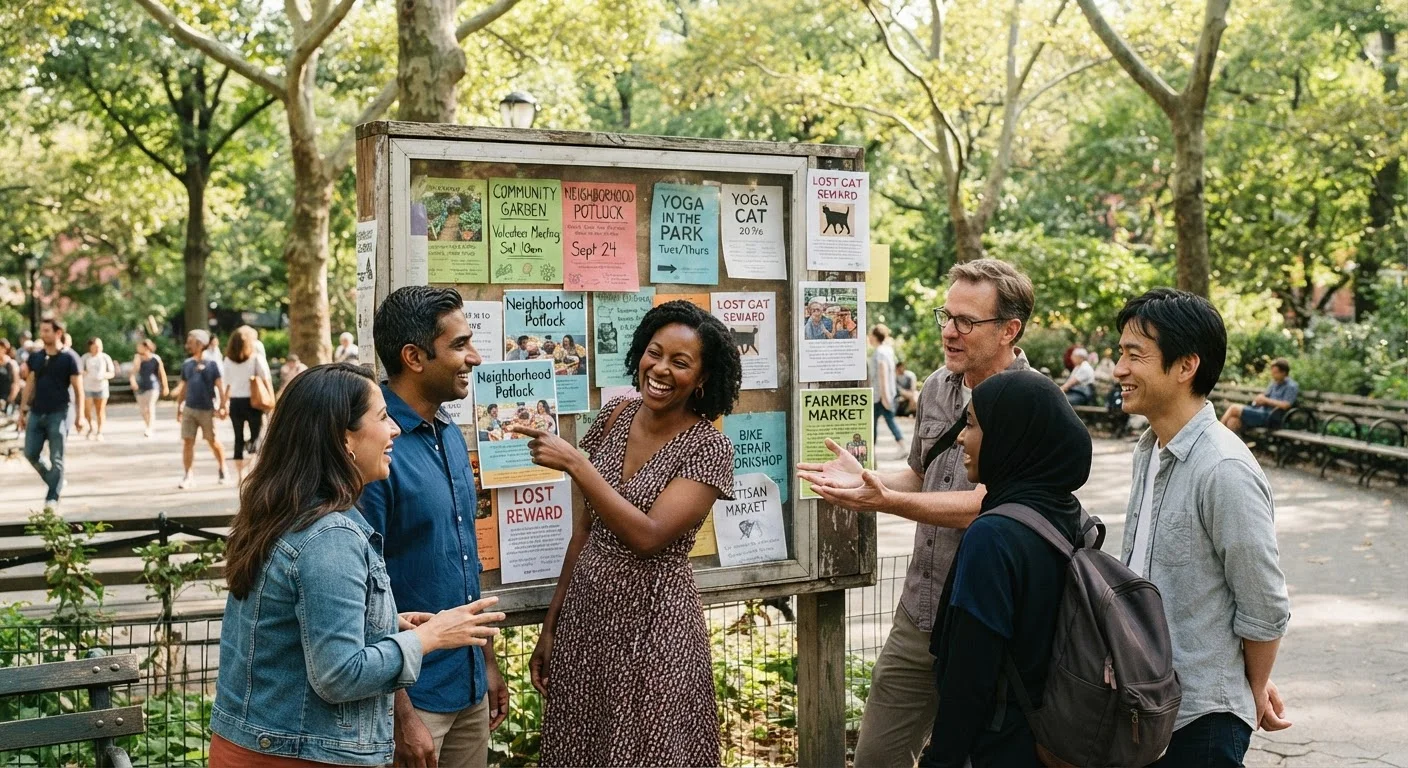
- Community participation: Joining neighborhood associations, attending public meetings, participating in local planning processes, and serving on advisory boards or commissions.
- Voluntary service: Contributing time and skills to nonprofits, schools, libraries, food banks, and mutual aid networks.
- Civic communication: Writing to elected officials, submitting public comments on proposed regulations, speaking at public hearings, and engaging with local journalism.
- Social and relational participation: Building relationships across difference, participating in community events, and maintaining the informal bonds that make neighborhoods feel like neighborhoods.
These categories overlap constantly. Someone who volunteers at a food bank may develop relationships that lead them to advocate for local policy changes. A neighbor who consistently attends block association meetings often becomes the connective tissue that holds a street together during hard times.
“Democracy is not a spectator sport. The vitality of a democracy depends on the active engagement of its citizens in civic and political life.”
— Robert Putnam, Political scientist and author of 'Bowling Alone'
Why Non-Electoral Engagement Often Hits Closer to Home
Federal elections capture national attention, but many of the decisions that shape everyday life happen at the local level — and local processes are far more accessible to ordinary residents. A single person who consistently attends city council meetings, asks well-informed questions, and builds relationships with local staff can have influence that would be impossible at the state or federal level.
~20%
Typical local election voter turnout
Municipal elections in the U.S. frequently see voter turnout well below 20%, according to research from Portland State University's City Observatory, meaning a small number of votes can determine local outcomes.
77 million
Americans who volunteered in a recent year
According to the U.S. Bureau of Labor Statistics' American Time Use Survey, tens of millions of Americans engage in formal volunteering annually, representing a major form of non-electoral civic participation.
2x
Trust advantage in high-participation communities
Robert Putnam's research on social capital found that communities with stronger civic association participation reported significantly higher levels of interpersonal trust compared to lower-participation areas.
Local civic structures — planning boards, library trustees, parks committees, school PTAs — are chronically under-resourced and genuinely hungry for engaged participants. These aren't just ceremonial roles. Zoning decisions affect housing costs. Library boards shape what resources are available to the public. School board choices ripple through a community for generations.
If you want to understand how to connect your existing skills to specific community needs, matching your skills to local volunteer opportunities is a useful starting point for turning general interest into real contribution.
The Social Glue Civic Life Provides
Beyond its practical effects, civic engagement performs an underappreciated social function: it builds trust. Robert Putnam's long-running research on social capital found that communities with stronger civic participation — through associations, volunteering, and informal social connection — tend to have higher levels of generalized trust and better health and economic outcomes.
That trust isn't abstract. It's what makes neighbors look out for each other during emergencies, what allows strangers to cooperate on shared problems, and what sustains the informal networks that often catch people before they fall through institutional cracks. When civic life weakens, those networks fray — and rebuilding them takes sustained collective effort.
Civic engagement, in this sense, is both a contribution to and a benefit from community. People who participate in community life tend to report stronger feelings of belonging and purpose. That's not a small thing in an era when social isolation has become a significant public health concern.
Getting Started Without Overwhelm
One of the biggest barriers to civic engagement isn't apathy — it's not knowing where to begin. The landscape of local institutions, organizations, and processes can feel opaque to newcomers, whether you've just moved to town or have lived there for years without plugging in.
A few practical entry points worth considering:
- Find your hyperlocal layer: Look up your neighborhood association, homeowners' association, or block club. These are often the most accessible entry points and require no prior civic experience.
- Show up once: Attend a single public meeting — a city council session, a school board meeting, a library board hearing. You don't have to speak. Just observe how decisions are made and who is in the room.
- Follow local journalism: Knowing what's being discussed in your community is itself a form of civic participation, and it's the foundation for more active involvement.
- Connect the dots: Talk to neighbors. Informal conversation is how most people first learn about issues worth caring about.
If you're new to an area and trying to build civic roots from scratch, a structured framework for new residents can help you navigate the process without feeling overwhelmed.
Civic engagement isn't a single act. It's a practice — and like most practices, it grows stronger the more consistently you show up.
This article is intended for general informational purposes. It does not constitute political, legal, or professional advice of any kind.