The Cost Categories That Change Completely
Switching to an electric vehicle doesn't mean escaping running costs — it means reorganising them. Two categories shift most dramatically: energy and routine maintenance.
Energy: From the Pump to the Plug
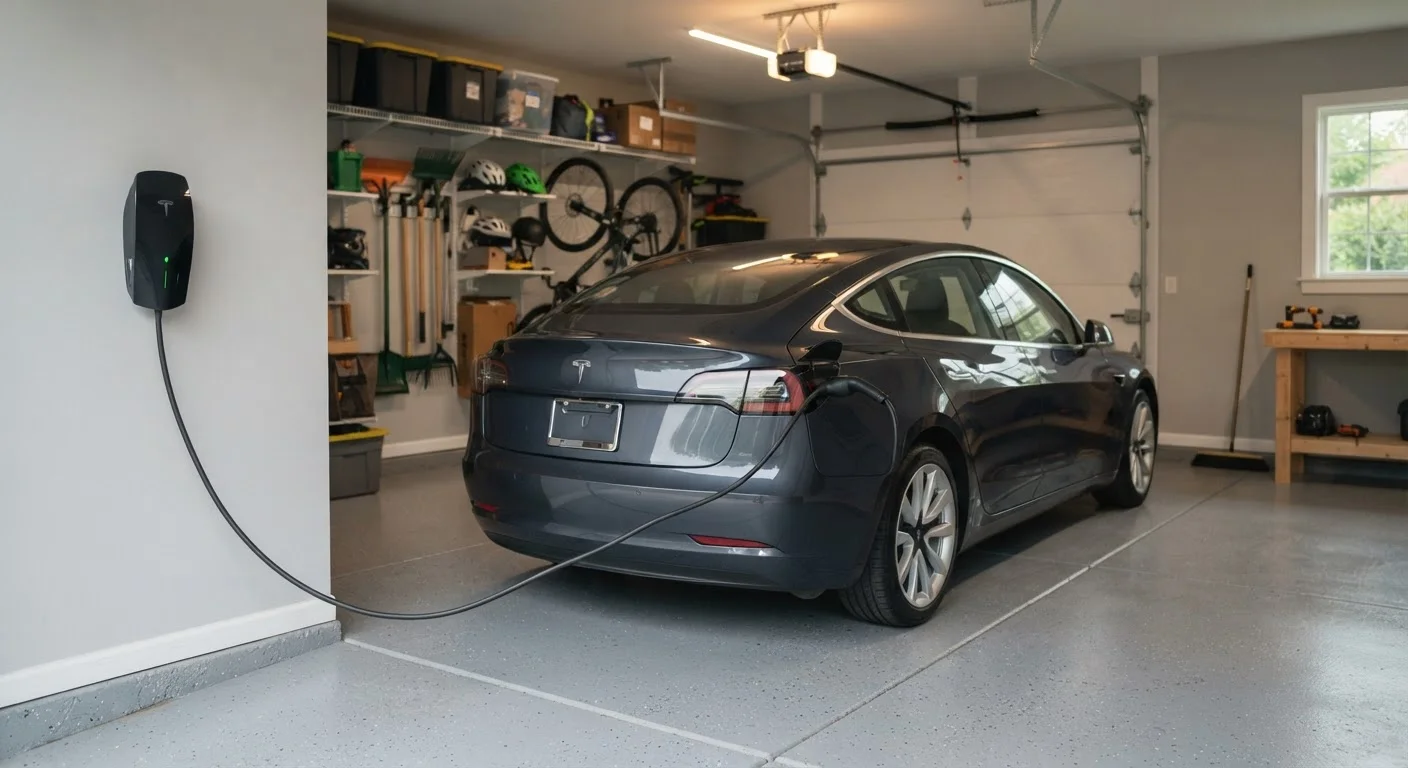
Petrol expenditure is replaced by electricity, and for most drivers this means a lower cost per mile. The precise saving depends on your local electricity rate, whether you charge primarily at home or on public networks, and how efficiently your specific vehicle uses energy. Drivers who can install a Level 2 home charger and charge overnight — often at lower off-peak rates — tend to see the largest savings. Public DC fast charging, while faster and convenient on road trips, typically costs more per kilowatt-hour and can narrow the gap with petrol costs considerably.
For a complete view of how energy costs compare across powertrains over the long run, see our lifetime fuel cost comparison across petrol, diesel, hybrid, and electric vehicles.
Routine Maintenance: Fewer Moving Parts, Smaller Bills
An electric drivetrain has significantly fewer components than a petrol engine — no oil, no exhaust system, no timing belt, no spark plugs. The maintenance schedule shrinks accordingly. Many EV owners report several years of ownership without the recurring service bills that petrol cars accumulate annually. Regenerative braking, which recovers energy during deceleration, also reduces brake pad wear, extending the life of brake components substantially.
That said, EVs are not maintenance-free. Tyres, cabin air filters, wiper blades, coolant for the battery thermal management system, and software updates all require attention. Tyres may actually wear faster on some EVs due to higher vehicle weight and the instant torque delivery that can stress rubber under hard acceleration.
Check Your Local Electricity Rate Structure
Before assuming home charging will always be the cheapest option, confirm whether your utility offers time-of-use (TOU) pricing. With TOU plans, off-peak overnight rates can be significantly lower than daytime rates, making overnight charging substantially cheaper. Without a TOU plan, the savings gap between home and public charging may be narrower than expected.
What Stays Largely the Same
Several ownership costs are essentially unchanged when you move from petrol to electric — and underestimating them is a common budgeting mistake.
Insurance
EV insurance premiums tend to run somewhat higher than for equivalent petrol vehicles. Repair costs are a primary driver: EV body repairs can involve high-voltage system considerations, specialised labour, and parts that are still maturing in terms of supply chain efficiency. The gap varies meaningfully by insurer and model, so comparing quotes carefully remains important. Our hidden ownership costs guide covers insurance alongside other expenses that often catch buyers off guard.
Registration, Taxes, and Fees
Annual registration fees and applicable road taxes apply to EVs just as they do to petrol vehicles, though the specific amounts vary by state. Some states have introduced additional annual EV fees to offset reduced fuel-tax revenue — a trend worth checking in your state before budgeting.
Tyres and Consumables
Tyres are a significant recurring cost regardless of powertrain. EV-specific tyres are often designed for lower rolling resistance and to handle extra vehicle weight, and they can carry a price premium over standard equivalents. Budget for the same replacement cycle discipline you would apply to any vehicle.
Depreciation
Depreciation is the largest single cost of car ownership for most drivers — and EVs are not exempt. Resale values for electric vehicles have historically been volatile as technology advances and new models arrive. Keeping a vehicle for longer generally reduces the annual depreciation burden, whichever powertrain it uses. See our full guide to true ownership costs for a broader breakdown of how depreciation fits into the overall picture.
~30–40%
Typical reduction in per-mile energy costs vs. petrol
Industry analyses consistently show EVs cost less per mile to fuel than petrol equivalents, though the exact margin depends on local electricity and petrol prices.
8 yrs / 100k mi
Common EV battery warranty coverage
Most major manufacturers offer battery warranties covering at least 8 years or 100,000 miles, typically with a minimum state-of-health threshold.
~40%
Fewer scheduled maintenance visits reported by EV owners
U.S. Department of Energy studies have found EV powertrain maintenance costs are meaningfully lower than for equivalent internal-combustion vehicles.
The Long-Term Variable: Battery Health
The traction battery is the component with no direct equivalent in a petrol vehicle — and it introduces a genuine long-term cost variable. All lithium-ion batteries lose some capacity over time and with charge cycles. For most drivers, real-world degradation over the first several years of ownership is modest and does not significantly affect usability. However, if a battery degrades to the point where replacement becomes necessary outside the warranty period, the cost can be substantial.
Most manufacturers cover the traction battery separately from the general vehicle warranty — commonly 8 years or 100,000 miles with a guaranteed minimum capacity retention threshold. Understanding what your specific warranty covers, and what it does not, is a key part of EV ownership due diligence.
Battery replacement costs have been declining as the technology matures and production scales, but remain a meaningful consideration for anyone planning to keep an EV beyond the warranty period. Factoring in a realistic scenario for battery health is part of any thorough annual ownership cost checklist.
Charging Infrastructure as a Hidden Upfront Cost
Many EV owners find that getting the full benefit of low running costs requires some upfront investment at home. Relying solely on a standard 120-volt household outlet — sometimes called Level 1 charging — is slow enough that it becomes impractical for drivers with higher daily mileage. A Level 2 home charging unit (240 volts) significantly speeds up overnight charging but typically requires professional installation and the unit itself. Costs vary depending on your home's electrical panel capacity and local labour rates.
This installation cost is a one-time expense rather than a recurring one, but it belongs in a complete financial picture of EV ownership. Drivers in apartments or rental properties may lack the ability to install home charging at all, making them more dependent on public infrastructure — and therefore facing a different cost structure than homeowners with a dedicated charging setup.
For drivers weighing the full picture across all vehicle types and ownership models, our car cost myths article addresses several assumptions that can skew these calculations. And for guidance on keeping any vehicle mechanically sound, the car maintenance hub covers the fundamentals that apply regardless of powertrain.
This article provides general information about electric vehicle running costs and is not a substitute for personalised financial or purchasing advice. Costs vary significantly by location, vehicle, driving habits, and individual circumstances.