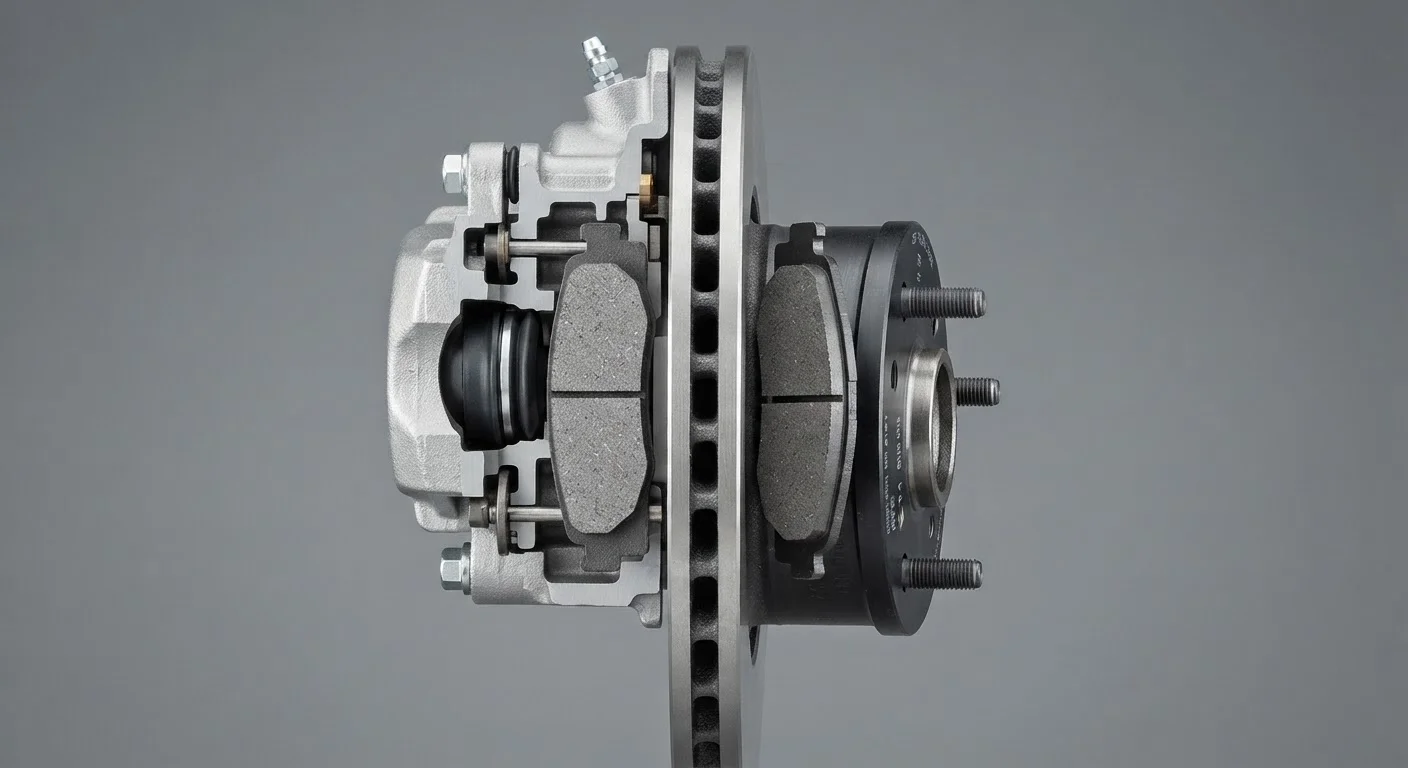
How Pads and Discs Work — and Why They Wear Differently
Every time you press the brake pedal, hydraulic pressure forces the brake caliper to squeeze two brake pads against a spinning brake disc (also called a rotor). The resulting friction converts kinetic energy into heat, slowing the vehicle. It's a brutally effective system — and a demanding one on its components.
Brake pads are designed as the sacrificial element in this system. Made from composite friction material bonded to a metal backing plate, they are engineered to wear down gradually while protecting the more expensive disc beneath. Most passenger vehicle pads start between 10–12 mm thick and are considered worn when they reach approximately 2–3 mm.
Brake discs are cast iron or, on some vehicles, composite construction. They experience friction on both faces but are substantially thicker and harder than the pad material. However, discs face a different class of stress: repeated thermal cycling as they heat up during braking and cool again. Over thousands of cycles, this can cause microscopic thickness variation, surface glazing, or — under extreme conditions — cracking.
Understanding this functional difference matters: pads wear linearly with use, while discs degrade in ways that are less predictable and sometimes independent of mileage. Brake fluid condition also plays a role in system health, since degraded fluid reduces hydraulic efficiency and can increase the heat transferred into components.
Reading the Warning Signs: Pads vs Discs
The sounds and sensations your braking system produces are its primary communication channel. Misreading them leads to misdiagnosis — and potentially replacing a component that wasn't the root cause.
Pad Warning Signs
- Squealing during normal braking: Most modern pads incorporate a hardened metal wear indicator tab. When friction material wears thin, the tab contacts the disc and produces a deliberate high-pitched squeal. This is a designed early warning, not a system failure — but it requires prompt attention.
- Reduced pedal feel or increased stopping distance: As pads thin, braking efficiency diminishes. If the vehicle feels like it needs more pedal pressure to achieve the same deceleration, pad inspection is the first step.
- Brake dust buildup: Unusually heavy dark dust on wheel faces can indicate pads wearing faster than expected, sometimes pointing to a sticking caliper rather than normal consumption.
Disc Warning Signs
- Pedal pulsation or vibration: A rhythmic pulse felt through the brake pedal — often matched by steering wheel shudder — almost always indicates disc thickness variation (DTV). As a disc develops uneven thickness, pad contact becomes intermittent rather than smooth.
- Steering pull under braking: If the vehicle drifts left or right when slowing, one disc may be worn more than its pair on the same axle, creating uneven braking force.
- Visible scoring or grooves: Deep circumferential grooves on the disc face, visible through the wheel spokes, indicate material loss that may have passed the minimum thickness threshold.
| Criterion | Brake Pads | Brake Discs |
|---|---|---|
| Primary role | Friction material; wears by design | Rotating contact surface; absorbs heat |
| Typical replacement interval | 25,000–70,000 miles | 50,000–120,000 miles (varies widely) |
| Key warning sound | High-pitched squealing | Deep grinding or scraping |
| Key warning sensation | Reduced pedal responsiveness | Pedal pulsation or vibration |
| Wear measurement | Visual pad thickness check | Micrometer measurement against minimum spec |
| Inactivity risk | Low — pads not significantly affected | High — surface rust forms quickly |
| Replaced in pairs? | Yes — always replace axle pair together | Yes — always replace axle pair together |
A grinding noise warrants special mention: it typically means pad friction material is entirely gone and metal backing plate is contacting disc. At that point, both components almost certainly need replacement — waiting amplifies damage and cost significantly.
Replacement Intervals and What Affects Them
No universal mileage interval applies to brake components because wear rate is highly variable. That said, general industry guidance provides a useful starting framework.
Brake pads on most passenger vehicles are commonly inspected at each tire rotation — roughly every 5,000–7,500 miles — and replaced anywhere between 25,000 and 70,000 miles depending on compound type, driving environment, and braking habits. City driving with frequent stops accelerates pad wear significantly compared to highway commuting.
Brake discs typically outlast two to four sets of pads. However, they have a minimum thickness specification (stamped or cast into the disc itself) and must be replaced when worn to that limit regardless of age. Thickness should be measured with a micrometer during any brake service — visual inspection alone is insufficient.
Minimum Thickness Specs Matter
Every brake disc has a minimum thickness value cast or stamped into it — often on the inner edge of the disc hat. Once a disc is machined or worn to that number, it must be replaced regardless of its visual appearance. Operating below minimum thickness increases the risk of disc cracking under heavy braking loads. Always ask a mechanic to measure disc thickness rather than relying on a visual check alone.
When pads are replaced, it's worth evaluating whether discs should be replaced at the same time. Installing new pads on heavily worn or scored discs shortens pad life and can compromise braking feel. Many professional mechanics recommend replacing disc and pad together on each axle once the disc is near or below mid-life thickness.
Knowing when to handle a job yourself and when to call a professional applies directly here — measuring disc thickness with a micrometer and evaluating caliper condition requires tools and knowledge most home mechanics should assess honestly before attempting.