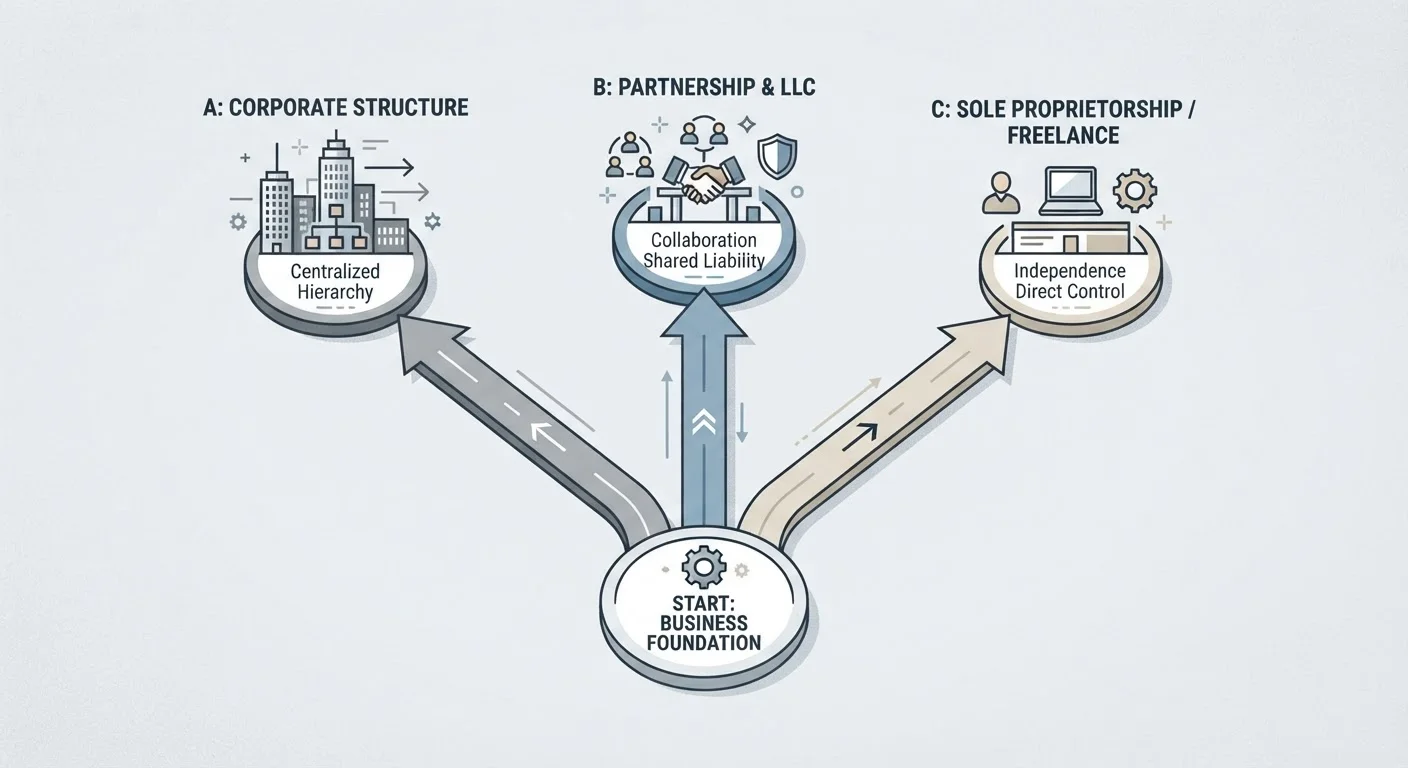
Why Structure Matters Before You Start Trading
Picking a business structure is not a formality to rush through. It determines how you're taxed, what happens if the business runs into debt, how you pay yourself, and even how seriously potential clients or lenders take you. Get it wrong and you may face an expensive restructuring later — or worse, unexpected personal financial exposure.
This article compares the three structures most commonly used by US small business owners and independent operators: sole trader (sole proprietorship), partnership, and limited company (LLC or corporation). For a deeper look at what formalising your business actually involves, see what new founders need to know about legal entities.
This article provides general educational information only and is not legal, tax, or financial advice. Consult a qualified professional before making decisions about your business structure.
Sole Trader: Maximum Simplicity, Maximum Exposure
A sole proprietorship — often called sole trader — is the default structure when an individual starts trading without formally registering a separate business entity. There is no legal distinction between you and your business: you own the assets, and you're personally responsible for every liability.
What it takes to set up
In most US states, you can begin operating as a sole proprietor immediately. If you use a name other than your own, you'll typically need to file a DBA (Doing Business As) — also called a fictitious business name — with your county or state. Costs are generally under $100.
Tax treatment
Business income flows directly to your personal tax return on Schedule C. You pay income tax plus self-employment tax (covering Social Security and Medicare contributions, currently 15.3% on net earnings up to the annual threshold). There's no separation — a profitable year increases your personal taxable income directly.
The liability problem
If a client sues you or your business can't pay a supplier, your personal assets — savings, car, home — can be at risk. This unlimited personal liability is the most significant drawback of operating as a sole proprietor. Business insurance can mitigate some risk, but it doesn't replace structural protection.
| Sole Trader | General Partnership | LLC | |
|---|---|---|---|
| Setup complexity | Very low — minimal filings | Low — agreement recommended | Moderate — state filing required |
| Setup cost | Under $100 (DBA if needed) | Low — legal fees for agreement | $50–$500 state filing fee |
| Personal liability | Unlimited | Unlimited (all partners) | Limited to investment |
| Federal tax treatment | Pass-through, Schedule C | Pass-through, Schedule K-1 | Pass-through by default |
| Self-employment tax | Yes, on net earnings | Yes, on active earnings | Depends on election |
| Ongoing admin burden | Minimal | Low | Moderate — annual reports |
| Credibility with clients/lenders | Moderate | Moderate | Higher |
Partnership: Shared Ownership Without a Corporate Shell
A general partnership forms automatically when two or more people go into business together without creating a formal entity. Like a sole proprietorship, income and liabilities pass directly through to the individual partners.
General vs. limited partnerships
In a general partnership, all partners share management responsibility and unlimited personal liability — including for each other's business actions taken within the scope of the partnership. That last point is critical: one partner's negligent decision can expose all partners personally.
A limited partnership (LP) allows some partners (limited partners) to contribute capital while capping their liability at the amount invested, provided they don't participate in management. The general partner still holds unlimited liability. LPs are common in investment and real estate structures rather than everyday small businesses.
Tax treatment
Partnerships file an informational return (Form 1065) with the IRS, but do not pay federal income tax at the entity level. Each partner receives a Schedule K-1 showing their share of income, deductions, and credits, which they report on their individual returns. Partners who actively work in the business also owe self-employment tax on their share of earnings.
Partnership agreements
A written partnership agreement is not legally required in most states, but operating without one is a significant risk. Default state rules govern disputes — and they rarely reflect what founders actually intended. A clear agreement should cover profit sharing, decision-making authority, and what happens if a partner exits.
Limited Company: Separate Legal Identity, Added Complexity
Forming a limited liability company (LLC) or corporation creates a legal entity that is separate from its owners. The business can own assets, enter contracts, and incur debts in its own name. This separation is the source of the structure's primary advantage: limited liability.
LLC vs. corporation
An LLC is the most flexible option for most small businesses. By default, a single-member LLC is taxed like a sole proprietorship and a multi-member LLC like a partnership — income passes through to members. Members can also elect to be taxed as an S corporation, which can reduce self-employment tax at higher income levels. Formation typically requires filing Articles of Organization with your state and paying a filing fee (commonly $50–$500 depending on the state).
A C corporation is a separate tax-paying entity, subject to corporate income tax, and profits distributed as dividends are taxed again at the shareholder level. This double taxation is a drawback for small businesses unless there are specific reasons — like seeking venture capital — to use a C corp structure.
Ongoing obligations
LLCs and corporations must maintain their legal separation to preserve liability protection. That means keeping business and personal finances strictly separate, filing annual reports with the state, and following any operating agreement or bylaw requirements. Failing these basics can result in a court piercing the corporate veil — effectively ignoring the legal separation and holding owners personally liable.
For a detailed look at how this structure affects day-to-day operations and hiring, see sole trader vs. limited company operational differences. The financial implications are explored further in the financial implications of each structure.
Making the Decision: Questions Worth Asking
Before settling on a structure, work through these practical questions:
- What is your liability exposure? If your work involves physical goods, client premises, professional advice, or significant contracts, personal liability protection matters more.
- Are you working alone or with others? A multi-member structure — whether a partnership or LLC — needs a written agreement that spells out ownership percentages and decision-making rules.
- What are your projected earnings? At lower income levels, the administrative overhead of a formal entity may outweigh the tax benefits. At higher profit levels, the math often shifts. Understanding key financial terms will help you evaluate this clearly.
- How do your clients or lenders view structure? Some corporate clients and lenders are more comfortable contracting with or lending to a registered entity than an individual.
- What's your business name plan? Your structure affects how you can register and protect a name. Naming your business correctly is a separate but closely related decision.
Structure decisions intersect with tax planning, state law, and your specific industry. A business attorney or CPA familiar with your state's requirements is well-positioned to help you weigh these trade-offs against your actual circumstances.