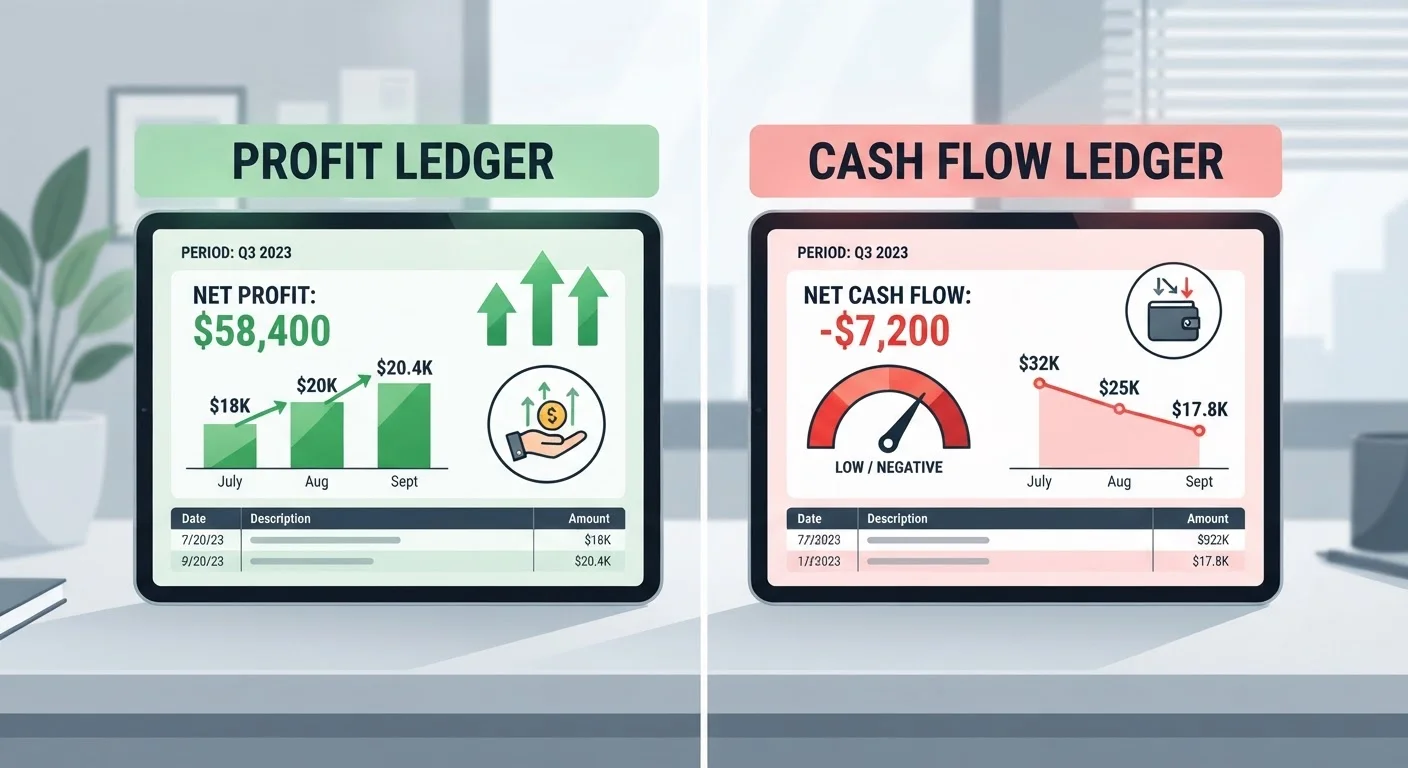
Two Numbers, Two Very Different Stories
Ask most small business owners how they are doing financially and they will point to profit. That makes intuitive sense — profit is what is left after you subtract your costs from your revenue, and a positive number feels like success. But profit alone can give you a dangerously incomplete picture of your business's financial health.
Cash flow measures something different: the actual movement of money into and out of your business within a specific period. You can be profitable on paper and still find yourself unable to cover payroll, pay a supplier, or keep the lights on. This is not a rare edge case — it is a pattern that catches countless small business owners off guard every year.
The core of the problem is timing. Most small businesses using accrual accounting (which the IRS generally requires once revenue exceeds certain thresholds) record income when a sale is made, not when payment is received. Expenses work similarly. The result is a profit figure that may not reflect what is actually sitting in your bank account. See our plain-language breakdown of the P&L statement for more on how accrual accounting shapes your financials.
Where the Gap Between Profit and Cash Flow Comes From
Several common business scenarios can drive a wedge between your profit and your available cash:
- Slow-paying customers: If you invoice clients on 30-, 60-, or 90-day payment terms, you have recognized revenue — and profit — long before cash arrives. Meanwhile, your own suppliers and employees still need to be paid on schedule.
- Inventory investment: Purchasing stock ties up cash immediately, but profit is only recorded when that inventory is sold. A retailer stocking up for a busy season may look cash-poor for weeks before revenue follows.
- Rapid growth: Counterintuitively, a surge in orders can accelerate a cash crisis. You spend on labor, materials, and overhead today; revenue arrives later. The faster you grow, the wider that gap can become.
- Loan repayments: Principal payments on business debt reduce cash but do not show up as an expense on your income statement, meaning they affect cash flow without touching your profit figure.
- Capital purchases: Buying equipment or vehicles is a cash outflow but is typically depreciated over several years in your accounts — so the full cash hit is invisible in your monthly profit calculation.
| Criterion | Profit | Cash Flow |
|---|---|---|
| What it measures | Revenue minus all costs over a period | Actual cash moving in and out |
| Accounting basis | Accrual (income when earned) | Cash basis (money when received/paid) |
| Timing of recognition | When sale or expense is incurred | When cash actually changes hands |
| Includes loan repayments? | No (principal not an expense) | Yes (cash leaves the business) |
| Includes depreciation? | Yes (reduces reported profit) | No (non-cash charge) |
| Useful for | Long-term viability assessment | Short-term operational decisions |
| Key risk if ignored | Mispricing, unsustainable cost structure | Insolvency despite strong sales |
Understanding these gaps is the first step. The common financial misconceptions that cost small business owners money article covers related blind spots worth reviewing alongside this one.
How to Track and Manage Both Metrics
The practical fix is not complicated, but it does require discipline. Here is what small business owners should have in place:
Maintain a Cash Flow Statement
Your accountant or bookkeeping software can produce a cash flow statement alongside your profit and loss report. The cash flow statement shows operating, investing, and financing activities separately, giving you a clear view of where money is actually going. Review it at least monthly — weekly if your business has tight margins or irregular income.
Build a 13-Week Cash Flow Forecast
A rolling 13-week (roughly three-month) cash flow forecast maps out expected inflows and outflows week by week. It is a working management tool, not just a reporting document. Update it regularly and use it to anticipate shortfalls before they become emergencies.
Tighten Your Receivables Process
Late payments are among the most controllable causes of cash shortfalls. Shorten payment terms where possible, send invoices promptly, and follow up systematically on overdue accounts. Our invoicing practices that protect your cash flow provides specific steps for getting paid faster and more reliably.
Separate Operating Cash from Profit Distributions
Avoid the temptation to withdraw profit from the business the moment your income statement looks healthy. Keep a cash reserve — many advisors suggest maintaining at least two to three months of operating expenses — before treating profit as available for distribution.
Accrual vs. Cash-Basis Accounting
Most small businesses start on cash-basis accounting — recording income and expenses when money actually changes hands — which naturally keeps profit and cash flow closer together. Once a business grows or carries inventory, the IRS may require accrual accounting, which is when the profit-cash gap becomes most significant. Check with a qualified accountant to confirm which method applies to your business and what reporting obligations you have.
This article is for general informational and educational purposes only and does not constitute financial, tax, or legal advice. Consult a qualified accountant or financial professional for guidance specific to your business situation.
Why Growing Businesses Are Especially Vulnerable
Growth is where the profit-cash flow disconnect bites hardest. A business that doubles its revenue in a year may appear thriving on an income statement while quietly hemorrhaging cash. The cash flow pitfalls that catch early-stage founders off guard are well documented — and they do not disappear as a business matures.
Every new order at scale requires upfront spending: more inventory, more staff, more overhead. If your customer payment terms do not align with your supplier payment obligations, the gap widens with every unit you sell. This is sometimes called the cash conversion cycle — the time it takes for cash invested in operations to return as collected revenue. Shortening that cycle is one of the most powerful levers available to a growing business. For a broader look at the operational variables that shape profitability, see seven operational levers that drive small business profitability.
The bottom line: profit tells you whether your business model works. Cash flow tells you whether your business will survive long enough to prove it. Both numbers matter — and neither one tells the full story on its own.