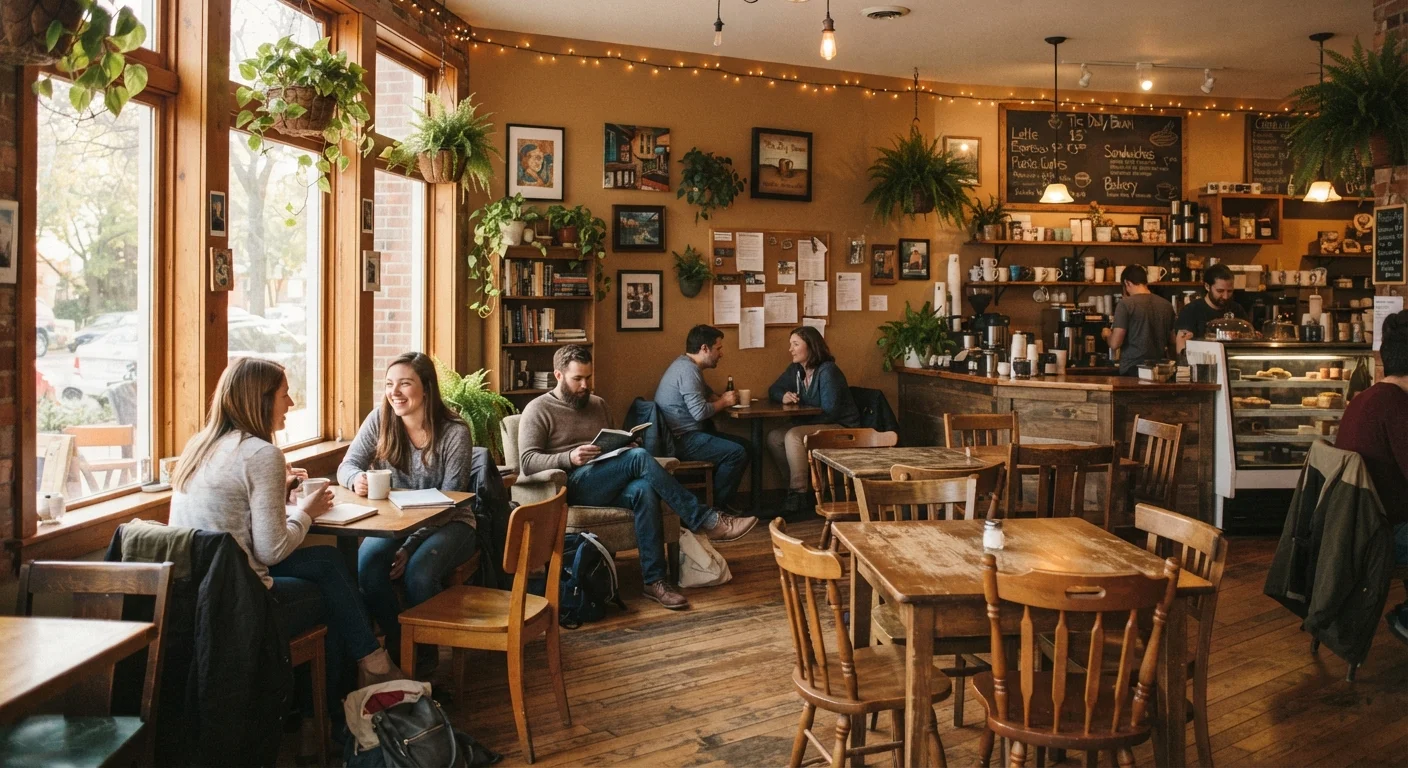
What Is a Third Place?
The term third place was coined by sociologist Ray Oldenburg in his 1989 book The Great Good Place. The idea is straightforward: if home is the first place and work is the second, then a third place is the informal, neutral ground where social life actually happens — the pub, the barbershop, the diner, the community garden.
Third places share a few defining qualities: they're accessible, they welcome regulars, conversation flows freely, and nobody's really obligated to be there. That last part is crucial. Third places are chosen, not required. That voluntary quality is what gives them their social power.
Third place
A social setting outside the home and workplace where people gather informally and regularly — such as a coffee shop, park, or community center.
Social infrastructure
The physical spaces and institutions — libraries, parks, community centers — that make informal social interaction possible in everyday life.
Weak ties
Casual acquaintances and familiar faces that aren't close friends but still provide a sense of belonging and community connection.
Loneliness epidemic
A widely documented pattern of rising social isolation among adults, recognized by public health bodies as a significant concern for mental and physical wellbeing.
Suburban sprawl
Low-density residential development that spreads outward from city centers, typically designed around car travel rather than walkable, shared community spaces.
Historically, these spaces were woven into the fabric of everyday life. You bumped into neighbors at the corner store. You lingered after church. You stopped at the café on the way home. Connection wasn't something you had to schedule — it was ambient, built into the structure of daily movement. That texture has quietly unraveled for many adults.
Why Third Places Matter for Adults
Third places are where weak ties form — the casual acquaintances, familiar faces, and loosely connected neighbors who, research consistently suggests, matter enormously for our sense of belonging. Close friendships are vital, but it's often the peripheral social layer — the barista who remembers your order, the regulars you chat with at the dog park — that gives daily life its social texture.
For adults, the stakes are particularly high. Unlike school-aged children, who have structured environments that force repeated contact with peers, adults must generate community deliberately. Without that, social networks can shrink steadily after the mid-twenties — sometimes without people fully noticing until they feel quite isolated.
This isn't just a comfort issue. Public health bodies, including the U.S. Surgeon General's office, have flagged adult loneliness as a significant concern with measurable effects on mental and physical wellbeing. The erosion of social infrastructure — the physical spaces where informal connection happens — is part of the story. This connects directly to broader shifts in how adults navigate major life transitions without the community scaffolding previous generations could count on.
What's Making Them Harder to Find
Several forces have converged to hollow out third-place culture in the United States. Understanding them helps explain why finding one can feel surprisingly difficult — and why it's not simply a personal failure of effort.
Suburban Design
Much of American residential development since the mid-twentieth century was built around the car, not the pedestrian. Neighborhoods designed without walkable commercial streets, plazas, or community anchors make spontaneous social contact structurally hard. As this article on the trade-offs of urban versus suburban life explores, where you live shapes your social life in ways that aren't always obvious from the outside.
The Shift to Remote Work
For many adults, the workplace served an unofficial third-place function — not as a true third place, but as a source of repeated low-stakes social contact. Remote work has genuine advantages, but it has also removed that incidental daily social layer for a significant portion of the workforce.
Commercial Pressures
Independent cafes, bookstores, pubs, and gathering spaces have faced sustained economic pressure. When they close, they're often replaced by businesses that aren't designed for lingering. Consumption without community becomes the default.
The Digital Substitution Trap
Digital Socializing Has Real Limits
Group chats, social media, and online communities can feel like connection — and they're not worthless. But most research suggests they don't fully replicate the wellbeing benefits of in-person, embodied social contact. Relying primarily on digital interaction as a substitute for physical third places may leave some social needs consistently unmet.
Social media and messaging apps create a sense of connection that can feel sufficient without delivering the embodied, spontaneous contact that research links most strongly to wellbeing. This isn't an argument against digital life — it's a recognition of its limits as a replacement for physical gathering.
How to Build a Third Place Into Your Life
The encouraging truth is that third places don't have to be discovered — they can be cultivated. The process is slow and somewhat awkward at first, but it's genuinely available to most adults willing to be consistent and a little patient.
Regularity Beats Variety When Building Community
It's tempting to try different spots and events looking for the 'right' fit. But third places work through familiarity — being a recognizable regular builds the low-stakes social bonds that make a place feel like yours. Pick one or two places and show up consistently before expanding. Even nodding hellos count.
Lower the Bar on What Qualifies
A third place doesn't need to be a charming neighborhood tavern. A library branch, a weekly yoga class, a community garden plot, a faith group, a recreational sports league — all of these can function as third places if you return to them regularly and allow loose social bonds to form. As you think about social space, it's worth noting that some adults are also rethinking shared living arrangements as a way to build ambient community into daily home life.
Third Places Look Different for Everyone
Not every third place looks like a café or a pub. For some adults, a faith community, a gym, or even a weekly farmers market fills this role. The defining quality isn't the setting — it's the regularity, informality, and sense of social welcome it provides. What matters is that you choose to show up, and that showing up feels like something.
Prioritize Physical Proximity
The closer a potential third place is to where you live or move daily, the more likely you'll actually go. Walking distance matters — not because driving is impossible, but because low-friction access is what makes regular attendance realistic for a busy adult life.
Give It Time
A third place takes months, not weeks, to feel like yours. Familiarity builds slowly: first you're a stranger, then a face, then a regular. The transition is quiet and unglamorous — and that's exactly how it's supposed to work. Social belonging in these spaces is earned through simple repetition, not grand gestures.
The search for a third place is really a search for the ordinary social texture that most human beings need to feel connected. It's worth the effort — and it starts with showing up somewhere, consistently, and giving it time.