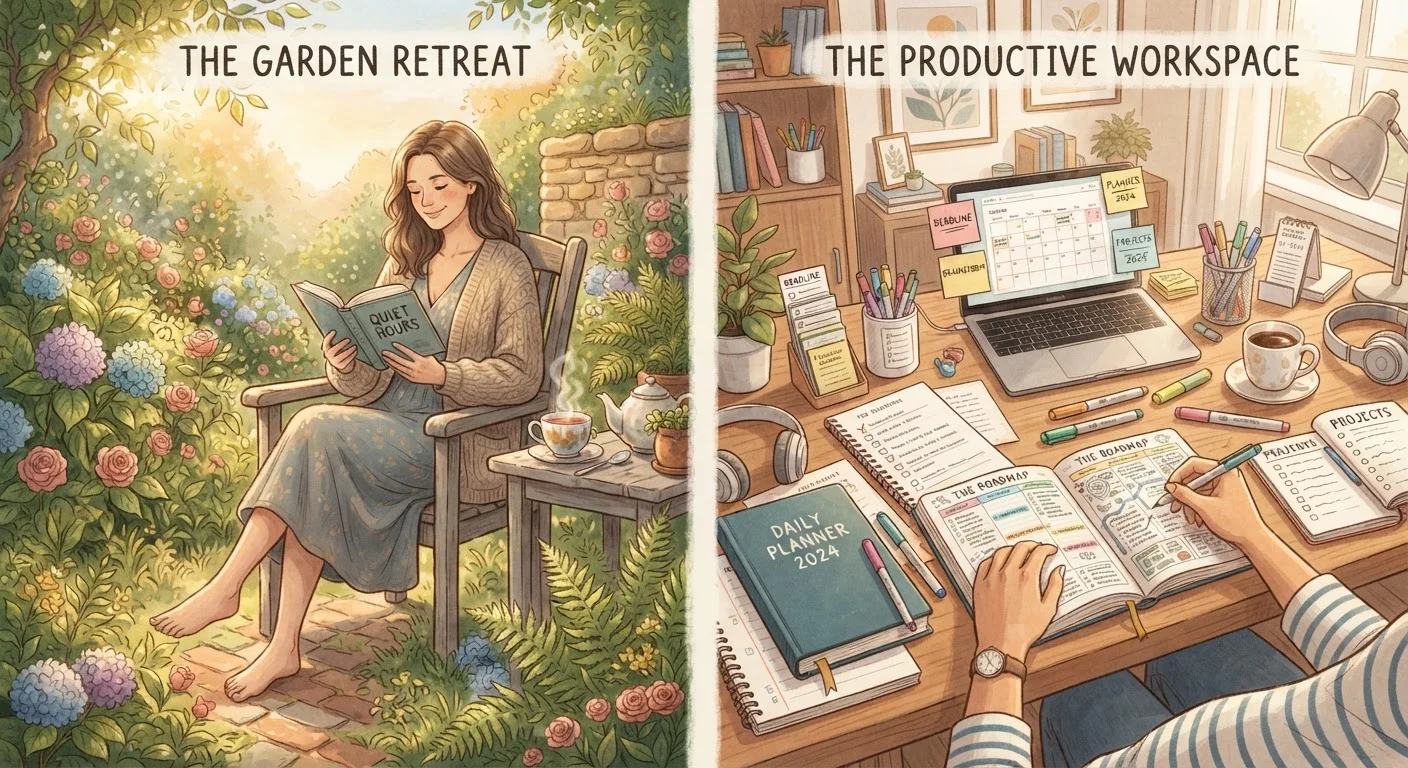
What Each Philosophy Actually Claims
At their cores, slow living and productivity culture aren't really fighting over the same territory — they're answering different questions. Slow living asks: what makes a day feel worthwhile? Productivity culture asks: what's the most effective way to spend a day? The tension arises because modern life tends to force both questions onto us simultaneously.
Slow living, which draws loosely from the Italian Slow Food movement of the 1980s and later thinkers like Carl Honoré, is less a rigid program than a cultural stance. It resists the idea that speed and output are inherently virtuous, and instead centers presence, simplicity, and connection as the measures of a good life. This doesn't mean doing everything slowly — it means doing things at the right pace for the right reasons.
Productivity culture, meanwhile, gets mischaracterized as pure hustle or grind culture, but its thoughtful practitioners — from knowledge-work writers to behavioral researchers — describe it quite differently. The goal is not to work more hours but to design systems that make effort more intentional and less draining. The problem is that the culture surrounding productivity tools often slides toward optimization as a value in itself, decoupled from any meaningful end.
Both philosophies, in their better forms, are pushing back against the same thing: the feeling of being swept along by life without agency. They just disagree on the cure.
How They Stack Up: A Side-by-Side Look
Understanding the practical differences between these two approaches can help clarify which elements genuinely resonate with your life — and which ones you're adopting out of cultural pressure rather than personal fit.
| Criterion | Slow Living | Productivity Culture |
|---|---|---|
| Core value | Presence and intentionality | Output and progress |
| Relationship to time | Time as something to inhabit | Time as a resource to allocate |
| Measure of a good day | Felt sense of meaning or rest | Tasks completed, goals advanced |
| Role of structure | Minimal; routines emerge naturally | Central; systems and planning tools |
| Approach to rest | Rest as inherently valuable | Rest as recovery enabling more output |
| Common pitfall | Passive avoidance of responsibility | Optimization anxiety and burnout |
| Community orientation | Connection, presence with others | Collaboration toward shared goals |
One thing the table makes visible: these philosophies often conflict most sharply around measurement. Productivity culture runs on metrics — tasks completed, projects shipped, habits tracked. Slow living tends to treat measurement itself as a symptom of the problem. If you find data about your behavior energizing, that's a meaningful clue about your temperament. If tracking makes you feel surveilled by yourself, that tells you something too.
Worth noting: neither framework says much about the structural realities — economic pressure, caregiving demands, health — that shape how much genuine choice any individual has over their time. That's a limitation both philosophies share.
The Real Costs of Each Approach
Slow living has genuine costs that its more idealized portrayals tend to gloss over. It can feel like a luxury available mainly to people with financial stability and flexible schedules. It can also drift into passive avoidance — using the language of intentionality to sidestep decisions or responsibilities. And in professional contexts, opting out of hustle norms can carry real career consequences depending on your field.
Productivity culture carries its own risks. When optimization becomes identity, rest starts to feel like failure. Researchers who study overwork have found consistent links between chronic time pressure and diminished wellbeing — not because effort is bad, but because the body and mind require genuine recovery, not just optimized rest scheduled between tasks. The productivity-as-virtue framing can also make it harder to recognize when a goal is no longer worth pursuing.
A Note on Economic Reality
Both slow living and productivity culture are often discussed as if they're equally available to everyone — and they're not. Financial stability, job security, caregiving responsibilities, and health all shape how much real agency any person has over their daily pace and priorities. Adopting either philosophy wholesale without accounting for these constraints can produce guilt rather than growth. Any honest engagement with how you spend your time has to begin with the actual conditions of your life, not an idealized version of it.
The honest picture is that both philosophies carry genuine insight and genuine blind spots. The question isn't which one is right — it's which elements actually serve the life you're trying to live. That's a question worth sitting with, and it connects to broader patterns explored in our piece on digital minimalism and lifestyle mythology, where adopted philosophies often serve us best when we treat them as tools rather than identities.
Finding a Synthesis That Actually Works
Most adults who reflect honestly on how they spend their time find that they need elements of both frameworks at different points — sometimes within the same week. A sustainable approach tends to look less like choosing a team and more like developing self-awareness about what different situations actually call for.
Some practical questions worth sitting with: Do you feel most like yourself when you're making progress toward something, or when you're fully present in the moment? When you're stressed, do you tend to under-structure or over-structure your time? Are the systems and habits you currently maintain ones you'd keep if no one could see them?
The habits that actually stick tend to be ones tied to genuine personal values, not borrowed frameworks. Whether you're drawn to the measured calm of slow living or the structured momentum of productivity systems, the most durable version is the one you'd maintain quietly, without an audience — because it actually makes your days feel better.
Both philosophies share one implicit assumption worth honoring: the day is finite, and how you spend it matters. The disagreement is just about what matters means.