What Each Approach Actually Involves
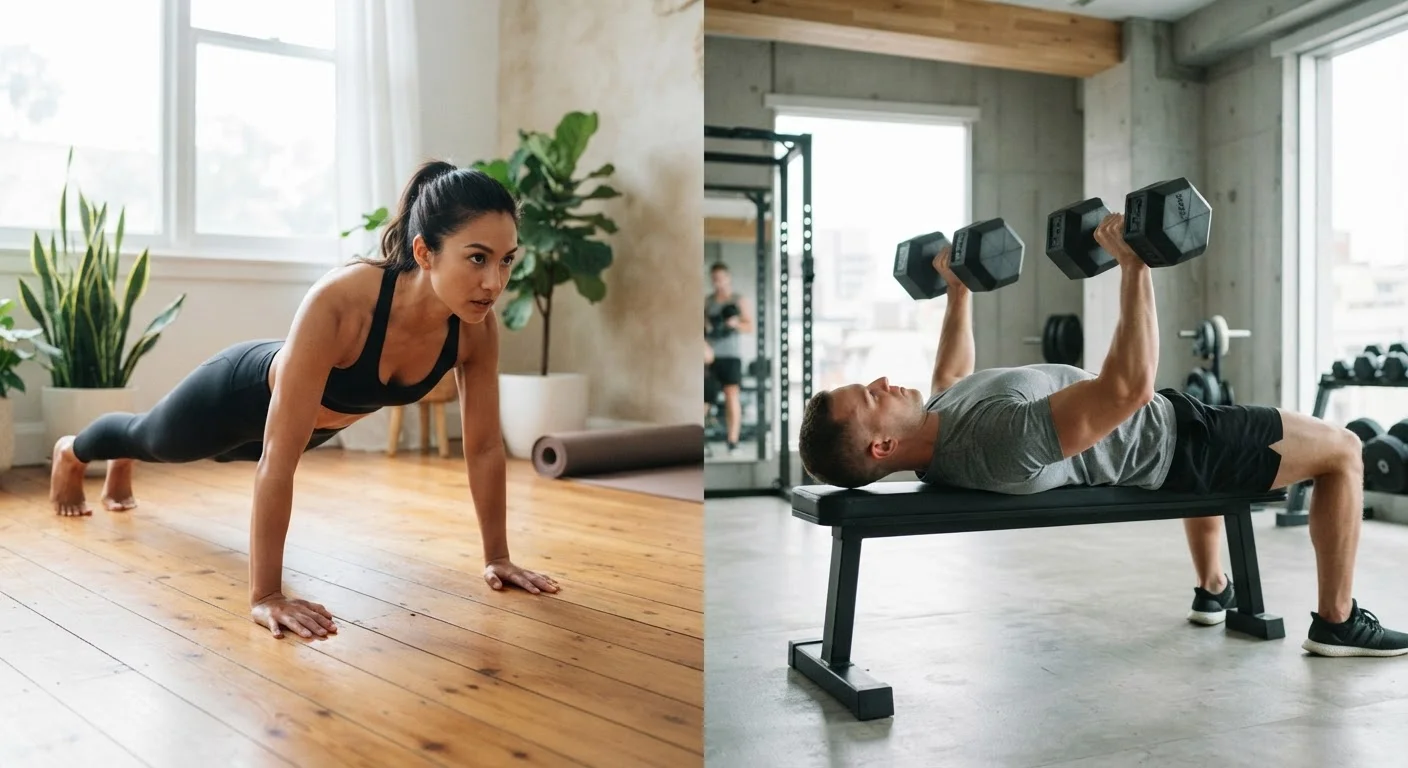
Bodyweight training uses your own mass as resistance — think push-ups, squats, lunges, planks, and pull-ups. No equipment is required beyond a stable surface and enough floor space to move. Weighted exercise adds external load through dumbbells, barbells, kettlebells, resistance bands, or cable machines to increase the demand placed on muscles.
Both methods are forms of resistance training, meaning they challenge muscles to work against a force. The fundamental physiological stimulus — mechanical tension on muscle tissue — is shared. Where they diverge is in how that tension is applied, how easily it can be scaled, and what equipment or space is needed to deliver it.
If you're new to structured exercise, starting with the basics before choosing a method is a reasonable first step. The method matters far less than building the habit itself.
Comparing the Two Across Key Dimensions
Understanding how each approach stacks up across practical and physiological factors helps clarify which suits your situation — rather than relying on gym culture or popular opinion.
| Bodyweight Training | Weighted Exercise | |
|---|---|---|
| Equipment needed | None required | Dumbbells, barbells, or bands |
| Cost | Free | Moderate to high (gym or gear) |
| Accessibility | Anywhere, anytime | Requires gym or home setup |
| Progressive overload | Complex — requires variation changes | Straightforward — add weight |
| Beginner-friendliness | High — low barrier to entry | Moderate — technique learning curve |
| Muscle-building ceiling | Lower for advanced trainees | Higher scalability long-term |
| Injury risk (with good form) | Generally low | Low to moderate |
| Flexibility for travel | Excellent | Limited without gym access |
A few of these criteria deserve unpacking. Progressive overload — systematically increasing demand over time — is widely considered a cornerstone of long-term fitness development. With weights, this is straightforward: add five pounds. With bodyweight, progression requires manipulating leverage, range of motion, tempo, or moving to harder exercise variations. It's achievable, but less linear.
Injury risk in both approaches is generally low when technique is sound. Weighted exercise carries a slightly higher threshold for error given external loads, particularly during compound lifts like deadlifts or overhead pressing. That said, bodyweight movements performed poorly — especially high-rep plyometrics — can also cause overuse or joint strain.
Muscle Building and Strength: What Research Suggests
A common assumption is that weighted training is uniquely superior for building muscle. The research picture is more nuanced. Studies comparing bodyweight and resistance-machine training in previously untrained adults have found comparable early-stage gains in muscle size and strength when effort levels are matched. Proximity to failure — working hard enough that completing additional reps would be very difficult — appears to matter more than whether a weight is external or self-generated.
Where weighted training tends to show a clearer edge is in advanced lifters and those pursuing maximal strength or hypertrophy. Once a person can perform sets of 20+ push-ups with good form, adding meaningful additional load through bodyweight variations alone becomes increasingly difficult. External resistance allows continued, measurable progression in a way that bodyweight manipulation eventually cannot replicate for most people.
Combining Both Methods Works Well
Many trainers and fitness researchers suggest a hybrid approach works well for most adults: use bodyweight movements for warm-ups, accessory work, or travel days, and weighted exercises as the primary driver of progressive overload. This prevents the false choice between the two and allows each method to cover the other's gaps. Even modest resistance band additions to a bodyweight routine can meaningfully extend how long that routine remains challenging.
For those whose goals include improving daily function — carrying groceries, climbing stairs, maintaining posture — both methods are broadly effective. The distinction between strength training and cardio is often more relevant to functional goals than the bodyweight-versus-weights debate.
Practical Considerations: Lifestyle, Access, and Sustainability
For many adults, the biggest barrier to exercise isn't motivation — it's logistics. Gym memberships cost money and require travel. Home equipment takes up space and represents an upfront investment. Bodyweight training's main advantage is that it eliminates both barriers entirely, making it the more realistic option for people with unpredictable schedules, limited budgets, or frequent travel.
Weighted training typically requires either a gym membership or a home setup with at least some equipment. Resistance bands occupy a middle ground — they add external load without the bulk or cost of free weights and are worth considering for those who want scalable resistance without a gym commitment.
Sustainability is the most underrated variable. Building a weekly routine you can maintain is more important than optimizing which method delivers marginally better results on paper. If bodyweight training is what you'll do consistently three times a week while a gym membership goes unused, bodyweight wins — not because it's inherently superior, but because it's the method you'll actually use.
Watch for signs that your current approach isn't working. Plateaus, persistent fatigue, or waning enthusiasm can all indicate it's time to reassess. Signs your routine needs adjusting are worth recognizing early rather than pushing through ineffective patterns.
This article is for general informational purposes only and is not a substitute for personalized medical or fitness advice. Consult a qualified healthcare or fitness professional before beginning a new exercise program, particularly if you have any underlying health conditions or injuries.