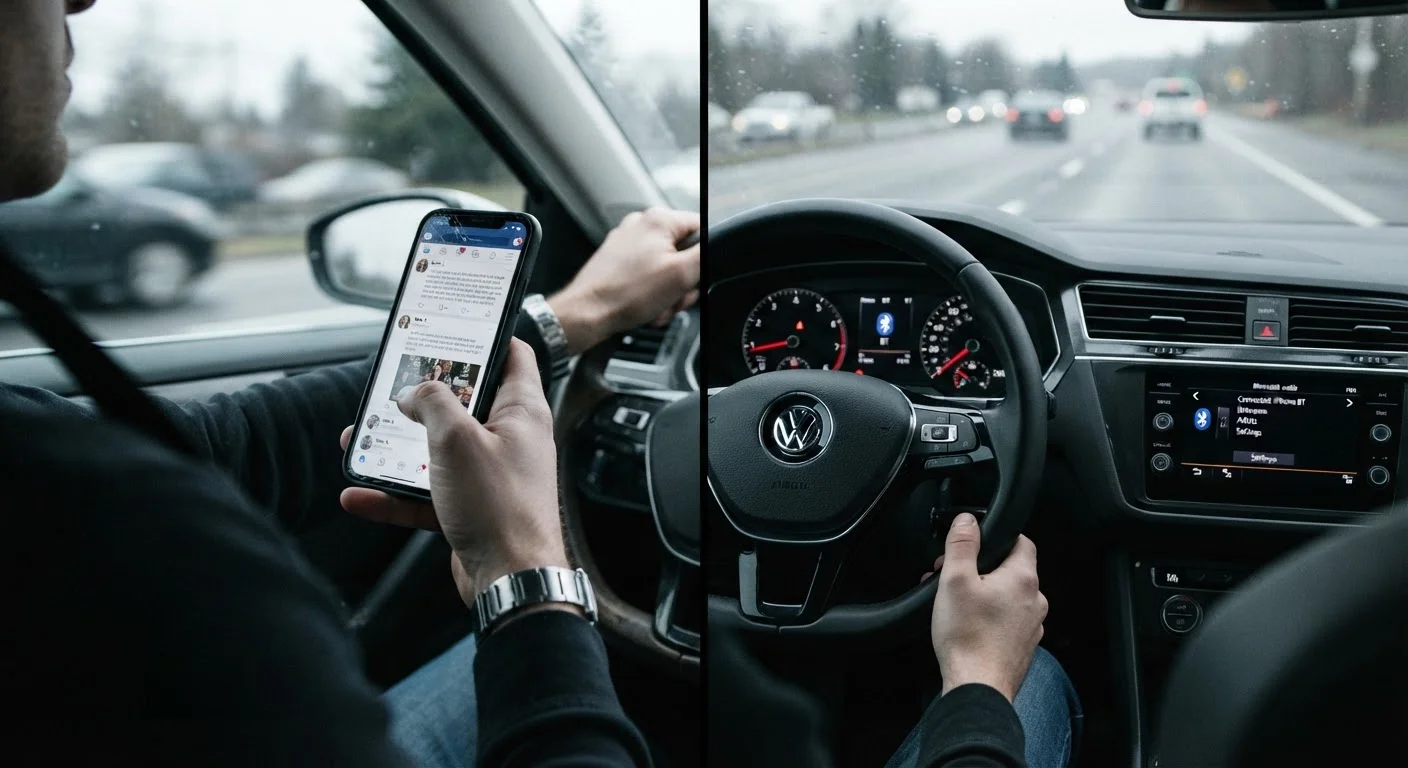
The Core Difference: Physical vs. Cognitive Distraction
Distracted driving researchers typically categorise impairment into three types: visual (eyes off the road), manual (hands off the wheel), and cognitive (mind off the task of driving). Hand-held phone calls activate all three simultaneously. Hands-free calls eliminate the manual component and reduce the visual one — but cognitive distraction, the subtlest and arguably most dangerous category, remains essentially unchanged.
This distinction matters enormously. When a driver holds a phone, they must look at it to dial, grip it continuously, and divide their mental attention between the conversation and the road. Remove the device from the hand and two of those demands shrink — but the conversation itself continues to consume working memory, suppress peripheral awareness, and delay responses to unexpected hazards.
Traffic safety researchers describe this as inattention blindness: a driver's eyes may be pointed forward, but the brain is processing the phone conversation rather than the driving environment. Studies using driving simulators and instrumented vehicles have documented that drivers miss a significant proportion of visual cues — including red lights, pedestrians, and lane changes — while engaged in phone conversations, regardless of device type.
| Criterion | Hand-Held Calls | Hands-Free Calls |
|---|---|---|
| Manual distraction | High — device held throughout | Minimal — hands remain on wheel |
| Visual distraction | High — glances at screen to dial | Low — no need to look at device |
| Cognitive distraction | High — conversation tax on attention | High — same conversation tax applies |
| Legal status (most U.S. states) | Prohibited while driving | Permitted for most adult drivers |
| Estimated crash risk vs. no call | ~4x higher | ~4x higher (cognitive component) |
| Reaction time impact | Significantly delayed | Meaningfully delayed |
| Caller awareness of road conditions | None | None |
What the Research Numbers Actually Show
Multiple peer-reviewed studies and meta-analyses — including foundational work by researchers at the University of Utah and the AAA Foundation for Traffic Safety — consistently estimate that using a phone while driving increases crash risk by approximately four times compared to driving without any phone use. Crucially, this elevated risk appears broadly similar for both hand-held and hands-free conditions when measuring cognitive load alone.
~4x
Increased crash risk during any phone call
Multiple peer-reviewed studies and AAA Foundation research estimate crash risk is roughly four times higher when a driver is engaged in a phone conversation compared to driving with no call.
2.27 vs. 2.45
Cognitive demand score: hands-free vs. hand-held
A AAA Foundation cognitive distraction study rated hands-free calls at 2.27 and hand-held calls at 2.45 on a 5-point scale — a modest difference, both well above baseline driving at 1.0.
50%
Reduction in visual processing while on a call
University of Utah research found that drivers engaged in phone conversations processed up to 50% less of the visual information in their driving environment compared to undistracted drivers.
A widely cited AAA Foundation study on cognitive distraction rated tasks by their mental demand on a scale from 1 (baseline driving) to 5 (most demanding). Hand-held calls scored around 2.45; hands-free calls scored around 2.27 — a statistically modest difference. By contrast, listening to the radio scored approximately 1.21. The takeaway: going hands-free reduces distraction somewhat, but far less than most drivers assume.
One important caveat: studies measuring real-world crash involvement — rather than simulator performance — have produced a range of estimates, and isolating phone-call causation from confounding variables (speed, road type, driver age) is methodologically challenging. Researchers generally treat these figures as indicative of meaningful risk rather than precise predictions for any individual driver.
Why Talking to a Passenger Is Different
A common objection to hands-free research is: if conversation is the problem, why don't we ban passengers? The answer lies in how conversations adapt to context. A passenger physically present in the vehicle can see the same road conditions the driver sees. They naturally pause conversation at a complex intersection, alert the driver to a hazard, or modulate their demands on the driver's attention in real time.
A caller on the other end of a phone — hand-held or hands-free — has no access to road conditions. They continue talking through a pedestrian crossing, a merging highway, or a sudden hard-braking event ahead. The driver must manage the conversation and the road independently, without the natural synchronisation a co-present passenger provides.
This distinction is well-supported in the literature and represents one of the clearer, more replicated findings in distracted driving research. It does not mean passengers carry zero distraction risk — animated discussions with passengers can still impair driving — but it explains why phone conversations of both types carry a risk profile that passenger conversation generally does not reach at the same level.
Legal Landscape and Practical Guidance
As of the time of writing, the majority of U.S. states prohibit hand-held phone use while driving, and a growing number restrict all phone use for novice or young drivers. A smaller but increasing number of states have moved toward broader hands-free mandates for all drivers. Penalty structures vary — fines, points on a licence, and increased insurance scrutiny are common consequences. Drivers should verify the specific laws in their state and any state they travel through.
From a practical standpoint, traffic safety organisations including the National Safety Council recommend that drivers avoid phone conversations of either type while the vehicle is moving. If a call is expected or unavoidable, pulling into a safe parking area is the approach most consistent with the research evidence. Voicemail, call-back-when-parked habits, and enabling do-not-disturb driving modes on smartphones are all strategies that address the distraction problem at its source rather than at its edges.
For fleets and commercial operations, many companies now enforce no-phone-call policies during vehicle operation — policies that go beyond what most state laws require, based on their own risk assessments and safety records.
This article is for general informational and educational purposes only. Readers should verify current distracted driving laws for their specific state and jurisdiction, as regulations change and vary significantly. For personalised legal advice, consult a qualified attorney.